


This Issue’s Literature Interpretation Recommendation
Predator-prey interactions mediate the formation of Janus droplets: The role of sodium alginate droplets
Research Team
Professor Zihao Wei’s team, Ocean University of China
Research Content
“Predator-prey interactions mediate the formation of Janus droplets: The role of sodium alginate droplets”
Journal
Food Hydrocolloids
Impact Factor
CAS (Chinese Academy of Sciences) Partition
Major Category: Agricultural and Forestry Science (Q1)
Minor Category: Applied Chemistry (Q1)
Janus droplets exhibit broad application prospects in the food industry due to their unique asymmetric structures and functional properties, including self-propulsion, compartmentalized reactions, and directional encapsulation. However, efficient preparation of food-grade Janus droplets still faces challenges of low yield and insufficient control precision. This study innovatively proposes a novel biomimetic construction strategy. By precisely regulating the asymmetric interactions between zein and sodium alginate droplets, this research successfully achieved controllable preparation of Janus droplets in a mixed oil-in-water droplet system. This study not only reveals the key role of the Marangoni effect driven by interfacial tension gradients in droplet interactions, but also systematically investigates the influence of key parameters such as droplet number ratio, size ratio, and sodium alginate molecular weight on the formation efficiency of Janus droplets, providing a theoretical basis and technical support for the scalable preparation of food-grade Janus droplets.
Through pendant drop measurements, the study found that the interfacial tension of zein droplets is significantly lower than that of sodium alginate droplets, and this difference creates the Marangoni effect that drives droplet interactions. During vortex mixing, zein droplets act as “predators” and actively capture sodium alginate “prey” droplets, driving the system toward free energy minimization. During vortex mixing, low-interfacial-tension zein droplets as “predators” can actively spread and capture high-interfacial-tension sodium alginate “prey” droplets, while the reverse process cannot occur. This unidirectional interaction mode is highly similar to predator-prey relationships in nature, driving the entire system toward free energy minimization.
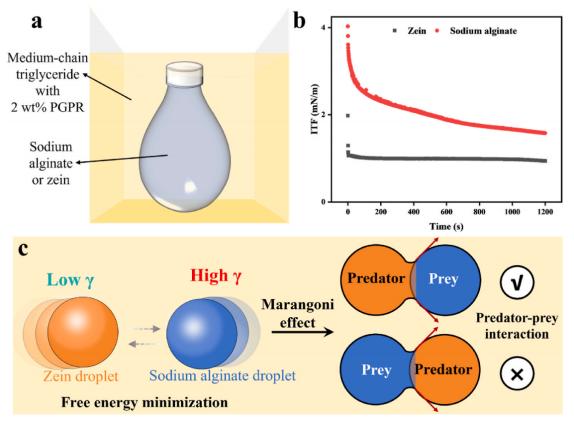
Figure 1
Using low-field nuclear magnetic resonance (LF-NMR) technology (Figure 2), the dynamic migration mechanism of water molecules during Janus droplet formation was revealed at the molecular level.
The study found that in the two-dimensional T₁-T₂ correlation spectra, the zein droplet spectrum shows a characteristic signal (T₁/T₂ = 1.68), indicating that as an amphiphilic molecule, it can effectively localize at the oil-water interface and mediate proton exchange; in contrast, sodium alginate droplets, due to poor interfacial properties, only show separation signals of oil and water phases. After the formation of Janus droplets, a new characteristic peak appears at T₁/T₂ = 3.76, and the T₂ relaxation time significantly decreases from 343.1 ms for mixed droplets to 307.7 ms. These changes clearly confirm that significant water molecular diffusion and exchange occurred between the zein and sodium alginate phases. This finding provides direct molecular evidence for the mechanism of predator-prey interaction-driven Janus droplet formation.
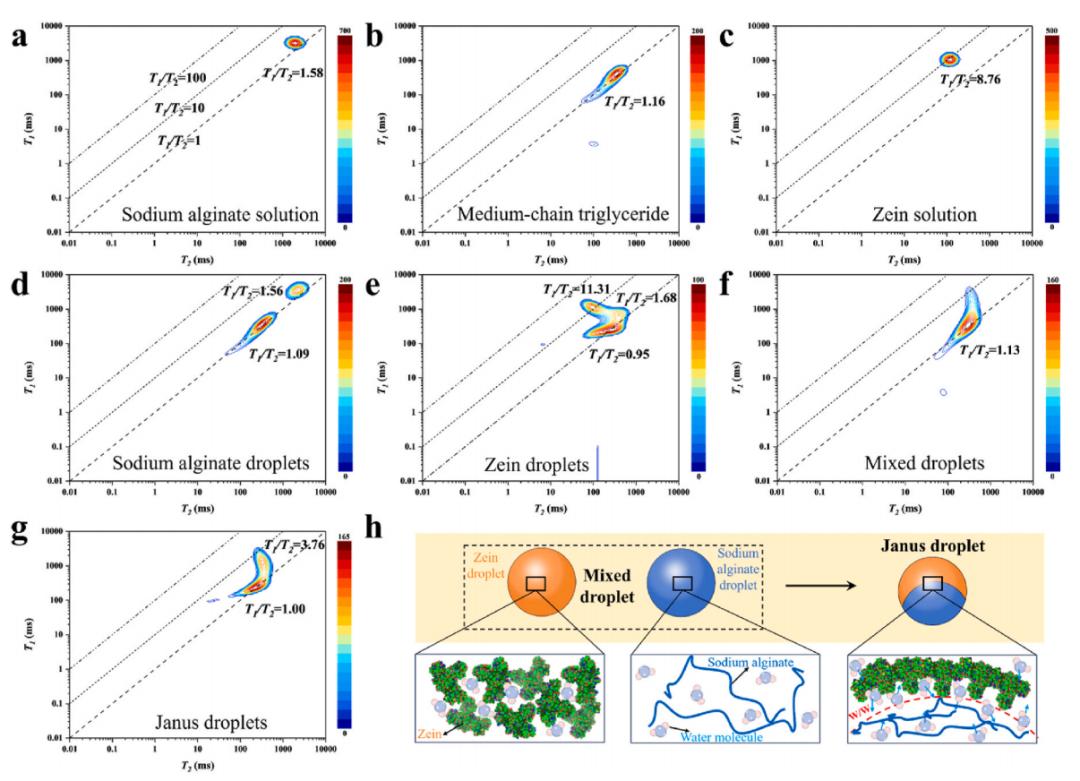
Figure 2
This study successfully constructed a biomimetic strategy based on predator-prey interactions, achieving controllable preparation of food-grade Janus droplets. The study confirmed that the interfacial tension gradient between zein and sodium alginate droplets is the key factor driving the Marangoni effect, promoting the system toward free energy minimization and inducing directional droplet collisions under vortex mixing conditions. By systematically regulating the physical parameters of droplets, the yield of Janus droplets can be effectively optimized: when the number ratio of predator to prey droplets is 1:1 and the size ratio is 2:1, the yield of Janus droplets reaches optimal; more importantly, droplets prepared with high molecular weight sodium alginate have higher rigidity and lower flow resistance, significantly increasing collision probability, resulting in a maximum Janus droplet yield of 85.43%. This study provides new biomimetic ideas and methodological foundations for the efficient and controllable construction of food-grade Janus droplets, and is expected to promote their practical application in the food industry.
Reference
Li X, Xue C, Wei Z. Predator-prey interactions mediate the formation of Janus droplets: The role of sodium alginate droplets [J]. Food Hydrocolloids, 2026, 172: 112195.1.
 Scan QR Code
 Scan QR Code
 Phone Support
Phone: 400-060-3233
After-sales: 400-060-3233
 WeChat Support

 Official Account

Back to Top