


01# Application Background
Magnesium hydride (MgH₂), with its high theoretical hydrogen storage capacity of 7.6 wt%, abundant raw material reserves, low cost, and good reversible hydrogen absorption/desorption properties, is regarded as one of the most promising solid-state hydrogen storage materials.
However, practical application of MgH₂ has long been constrained by two major bottlenecks: first, slow hydrogen absorption/desorption kinetics; second, high thermodynamic stability of the Mg–H bond, resulting in elevated operating temperatures and long reaction times, which are difficult to meet the requirements of onboard and stationary hydrogen storage systems. To overcome these bottlenecks, researchers have improved the hydrogen storage performance of MgH₂ through catalyst doping.
In this case, a layered MnB-MBene-AlF₃ catalyst was prepared by a PVDF-assisted gas-solid phase etching method and ball-milled with MgH₂ at a ratio of 10 wt%. This catalyst can reduce the initial hydrogen desorption temperature of MgH₂ by more than 120 °C, lower the hydrogen desorption activation energy to 94.86 kJ/mol, and maintain a capacity retention of 98.5% after 20 cycles.
In evaluating catalyst modification effects, conventional temperature-programmed desorption (TPD) and isothermal hydrogen absorption/desorption tests can only provide macroscopic thermodynamic and kinetic parameters, and it is difficult to directly reveal the microscopic motion state and bonding strength of H protons in the lattice. Low-field nuclear magnetic resonance (LF-NMR), as a non-destructive and rapid characterization technique, can directly reflect the migration ability and binding state of H atoms by detecting the relaxation behavior of ¹H nuclei, providing direct molecular-level evidence for catalytic mechanism research.
This case is compiled from research results published in the journal Rare Metals by Professor Zhang Liuting’s team at Jiangsu University, entitled “Chemical Removal of Al From Layered Mn₂AlB₂: Toward 2D-MBene and Its Application to MgH₂ Hydrogen Storage”.
02# Low-Field NMR Testing Protocol
Testing Equipment
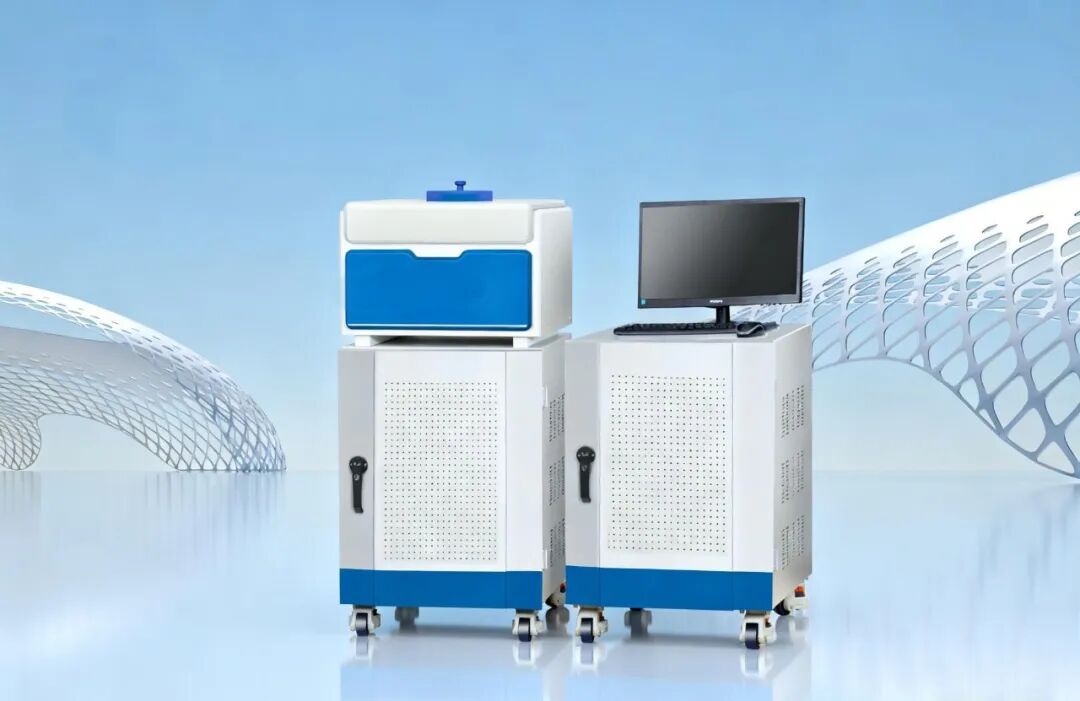
This case uses a Suzhou Niumag VTM20-010V-I low-field nuclear magnetic resonance spectrometer.
Basis for Sequence Selection
MgH₂ is an ionic hydride, with H bound in a rigid lattice. Strong ¹H–¹H homonuclear dipolar interactions cause T₂ relaxation to be extremely fast (on the order of microseconds). In the conventional spin echo (CPMG) sequence, the signal has already severely decayed within the instrument dead time, making it impossible to effectively acquire short-relaxation components. Therefore, the Magic-SE solid echo pulse sequence was used throughout this test. Through pulse combinations, the magnetization vector is refocused after the dead time to form an echo, ensuring accurate acquisition of short-relaxation components of solid-phase H.
Testing Principle
Low-field NMR is based on the phenomenon of nuclear magnetic resonance. By applying a weak 0.5 T magnetic field, it excites spin state changes of hydrogen nuclei (¹H) in the sample. After absorbing radio-frequency pulse energy at a specific frequency, hydrogen nuclei undergo energy level transitions and release energy during relaxation.
By analyzing the intensity and decay time of the relaxation signal, the dynamic characteristics of H atoms in the sample can be obtained. The core criterion is: due to the instrument dead time (the period after the RF pulse during which the coil cannot immediately receive signals), components with extremely fast relaxation lose their signal during this period. The intensity and decay rate of the relaxation signal can directly reflect the dynamic characteristics of H atoms: under the same mass, a greater signal intensity and slower decay indicate higher mobility of H protons in the lattice, making it easier for them to escape from the lattice to form H₂.
Comparison Samples
Pure MgH₂ (ball-milled, as control group) and MgH₂ + 10 wt% MAB-PVDF composite (catalyst-modified group).
03# Test Results and Analysis
Signal Intensity Comparison
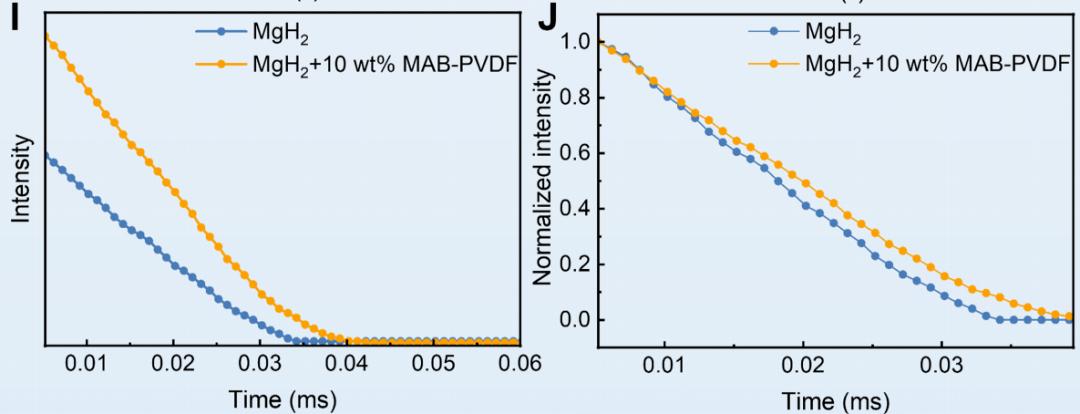
As shown in Figure I, the low-field NMR signal intensity of the MgH₂ + 10 wt% MAB-PVDF composite is significantly higher than that of pure MgH₂. This indicates that under the same mass, H protons in the composite system have higher detectability, reflecting that H atoms are more active in the lattice and less constrained.
Signal Decay Rate Comparison
From the decay behavior, the composite takes longer to decay to zero, and its overall decay rate is significantly slower than that of pure MgH₂. After normalizing the vertical axis (Figure J), the difference in decay rates becomes more intuitive: the normalized signal curve of the composite always lies above that of pure MgH₂, confirming that the introduction of the catalyst effectively delays the decay of the ¹H relaxation signal.
Mechanism Analysis
The experimental results of higher signal intensity and slower decay consistently indicate that the addition of MnB-MBene-AlF₃ catalyst weakens the Mg–H bond and enhances the migration ability of H protons in the MgH₂ lattice, making H easier to desorb and form H₂. This microscopic conclusion is fully consistent with the macroscopic test results that the initial hydrogen desorption temperature of the composite is reduced by more than 120 °C and the hydrogen desorption activation energy is lowered to 94.86 kJ/mol.
It is worth noting that the ferromagnetic MnB phase contained in the composite would theoretically slightly shorten the absolute relaxation time due to magnetic broadening effects. However, the measured results show the opposite trend—slower signal decay. This “reverse evidence” more powerfully confirms the real effects of Mg–H bond weakening and enhanced H mobility, excluding the possibility of false positives caused by ferromagnetic interference.
04# Application Value
Non-destructive and Rapid Evaluation
Low-field NMR requires no sample destruction and has a simple testing procedure. It can enable rapid screening of catalyst formulations and performance prediction during the R&D stage of hydrogen storage materials.
Microscopic Mechanism Verification
It complements macroscopic tests such as TPD and isothermal hydrogen absorption/desorption, providing direct evidence for catalytic mechanisms from the microscopic perspective of H proton migration and bonding strength.
Broad Applicability
The Magic-SE sequence can effectively acquire short-relaxation components and is suitable for relaxation characterization of various solid-state hydrogen storage systems, including MgH₂, metal hydrides, and complex hydrides.
 Scan QR Code
 Scan QR Code
 Phone Support
Phone: 400-060-3233
After-sales: 400-060-3233
 WeChat Support

 Official Account

Back to Top