

Polymeric materials are indispensable in daily life and industrial applications. However, most polymers are difficult to degrade or recycle, contributing to escalating environmental challenges. In recent years, self-healing polymer materials have shown promising development. Researchers have incorporated one or more types of dynamic bonds—such as hydrogen bonds, dynamic covalent bonds, ionic interactions, or metal coordination—into polymer networks. These dynamic bonds impart desirable properties like self-healing, shape memory, and recyclability, offering a path toward sustainable solutions.
In this study, the authors combined rheological analysis and solid-state NMR to characterise a novel solid–liquid elastomer (SLE) crosslinked via dynamic boron–oxygen coordination bonds. They explored the macroscopic viscoelasticity and microscopic chain dynamics of the system and discussed how dynamic bond content influences network structure parameters (e.g., uniformity, molecular weight between crosslinks) and chain mobility at various timescales (e.g., Rouse motion, reptation).
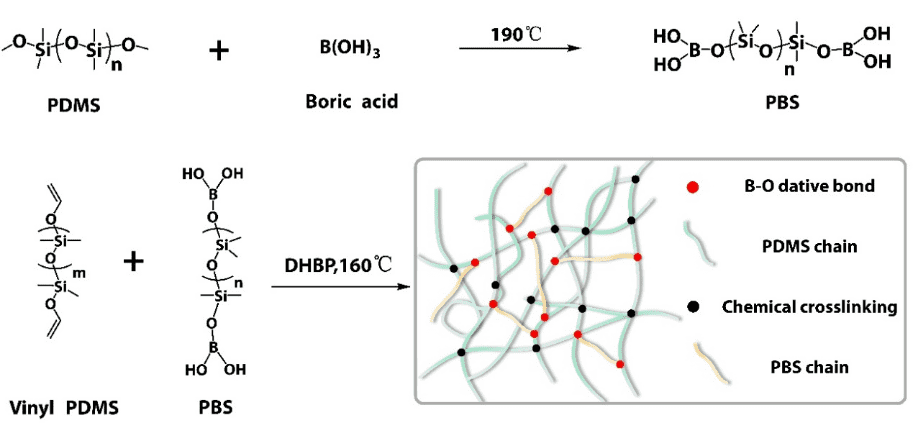
This SLE system was prepared by mixing boronic acid-terminated short-chain polydimethylsiloxane (PBS), vinyl-terminated PDMS, and a thermal crosslinking agent (DHBP), followed by hot pressing to trigger the crosslinking of Vinyl PDMS. As illustrated above [1], the resulting elastomers were labelled SLE-1, SLE-2, and SLE-3, based on the mass ratio of PBS to Vinyl PDMS (e.g., 1:1 in SLE-1), along with a fully crosslinked PDMS control sample.
To investigate the effect of dynamic bond content on internal structure, the authors first employed proton multiple-quantum nuclear magnetic resonance (1H MQ NMR) to assess network homogeneity. Dipolar couplings are commonly used for structural analysis, but in flexible or solution-phase systems, these couplings are averaged out by molecular motion. In constrained polymer networks, however, dipolar couplings persist due to limited chain mobility, allowing for detection via specific pulse sequences that excite double-quantum coherence. As excitation time increases, the DQ signal intensity initially rises and then decays (see below, panel a). Normalised signal fitting (panel b) yields the distribution of residual dipolar couplings Dres (panel c). Dres inversely correlates with segmental molecular weight, so its distribution reflects network homogeneity. For SLE samples, increasing the content of boronic ester-based dynamic bonds led to greater network inhomogeneity. This may be due to coordination between PBS and Vinyl PDMS hindering segmental mobility and thus chemical crosslinking efficiency. Additionally, PBS–PBS interactions via boronic ester condensation may further disrupt structural uniformity.
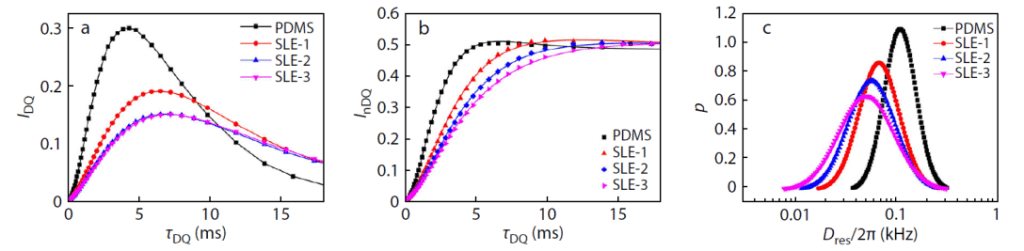
Panel a, b, c
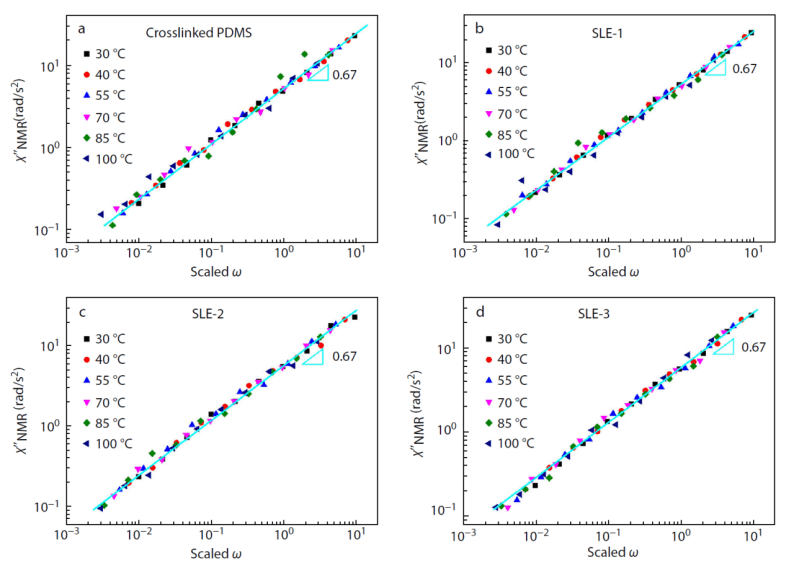
The authors also collaborated with Niumag to employ fast field cycling NMR (0.01–10 MHz 1H FFC NMR) to analyse changes in chain dynamics—specifically Rouse-type bead-spring motion—as dynamic bond content varied. FFC NMR is widely used to probe molecular motion in the kHz–MHz range. Samples were pre-polarised at a high magnetic field and then rapidly switched to different field strengths to measure the spin–lattice relaxation rate R1 (=1/T1). Relaxation in polymers arises from dipolar interactions between protons, modulated by chain motion. By applying the frequency–temperature superposition principle (FTS), the R1 vs. field strength data from 29–100 °C were overlaid into a master curve (shown below), representing the NMR susceptibility spectrum: wR1(w) = k[x”(w) + 2x”(2w)] = kx”NMR(w). Since the test temperatures were well above PDMS’s glass transition (Tg ≈ –70 °C), the slope corresponded to typical Rouse-type dynamics in all samples.
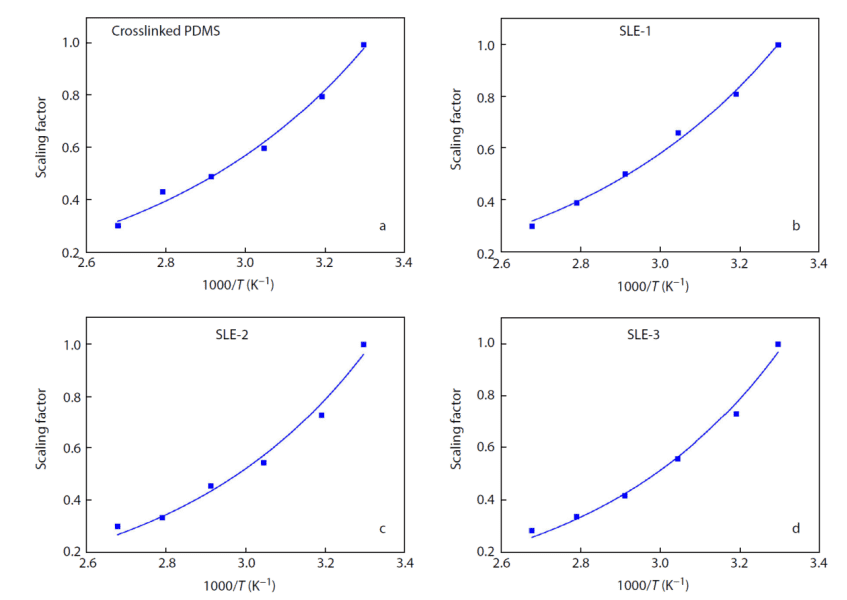
Using the Arrhenius equation, the authors fitted the shift factors used in superposition, revealing that the apparent activation energy increased with PBS content. This indicates that PBS hindered the Rouse relaxation of PDMS chains.
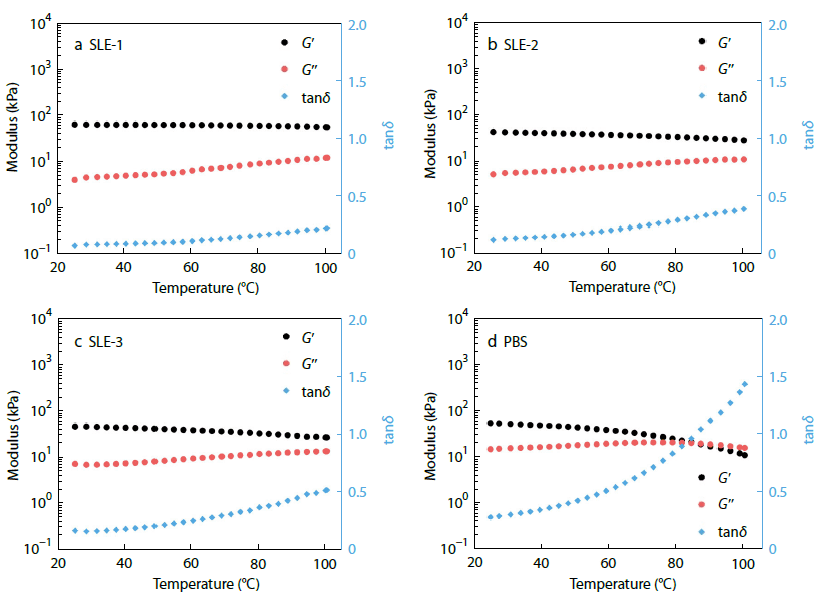
Rheological experiments were also conducted to study the viscoelastic properties of SLE. Rheology remains a classical approach for probing chain dynamics. In the tested temperature range, the storage modulus (G’) exceeded the loss modulus (G”), suggesting good thermal stability. However, a slight decrease in G’ at high temperatures may be attributed to rapid dissociation of boron–oxygen coordination bonds.
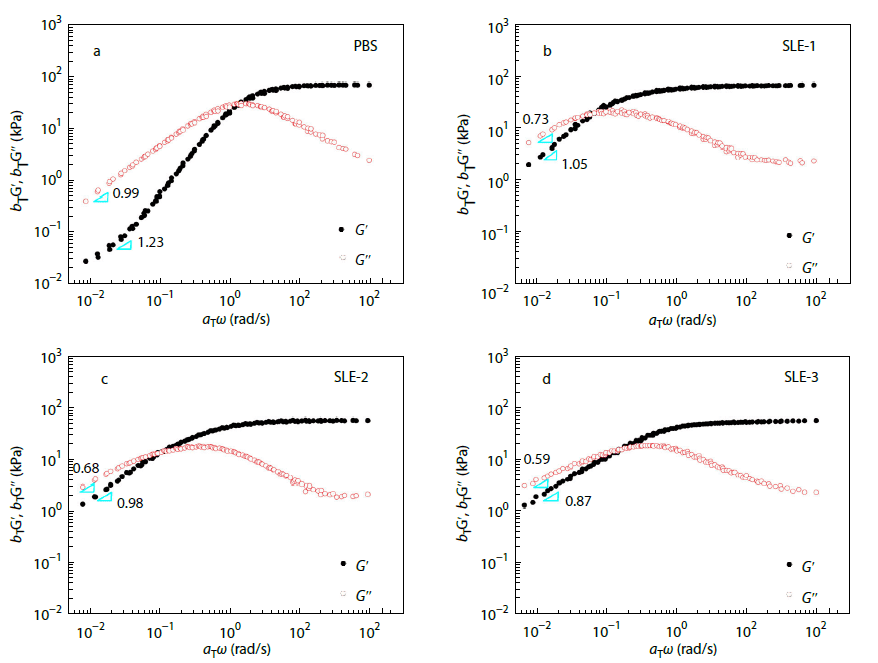
To further explore the impact of dynamic bonds on linear viscoelasticity, the authors conducted small-amplitude oscillatory shear tests and applied time–temperature superposition to generate master curves from dynamic moduli measured at various temperatures. As shown below, both storage and loss moduli displayed sub-Maxwellian slopes at the high-frequency end, indicating dynamic heterogeneity. The plateau modulus decreased with increasing PBS content, suggesting lower crosslink density—consistent with MQ NMR observations.
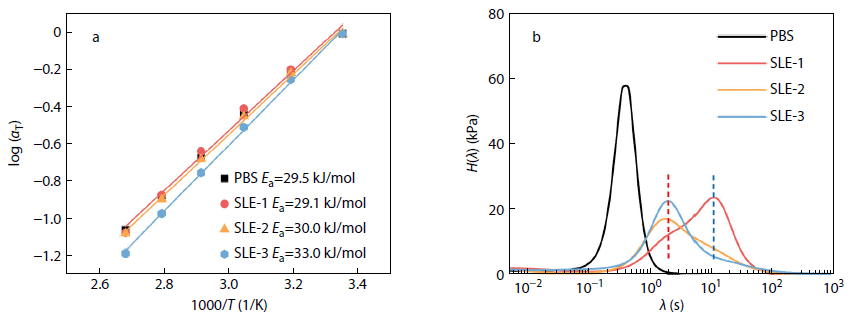
Arrhenius fitting of the shift factors confirmed that higher dynamic bond content hindered chain mobility, increasing activation energy—again aligning with FFC NMR results. The dynamic modulus master curve was further used to derive a relaxation time spectrum H(λ), shown below.
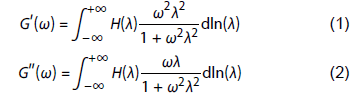
The SLE system clearly exhibited multiple relaxation modes. At lower PBS content, relaxation was dominated by PDMS segments (blue line, ~11.8 s). As PBS increased, dynamic bonding altered the relaxation profile, and short-time relaxations became dominant (red line, ~2.1 s).
This research was jointly conducted with Professor Xiaoliang Wang (Nanjing University) and Professor Jinrong Wu (Sichuan University), with financial support from the National Natural Science Foundation of China, Guangdong Natural Science Foundation, and Guangzhou Science and Technology Bureau.
Wu Q, Xiong H, Peng Y, et al. Highly stretchable and self-healing “solid–liquid” elastomer with strain-rate sensing capability. ACS Applied Materials & Interfaces, 2019, 11(21): 19534–19540.

 Scan QR Code
 Scan QR Code
 Phone Support
Phone: 400-060-3233
After-sales: 400-060-3233
 WeChat Support

 Official Account

Back to Top