

Polycaprolactone (PCL) is a biodegradable and biocompatible polymer that has been extensively studied and applied in the biomedical field—for controlled drug delivery systems, fluorescent probes, tissue engineering scaffolds, bio-dyes, and medical modelling materials. Typically, PCL is synthesised via ring-opening polymerisation (ROP) of the cyclic monomer ε-caprolactone, initiated by water, oxygen, or hydroxyl-containing compounds. However, intramolecular “back-biting” reactions often compete with the polymerisation process, inevitably affecting the polymer’s molecular weight and leading to the generation of oligomers. These oligomers not only compromise the overall material performance but also pose potential health risks upon human contact, significantly limiting the application and development of PCL.
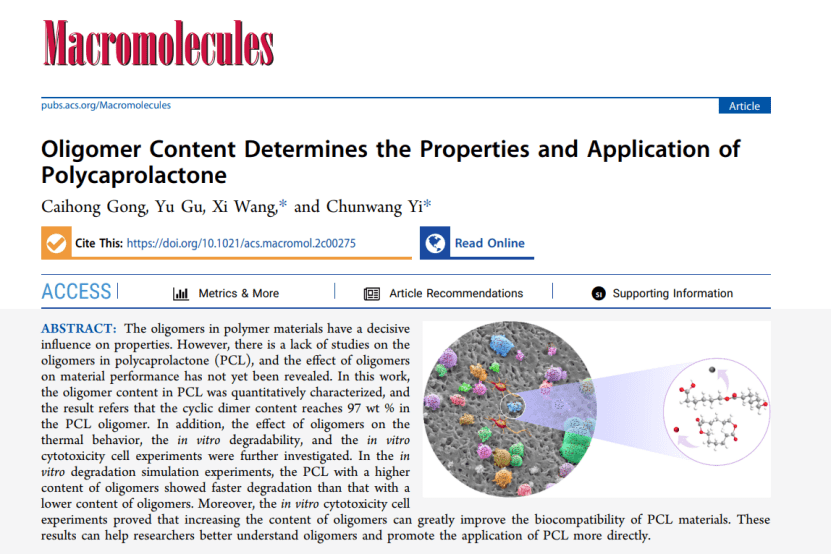
Recently, Professor Yi Chunwang’s polymer research group at Hunan Normal University made new progress in studying the “Impact of Oligomers on Biodegradable Polycaprolactone”. The team successfully regulated oligomer content in PCL, developing a series of PCL materials with diverse performance profiles, and for the first time established a liquid-phase standard curve for PCL oligomers. This work offers valuable theoretical guidance for broadening PCL’s use in various application scenarios.
This quantification of oligomers was achieved using low-field nuclear magnetic resonance (LF-NMR) analysis technology.
In earlier work, the team utilised LF-NMR to analyse the oligomer content in PCLs synthesised with various tin-based catalysts and commercial PCL products. Combined with mass spectrometry, they identified specific oligomer compositions. The lead author, Caihong Gong, discovered that tetraphenyltin significantly enhanced PCL’s molecular weight and mechanical properties, while effectively suppressing oligomer formation during polymerisation. Professor Shuanglin Qu’s group at Hunan University later conducted theoretical calculations, revealing that tetraphenyltin promotes the formation of an anhydride structure during ROP, thus reducing oligomer formation. This research was published in Molecular Catalysis under the title Catalytic Regulation of Oligomers in Polycaprolactone.
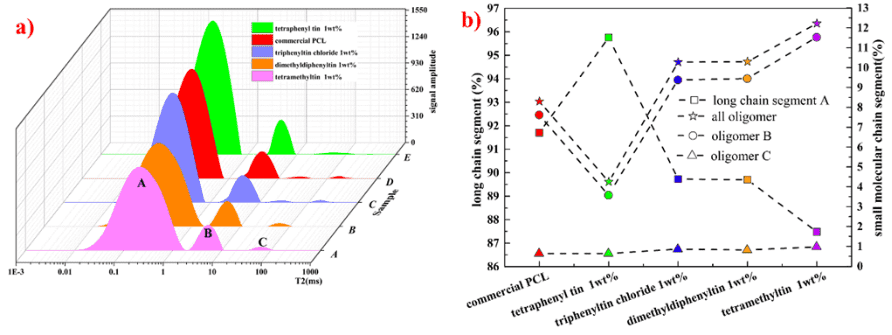
Figure 1: a) and b) Low-field NMR spectra; “A” represents long-chain PCL, “B” and “C” denote oligomers.
Through characterisation of PCL samples with varying oligomer content, it was found that samples with 4.3 wt% oligomers exhibited a melting point and crystallisation temperature of 62 °C and 38 °C, respectively. When the oligomer content increased to 12.5 wt%, these temperatures decreased to 51 °C and 20 °C. Furthermore, the sample with 4.3 wt% oligomers had a 100% decomposition temperature (Td100%) that was 96 °C higher than that of the 12.5 wt% sample.
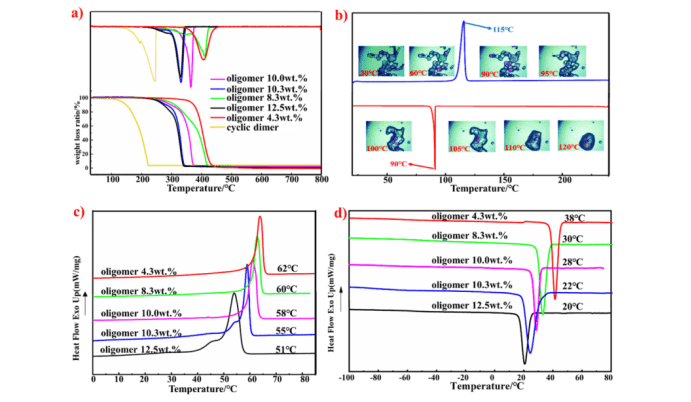
Figure 2: Effects of oligomer content on the decomposition, melting, and crystallisation temperatures of PCL.
Additionally, the team evaluated in vitro degradation of PCL with different oligomer contents in simulated body fluid. Samples with 12.5 wt% oligomers degraded significantly faster than those with 4.3 wt%. After 64 weeks, the 12.5 wt% sample lost approximately 80% of its mass, and its mechanical strength became unmeasurable by week 8. In contrast, the 4.3 wt% sample retained a molecular weight above 12,000 even after 64 weeks, while the high-oligomer sample dropped below 1,000 by week 20.
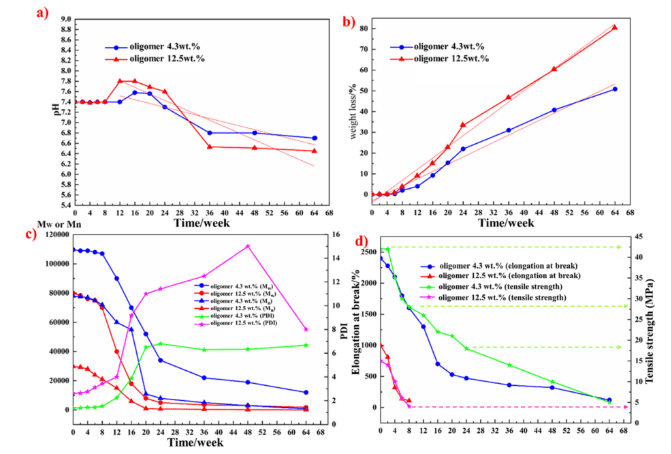
Figure 3: pH, mass loss, molecular weight, and mechanical properties during degradation of PCL with varying oligomer content.
PCL materials with different oligomer levels also showed varied biological responses. Samples with higher oligomer content exhibited more surface defects under identical degradation cycles. Notably, after 24 weeks of degradation, significant hydroxyapatite deposition was observed. Live/dead staining also confirmed enhanced bioactivity, with the 12.5 wt% PCL sample showing a higher density of viable cells.
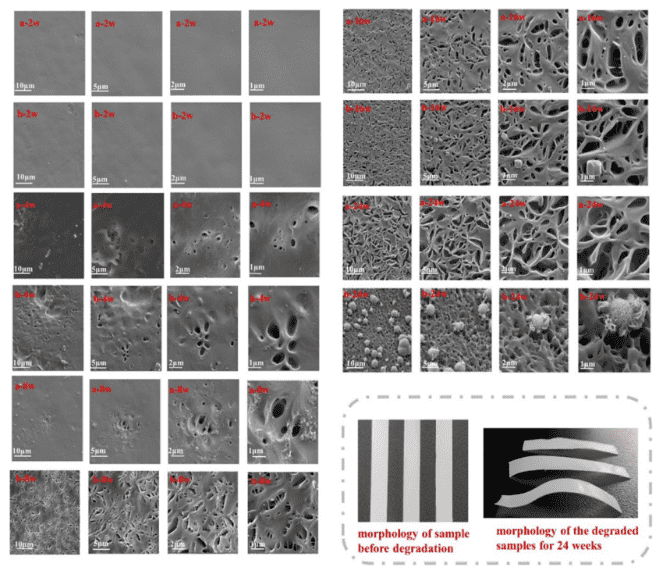
Figure 4: SEM images showing surface defects of PCL with varying oligomer content at different degradation stages.
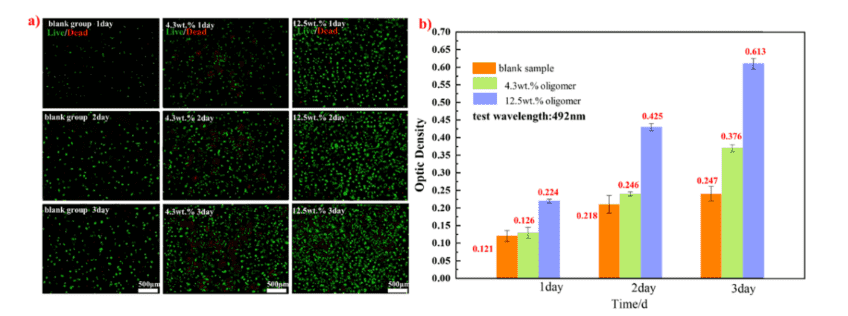
Figure 5: Fluorescence live/dead staining of cells on PCL surfaces with different oligomer levels; (b) MTT assay results.
The team also conducted mechanistic studies on how oligomer content influences the bioactivity of PCL using XPS, AFM, and contact angle tests in simulated body fluid (SBF). The related study, titled “Oligomer Content Determines the Properties and Application of Polycaprolactone”, was published in Macromolecules: https://doi.org/10.1021/acs.macromol.2c00275.
This work was financially supported by Hunan Juren Chemical New Materials Co., Ltd.—China’s only and the world’s fourth enterprise to master the production technologies of caprolactone monomer and its high polymers. Based on this collaboration, the team developed high-performance PCL and polyester-amide copolymer materials. The patented technology “A Polycaprolactone-based Polyamide Composite and Its Preparation Method” has been officially licensed to Hunan Juren Chemical New Materials Co., Ltd..
In addition, Professor Yi Chunwang’s group has long been dedicated to the synthesis of polyamides, spinning engineering, and functional product development. The team has made notable achievements in the production of intrinsically flame-retardant and functional polyamides, solution-dyeing processes, and oligomer regulation in caprolactam. Since 2019, the group has expanded its research into polycaprolactone. It currently maintains close collaborations with companies such as Fujian Yongrong Jinjiang Co., Ltd., Hunan Juren Chemical New Materials Co., Ltd., China Textile Academy, Sinopec, and Hunan Meiliper.
Original Article Links:
Catalytic Regulation of Oligomers in Polycaprolactone
https://doi.org/10.1016/j.mcat.2021.111594
Oligomer Content Determines the Properties and Application of Polycaprolactone: https://doi.org/10.1021/acs.macromol.2c00275

 Scan QR Code
 Scan QR Code
 Phone Support
Phone: 400-060-3233
After-sales: 400-060-3233
 WeChat Support

 Official Account

Back to Top