


Spontaneous imbibition experiments are fundamental for studying rock–fluid interaction mechanisms during water injection and hydraulic fracturing. Mineral composition and pore structure play critical roles in imbibition efficiency; however, their specific impact on oil recovery remains an area requiring further investigation.
This study conducted spontaneous imbibition experiments, utilizing low-temperature nitrogen adsorption and NMR techniques to explore: (1) how minerals and pore structure influence fluid behavior in tight sandstones; and (2) how various pore types contribute to oil recovery and how pore connectivity affects spontaneous imbibition.
The results indicate that due to wettability, brine tends to adhere to hydrophilic minerals, enhancing imbibition efficiency. As micropores develop, strong capillary pressure makes it easier for brine to displace oil. This study offers insights into how mineral composition and pore structures impact spontaneous imbibition, advancing our understanding of complex fluid–mineral interactions in tight sandstones.
Mineral composition and pore structure are two key parameters in evaluating tight sandstones. Mineral composition refers to the proportion of different inorganic and organic minerals, while pore structure relates to pore size, shape, and connectivity. Although hydraulic fracturing can improve reservoir performance, the interaction between mineralogy and pore structure introduces complexity, making it challenging to isolate single parameters. Therefore, understanding their relationship with spontaneous imbibition efficiency is crucial.
Current understanding of spontaneous imbibition in tight sandstones primarily considers matrix and fluid properties. Mineralogy and pore structure are believed to significantly influence imbibition rate and ultimate oil recovery. Clay minerals, being hydrophilic, tend to swell upon contact with water, affecting imbibition. Capillary pressure is influenced by pore radius—samples with higher spontaneous imbibition efficiency generally have smaller average pore sizes. Although researchers have conducted extensive experiments and theoretical modeling, the spontaneous imbibition mechanism and its correlation with matrix characteristics remain partially unclear.
This study investigates the influencing factors of spontaneous imbibition in tight sandstone, based on mineral composition and pore size distribution. Four sets of imbibition experiments were carried out under different mineral contents and pore networks to analyze imbibition efficiency and its determining factors.
Four tight sandstone samples were collected from the Triassic formations in Qingyang, Anhui, China. Quantitative mineral compositions were obtained using TS, XRD, and SEM, while pore size distribution was analyzed using gas adsorption methods.
Mineral Composition:
To examine the impact of mineralogy and pore structure on core imbibition, basic petrophysical parameters of sandstone were measured as follows:
Mineral composition was obtained using TS, SEM, and XRD techniques. Detrital minerals included substantial amounts of quartz and feldspar. Among clay minerals, chlorite and illite were predominant.
As shown in Figure 1, samples contained various minerals, leading to diverse pore structures across the study area. Detrital minerals such as feldspar and quartz primarily contributed to intergranular pores (Fig. 1b & c). The dissolution of albite and rock fragments significantly impacted the development of dissolution pores (Fig. 1e & f). Intercrystalline pores, mainly from clay minerals, were dominant in samples 3 and 4 (Fig. 1h, i, k, l).
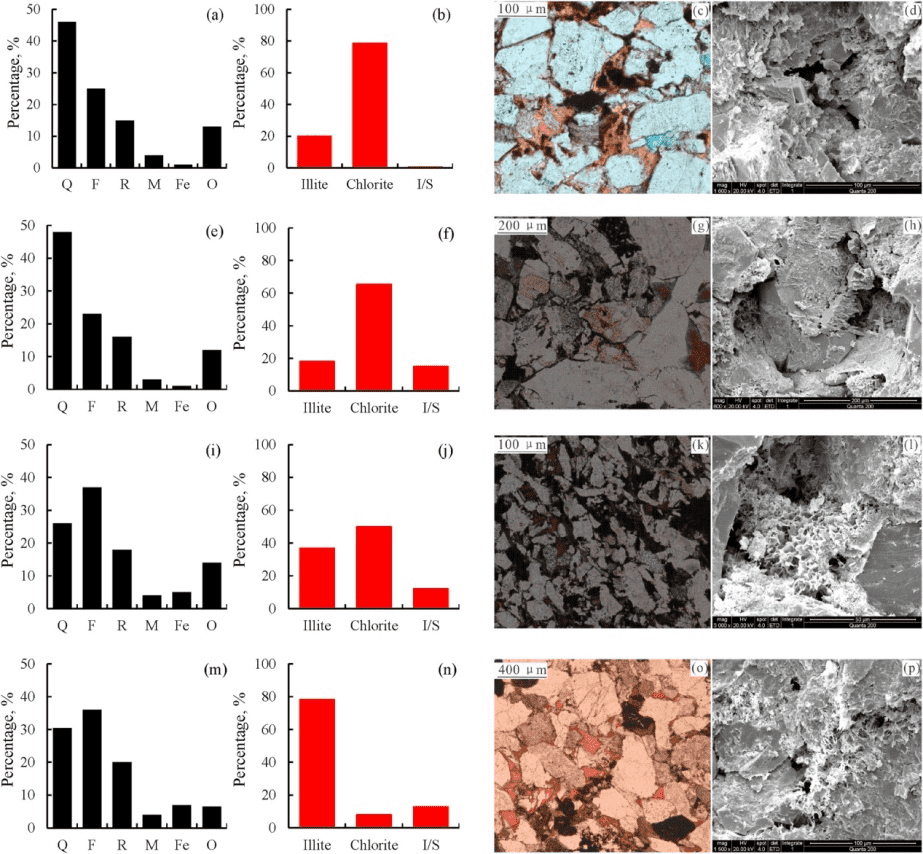
Figure 1: Mineral Composition (Column 1: TS-based mineral composition; Column 2: Clay minerals from XRD; Column 3: TS observation; Column 4: SEM images. Q: Quartz; F: Feldspar; R: Rock fragments; M: Mica; Fe: Ferrocalcite; O: Others)
Pore Size Distribution:
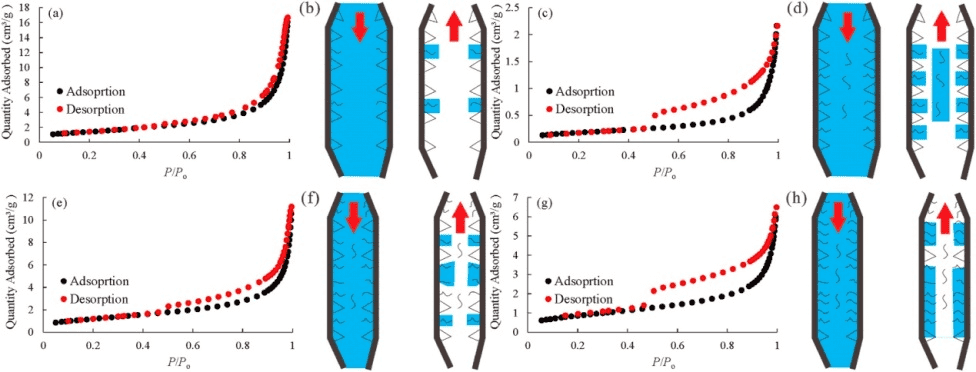
Figure 2 presents the nitrogen adsorption/desorption isotherms for all samples. Notably, samples rich in illite and I/S mixed layers with smaller pore sizes tend to constrain nitrogen more effectively.
Pore Size Distribution:
Figure 2: Nitrogen adsorption/desorption isotherms for all samples, indicating that samples with abundant illite and I/S mixed layers and smaller pores tend to retain more nitrogen.
BET and BJH models were used to calculate surface area and pore volume (see Table 2). Sample 1 displayed a distinct left peak (Fig. 3), while the other samples showed more even distributions. Sample 1 exhibited a broad peak between 0.1 and 0.5 μm in pore volume, indicating that larger pores significantly contributed to total pore volume. In contrast, others showed skewed distributions with lower amplitudes. These results suggest micropores dominate surface area, while macropores dominate pore volume.
Table 2: Average pore diameters calculated using BET and BJH models
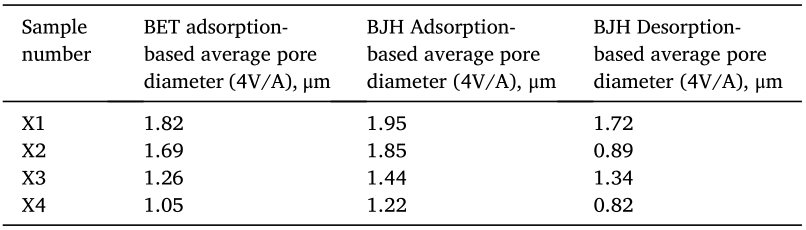
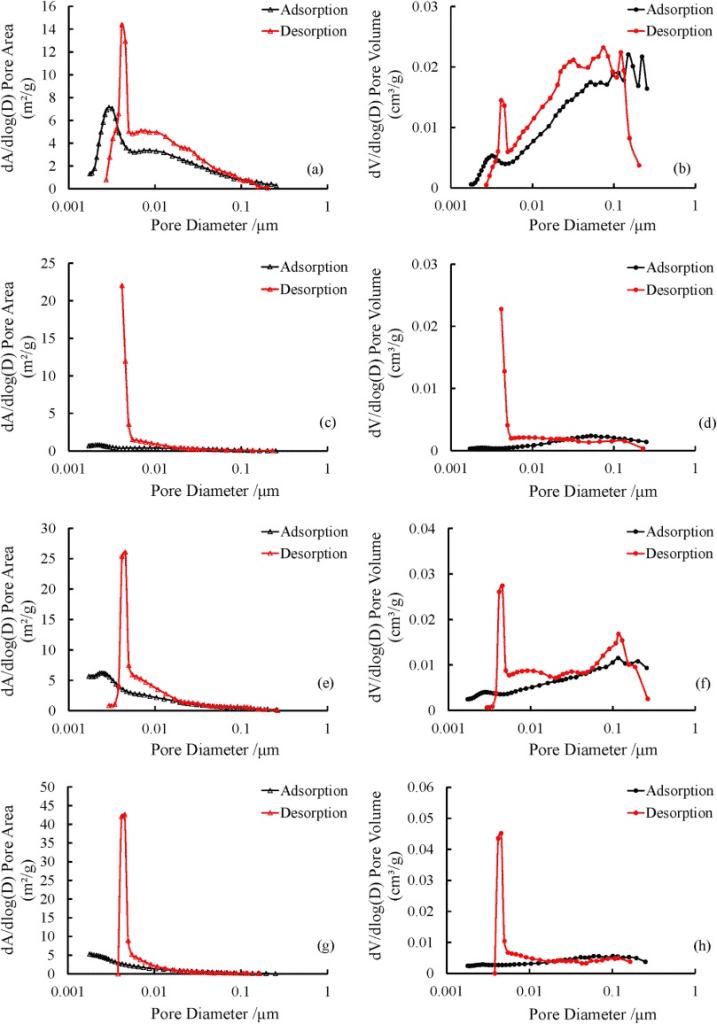
Figure 3: Pore area and volume distributions from nitrogen adsorption. X1: a–b, X2: c–d, X3: e–f, X4: g–h
Table 1: Basic physical properties of rock samples

All four samples were dried at 120°C for 72 hours, then saturated in kerosene at 20 MPa pressure for 12 hours. After saturation, they were wiped, weighed, and immersed in a 40% KCl solution to suppress water signals. T2 spectra were recorded at 0, 4, 8, 18, 48, and 72 hours. NMR measurements were conducted using equipment provided by Suzhou Niumag Analytical Instruments Co., Ltd. Parameters: echo spacing = 0.2 ms, wait time = 6 s, number of scans = 64.
1) Results and Analysis
Imbibition can be divided into three stages: early, middle, and late. The early stage (0–8 hours) showed a rapid imbibition rate, while the middle (8–18 hours) and late (18–72 hours) stages were more moderate. Most spontaneous imbibition occurred in the early phase, with oil displacement decreasing significantly over time.
2) Relationship Between Pore Size Distribution and Imbibition
Different samples yielded distinct imbibition results, mainly influenced by hydrophilic clay minerals and micropores. Figure 4 illustrates how these minerals relate to oil recovery at various stages. In the early phase, illite and I/S mixed layers played a major role in production efficiency. Samples 3 and 4, with smaller pore sizes, exhibited higher oil recovery due to stronger capillary pressure (Fig. 4a). In the middle stage, illite and I/S swelling reduced pore space, significantly affecting samples with smaller pores (Fig. 4b). During the late stage, hydrophilic minerals still contributed to oil displacement in samples with poor physical properties (Fig. 4c).
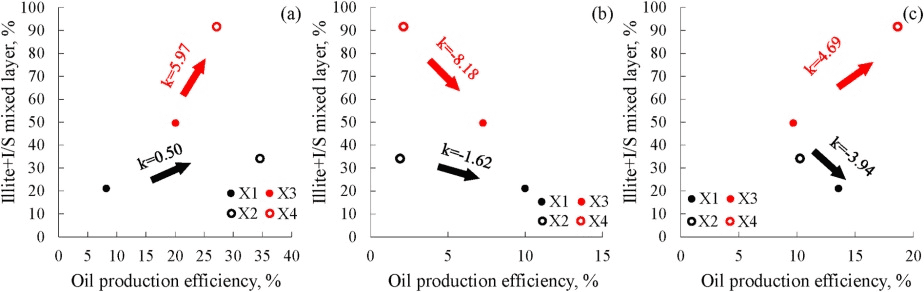
Figure 4: Fitting of hydrophilic clay minerals and oil recovery efficiency. (a) Early stage; (b) Middle stage; (c) Late stage. k: slope.
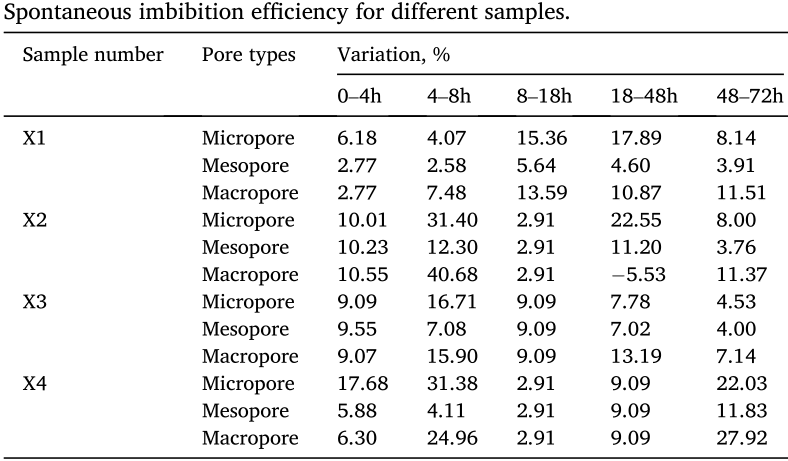
Another notable finding: higher porosity and permeability didn’t necessarily lead to better oil recovery. For example, Sample 1 had the highest porosity and second-highest permeability, yet its final spontaneous imbibition efficiency was lower than Sample 4 (Fig. 5, Table 3). Samples with high pore ratios didn’t always exhibit high efficiency. Different pore types could produce similar imbibition capabilities (Fig. 5a, Table 3). Sample 2, rich in dissolution pores due to feldspar dissolution, showed the highest imbibition efficiency owing to increased surface area (Fig. 5b, Table 3). While uniformly distributed pores didn’t offer imbibition advantages, Sample 4—with a few micro-fractures—demonstrated stronger imbibition performance (Fig. 5c & d, Table 3).

Figure 5: T2 spectra at various time intervals and SEM images of the four samples.
Table 3: Spontaneous imbibition efficiency of different samples
3) Influence of Pore Connectivity on Imbibition
Figure 6 presents capillary pressure (left) and cumulative T2 curves (right) derived from PCMI and NMR tests, respectively. Imbibition saturation occurs at crossover points between initial and final T2 curves, correlating with pore radius. The zone formed between them (blue-shaded area in Fig. 6) is known as the main imbibition zone. A larger imbibition area generally indicates higher oil recovery efficiency. Thus, this area serves as a valuable indicator for spontaneous imbibition performance in tight sandstones.
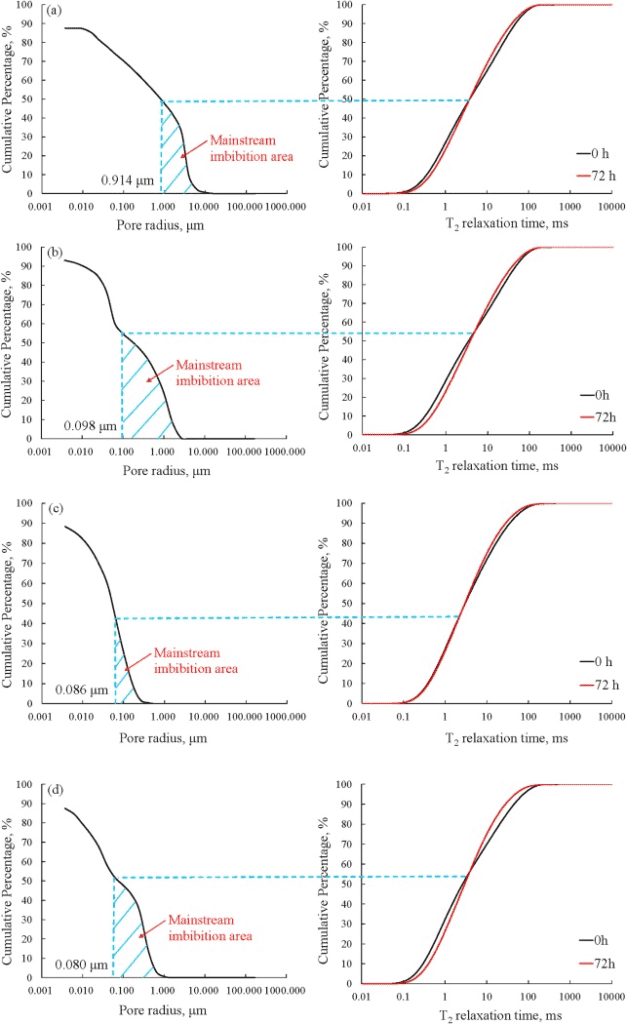
Figure 6: Capillary pressure and cumulative T2 curves for the four samples
1. Hydrophilic mineral content positively impacts oil recovery. As the proportion of macropores increases, more fluid can be absorbed by the sample.
2. A greater presence of micropores facilitates oil displacement. These small pores generate strong capillary forces, enhancing oil mobility.
3. Imbibition area is a key indicator of oil recovery efficiency—larger imbibition areas typically correspond to higher recovery rates.
[1] Liu, Y. Y. F. (2021). Impacts of mineral composition and pore structure on spontaneous imbibition in tight sandstone. Journal of Petroleum Science & Engineering, 201(1).

 Scan QR Code
 Scan QR Code
 Phone Support
Phone: 400-060-3233
After-sales: 400-060-3233
 WeChat Support

 Official Account

Back to Top