

In recent years, global energy demand has continued to grow, and natural gas has become increasingly important as a cleaner fossil fuel. Tight gas, as a key unconventional natural gas resource, is widely distributed in China’s Ordos, Sichuan, and Songliao Basins. However, tight gas reservoirs typically have low permeability and cannot be exploited on a large industrial scale without stimulation measures. Conventional hydraulic fracturing not only consumes huge amounts of water—posing challenges in water‑scarce regions—but also tends to cause clay swelling and water blocking effects in water‑sensitive formations, leading to reservoir damage and production decline.
Therefore, researchers have been working to develop water‑free fracturing technologies. CO₂ foam fracturing, as an advanced CO₂‑based fracturing technology, offers advantages such as enhanced proppant transport capacity and reduced fluid loss, making it highly promising for tight gas reservoir applications. In addition, this technology has the potential for underground CO₂ sequestration, contributing to carbon emission reduction.
Despite its great potential, research on the flowback behavior of fracturing fluid and CO₂ storage potential after CO₂ foam fracturing remains insufficient. This case study combines physical displacement experiments with low‑field nuclear magnetic resonance (LF‑NMR) technology to investigate the effects of foam quality on fracturing fluid flowback efficiency, microscopic retention characteristics, and CO₂ storage efficiency, and to examine the roles of parameters such as foam quality, injection rate, injection volume, and soaking time at the field scale.
The application of LF‑NMR technology in this case study demonstrates the following major advantages:
The technology can characterize pore structure and fluid distribution by measuring the transverse relaxation time T₂ without damaging the core sample.
Since T₂ is mainly controlled by surface relaxation and is related to the surface‑to‑volume ratio of pores, fluids in small and large pores can be distinguished based on T₂ values, allowing evaluation of hydrogen fluid content changes in different pores.
By comparing the integrated areas of T₂ spectra before and after flowback, the retention percentages of fracturing fluid in small pores, large pores, and all pores can be quantitatively calculated, aiding the study of CO₂ foam fracturing and carbon sequestration mechanisms.
Research Case: CO₂ foam‑assisted fracturing fluid flowback and CO₂ sequestration in tight sandstone gas reservoirs: Experimental and numerical study [1]:
Experimental Protocol
1 Core preparation and physical property testing
The prepared cores were dried at 110 °C for 24 hours. Dry weight, length, and diameter were measured, and permeability was determined using the gas permeability testing method.
2 Core saturation and NMR testing
The cores were vacuum‑saturated with simulated formation water for 48 hours. Wet weight was measured and porosity was calculated. NMR testing was performed on the saturated cores to obtain the initial T₂ spectrum.
3 CO₂ foam preparation and injection
A foam generator was used to prepare CO₂ foam fracturing fluid with specified foam quality (fracturing fluid was added first, followed by a specified volume of CO₂). Under conditions of 15 MPa and 120 °C, the CO₂ foam was injected into the core holder at a constant rate of 0.01 mL/min. Pressure changes were recorded in detail during injection. After injection, the inlet was closed and the entire system was shut in.
4 Fracturing fluid flowback
After the shut‑in period, the inlet was gradually opened to start flowback. The flowback fluid entered a gas‑liquid separator to separate the fracturing fluid and CO₂. The mass of flowback fracturing fluid and the volume of CO₂ were recorded in detail until no liquid droplets appeared. After flowback, the core was weighed and an NMR test was performed. The fracturing fluid flowback efficiency and CO₂ storage efficiency were calculated.
5 Experiments with different foam qualities
CO₂ foam fracturing fluids with foam qualities of 50%, 60%, and 70% were prepared, and steps (2) to (4) were repeated to investigate the effect of foam quality on flowback efficiency and CO₂ storage efficiency.
Experimental Conclusions
This study, based on low‑field NMR technology, investigates the application of CO₂ foam fracturing in tight sandstone gas reservoirs, focusing on the evaluation of fracturing fluid flowback efficiency, microscopic retention characteristics of fracturing fluid, and CO₂ storage potential during the process.
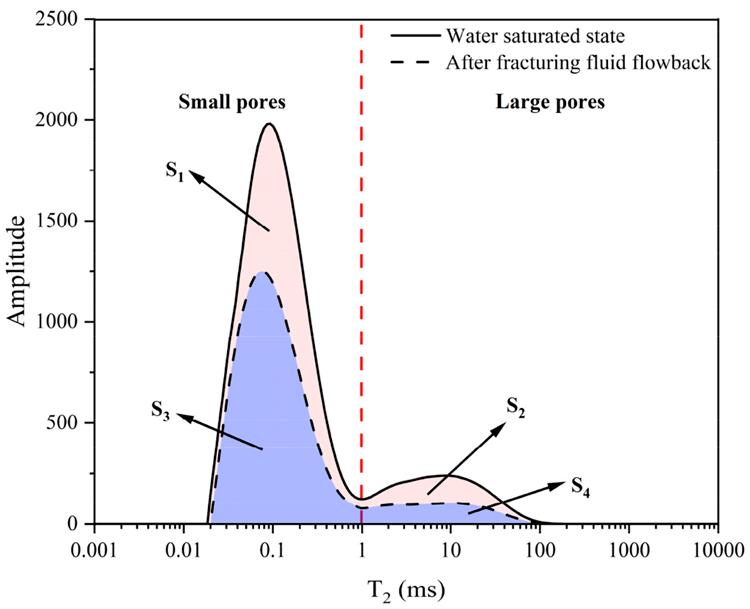
Figure 1: T₂ relaxation spectra before and after CO₂ foam fracturing fluid flowback.
Figure 1 characterizes fracturing fluid retention by comparing the NMR relaxation spectra of the core in the initial water‑saturated state (red solid line) and the post‑flowback state (black dashed line).
The analysis shows that after flowback, the spectral amplitude (S₁) in the small‑pore region (corresponding to shorter relaxation times) remains significantly higher than that in the water‑saturated state (S₃), indicating that a large amount of fracturing fluid is retained in small pores. The signal areas can be used to calculate the retention percentages of fracturing fluid in different pore types, enabling quantitative evaluation of flowback effectiveness.
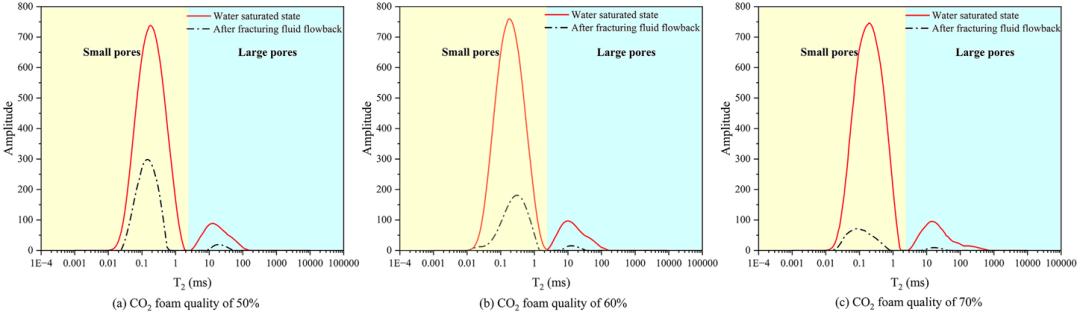
Figure 2: T₂ relaxation spectra before and after flowback for different CO₂ foam qualities.
Figure 2 shows the microscopic retention characteristics of fracturing fluid in cores under different CO₂ foam qualities (50%, 60%, and 70%). As the CO₂ foam quality increased from 50% to 70%, the amplitude of the T₂ spectrum after flowback decreased more significantly, indicating that higher foam quality helps reduce fracturing fluid retention in various pores.
Low‑field nuclear magnetic resonance (LF‑NMR) technology can characterize the microscopic retention behavior of fracturing fluid. Based on the T₂ spectral areas, the retention percentages of fracturing fluid in small and large pores can be calculated separately, enabling quantitative assessment of microscopic retention behavior. By comparing the changes in T₂ spectra before and after flowback under different CO₂ foam qualities, the influence of process parameters on retention can be evaluated, while also assessing CO₂ storage potential.
Recommended Equipment
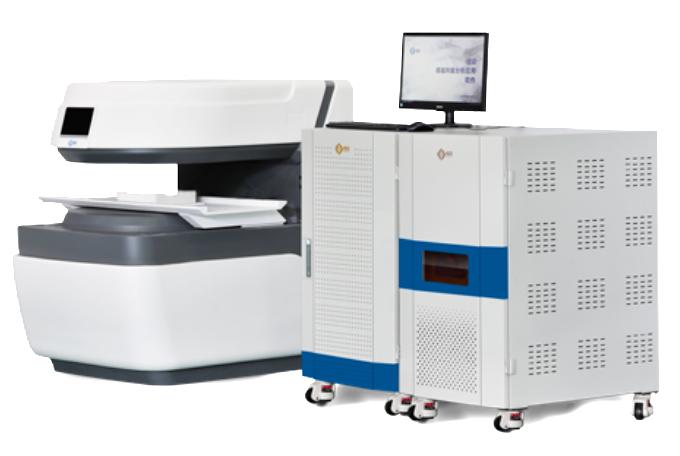
Large‑bore Nuclear Magnetic Resonance Imaging Analyzer
Reference
[1] Bo Han, Hui Gao, Yuanxiang Xiao, et al. CO₂ foam‑assisted fracturing fluid flowback and CO₂ sequestration in tight sandstone gas reservoirs: Experimental and numerical study[J]. Geoenergy Science and Engineering, 2026.
 Scan QR Code
 Scan QR Code
 Phone Support
Phone: 400-060-3233
After-sales: 400-060-3233
 WeChat Support

 Official Account

Back to Top