

As a core technology for the development of unconventional oil and gas resources, hydraulic fracturing relies heavily on the research and development of high-performance fracturing fluid systems. Among various fracturing fluid systems, water-based polymer fracturing fluids represented by hydroxypropyl guar gum (HPG) have become the mainstream choice for current shale gas fracturing operations due to their excellent viscosity-increasing properties and environmental friendliness. The three-dimensional network structure formed by HPG fracturing fluid through crosslinking reactions endows it with unique rheological properties. This crosslinked structure not only effectively suspends proppants but also maintains stable performance in the downhole environment with high temperature and high pressure.
As a key parameter characterizing the network structure of HPG fracturing fluid, the crosslinking degree directly affects several important performance indicators of the fracturing fluid. Firstly, the crosslinking density determines the elastic modulus and viscous modulus of the system, thereby influencing the sand-carrying capacity of the fracturing fluid and the fracture propagation effect. Secondly, an appropriate degree of crosslinking is the basis for ensuring the temperature resistance of the fracturing fluid, which is particularly crucial for fracturing operations in deep high-temperature reservoirs. In addition, the structural characteristics of the crosslinked network are also related to the gel-breaking behavior of the fracturing fluid, affecting the post-fracturing flowback efficiency and reservoir protection effect.
Currently, the characterization technology for the crosslinking degree of fracturing fluids still faces significant challenges. Researchers often need to combine multiple testing methods to conduct a comprehensive evaluation of the crosslinking state. At present, the characterization of crosslinking degree mainly relies on rheometers (for measuring viscoelasticity) and infrared spectroscopy (for analyzing changes in functional groups). However, rheometers can only reflect macroscopic mechanical properties and cannot distinguish the microscopic differences in crosslinked network structures; infrared spectroscopy is limited by the complexity of sample preparation and insufficient quantitative accuracy. Furthermore, neither of the two methods can realize the quantitative characterization of crosslinking degree. Therefore, a more efficient and accurate detection method is urgently needed. Due to its sensitivity to molecular motion, low-field nuclear magnetic resonance (LF-NMR) technology has shown unique advantages in the characterization of polymer crosslinked networks in recent years. It can quickly detect and quantitatively characterize the crosslinking degree of samples, thus becoming a new method for the analysis of the crosslinking degree of HPG fracturing fluid.
Case Study on Quantitative Characterization of Crosslinking Degree of Hydroxypropyl Guar Gum Fracturing Fluid by Low-Field Nuclear Magnetic Resonance [1]
Experimental Materials:
Samples: Hydroxypropyl guar gum (HPG); deuterated water (D₂O);
Crosslinking agents: Ethylene glycol, boric acid, D-sorbitol; cyclic boron crosslinking agent (OBC), etc.
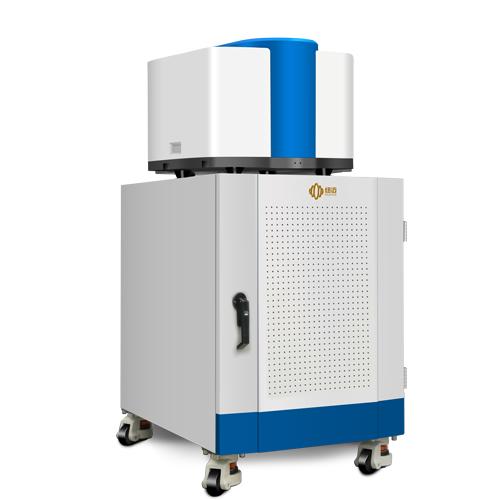
Instrument: Low-field nuclear magnetic resonance analyzer (MicroMR12-040V).
Experimental Protocol:
Dissolve hydroxypropyl guar gum in deuterated water, let it stand at room temperature (20℃), and then place it in a water bath at 25℃ for 4 hours to allow full swelling, so as to prepare the base fluid.
Add cyclic boron crosslinking agent (OBC) with different proportions (0.1% to 1.0%) into different base fluids, and stir evenly to obtain fracturing fluid gels with different crosslinking degrees.
Use an LF-NMR analyzer for testing, and adopt the CPMG sequence to measure the T₂ relaxation time of protons in the sample. (Parameters: Sampling Bandwidth (SW) = 200 KHz, Waiting Time (TW) = 1500 ms, First Data Adjustment (RFD) = 0.02 ms, Analog Gain Adjustment (RG) = 10 dB, Digital Gain Adjustment (DRG) = 3, Preamplifier Gain Adjustment (PRG) = 3, Number of Scans (NS) = 8, Echo Time (TE) = 0.15 ms, Number of Echoes (NECH) = 2000.)
Analyze the T₂ relaxation spectrum and calculate the crosslinking degree.
Analysis of Experimental Results.
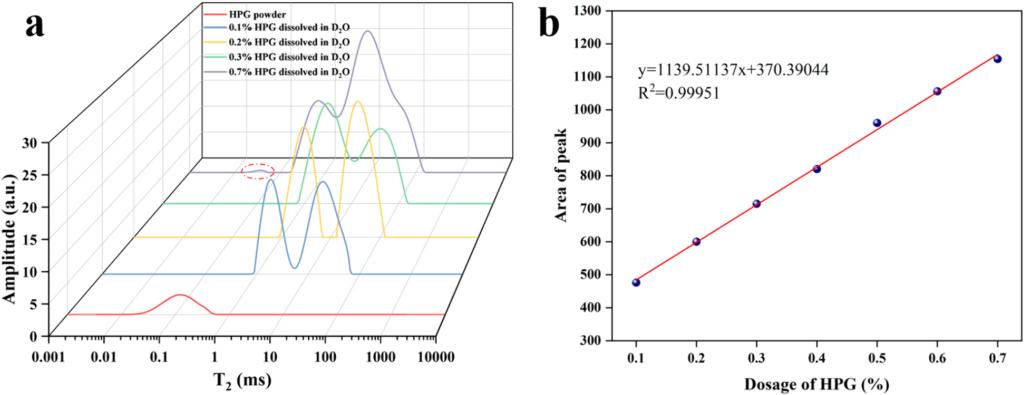
Figure 1: Hydroxypropyl guar gum base fluid at 0.1–0.7% guar gum concentration: (a) Relaxation distribution; (b) Relationship between total T₂ peak area and guar gum dosage
Figure 1 shows the relaxation distribution of guar gum powder and guar gum base fluid prepared with deuterated water at different concentrations, as well as the change in peak area. As shown in Figure 1(a), there is only one fast relaxation peak in the relaxation distribution of guar gum powder, which is located at 0.03–1 ms. This may be because the guar gum molecules are in a solid powder state and cannot stretch, and there is no linear structure with good fluidity. For the guar gum base fluids prepared with 0.1, 0.2, 0.3, and 0.7 wt% deuterated water, two peaks are observed, and the peak area and position change with the increase of guar gum concentration. When the concentration of guar gum increases to 0.7 wt%, a peak located at approximately 0.05 ms is observed, which is consistent with the relaxation peak position of solid guar gum powder. This may be due to the presence of undissolved guar gum molecules in the high-concentration guar gum.
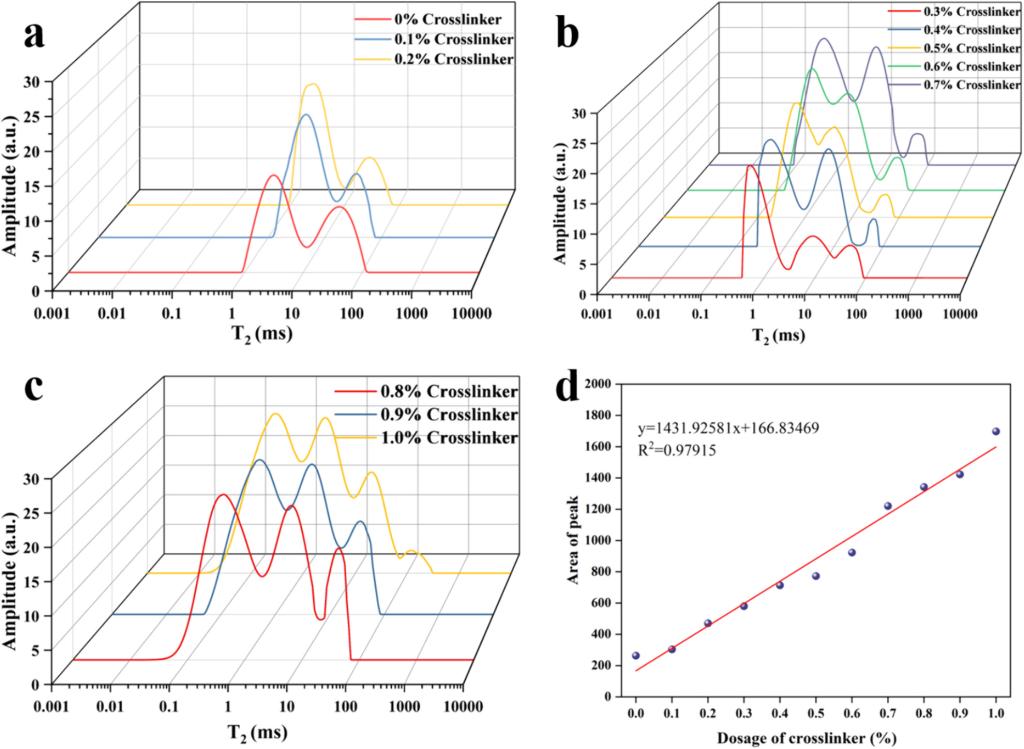
Figure 2: Relaxation distribution under different crosslinking agent dosages: (a) 0–0.2%
As shown in Figure 2, with the increase of crosslinking agent dosage, multiple peaks appear in the relaxation distribution. As the dosage of crosslinking agent increases, the signal intensity and proportion of the fast relaxation peak increase continuously, and the fluidity decreases. This is because the addition of crosslinking agent forms more membrane structures and a denser fracturing fluid network structure. As shown in Figure 2(c), by increasing the amount of crosslinking agent to 0.8%, 0.9%, and 1%, the range of the T₂₁ peak expands to 0.04–3 ms, while the positions of the T₂₂ and T₂₃ peaks remain unchanged. This indicates that the gel has a denser structure, which may be due to excessive crosslinking leading to excessive shrinkage of the gel network. The T₂ distribution measured by LF-NMR reflects the movement behavior of the linear and membrane-like structures formed by the combination of guar gum molecules and crosslinking agents. However, when the crosslinking agent is excessive, the free crosslinking agent molecules cannot combine with guar gum. This is evidenced by the peak at 100–300 ms in the T₂ distribution of 1.0% crosslinking agent in Figure 3(c), indicating the presence of unreacted excessive crosslinking agent. For more detailed experimental content, please refer to Reference [1].
Based on the above research, it can be demonstrated that the crosslinking degree measured by LF-NMR can quantitatively characterize the crosslinking degree of fracturing fluid gel, providing support for the monitoring of the formula of fracturing fluid and its state during use.
[1] Zhang C, Wang Y, Yin Z, et al. Quantitative characterization of the crosslinking degree of hydroxypropyl guar gum fracturing fluid by low-field NMR[J]. International Journal of Biological Macromolecules, 2024, 277(Part 3): 11. DOI: 10.1016/j.ijbiomac.2024.134445.
 Scan QR Code
 Scan QR Code
 Phone Support
Phone: 400-060-3233
After-sales: 400-060-3233
 WeChat Support

 Official Account

Back to Top