


Portable nuclear magnetic resonance (NMR) analysis technology for oilfield sites represents a major breakthrough in oil and gas exploration in recent years. Conventional NMR equipment relies on laboratory environments—large in size and complex to operate—making it difficult to meet the demand for real-time data acquisition at field sites. As oil and gas development extends into complex formations, the need for accurate, on-site acquisition of reservoir petrophysical parameters (such as porosity, permeability, and fluid saturation) has become increasingly urgent, leading to the emergence of portable NMR instruments.

The necessity of this technology lies in three aspects. First, real-time on-site analysis enables rapid determination of reservoir oil-bearing potential, guiding critical operations like drilling and fracturing, and avoiding decision-making delays caused by traditional sample-shipping testing. Second, non-invasive measurement reduces core loss, offering significant advantages in unconventional reservoirs such as shale oil and tight gas. Third, integrated designs withstand harsh environments—deserts, offshore platforms, and mountainous areas—significantly improving exploration and development efficiency. Today, this technology has become a key pillar of smart oilfield construction, driving the industry toward greater efficiency and lower carbon emissions. The following are its typical application scenarios and value analysis:
Scenario: Immediate analysis of cores, cuttings, or sidewall samples during drilling.
Functions: Determines critical parameters including porosity, permeability, fluid saturation (oil/gas/water ratios), and movable fluid content.
Advantages: Replaces time-consuming laboratory analysis, enabling quick assessment of reservoir properties to guide subsequent completion optimization. For example, real-time trajectory adjustments can be made during horizontal drilling to avoid low-permeability zones.
Scenario: On-site detection of drilling fluids, fracturing fluids, or injected chemicals.
Functions: Analyzes fluid viscosity, oil/water ratio, emulsion stability, and identifies degradation of additives (e.g., polymers).
Advantages: Dynamically optimizes fluid formulations, prevents borehole instability or formation damage, and reduces cost waste.
Scenario: Evaluation of fracturing effectiveness in unconventional reservoirs such as shale and tight sandstone.
Functions: Quantifies fracture aperture, connectivity, and matrix pore distribution, and identifies effective flow channels.
Advantages: Optimizes fracturing parameters (e.g., cluster spacing, proppant volume) to enhance single-well productivity.
Scenario: Review of shut-in or low-efficiency wells.
Functions: Analyzes changes in reservoir properties (e.g., pore clogging, wettability alteration) and identifies undeveloped pay zones.
Advantages: Provides a basis for sidetracking, re-fracturing, or injection-production adjustments, extending the economic life of oilfields.
The following is an application case of Niumag‘s portable NMR at an oilfield site:
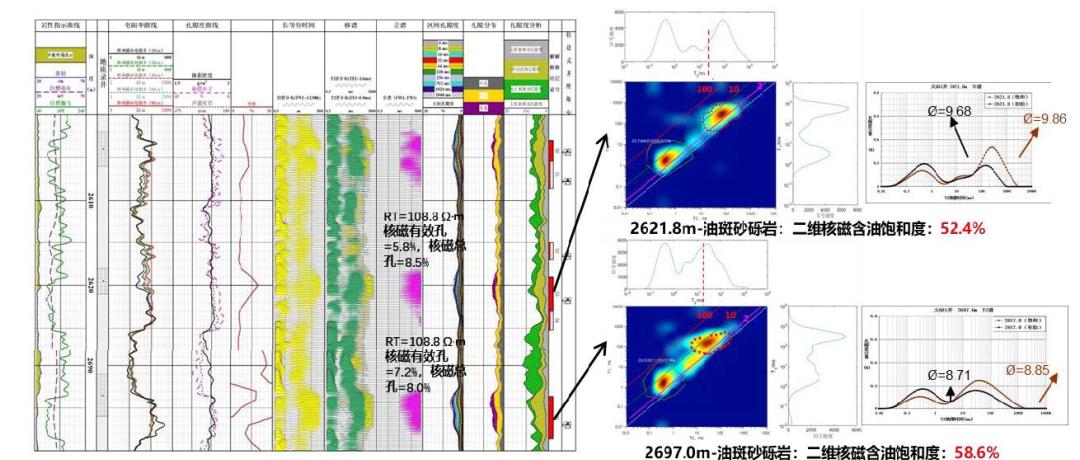
In a low-porosity, low-permeability sandy conglomerate reservoir of an oil well, pores are predominantly micro-pores with some mesopores developed. Based on two-dimensional NMR spectral characteristics, a distinct movable oil signal was observed, leading to a comprehensive interpretation as an oil-bearing zone.
Niumag‘s portable NMR is suitable for samples up to 1.5 inches in diameter and has gained strong customer recognition for its excellent stability and repeatability. It essentially “relocates” the laboratory to the oilfield site, allowing individual operators or small teams to use it flexibly within a logging truck, greatly improving the timeliness and efficiency of obtaining formation data. While continuously strengthening product hardware capabilities, Niumag also optimizes measurement software and enhances its software intelligence—integrating the measurement needs of cores under different field states, delivering combined output of various results, and automatically generating test reports that comply with industry standards, freeing oilfield clients from data processing burdens.
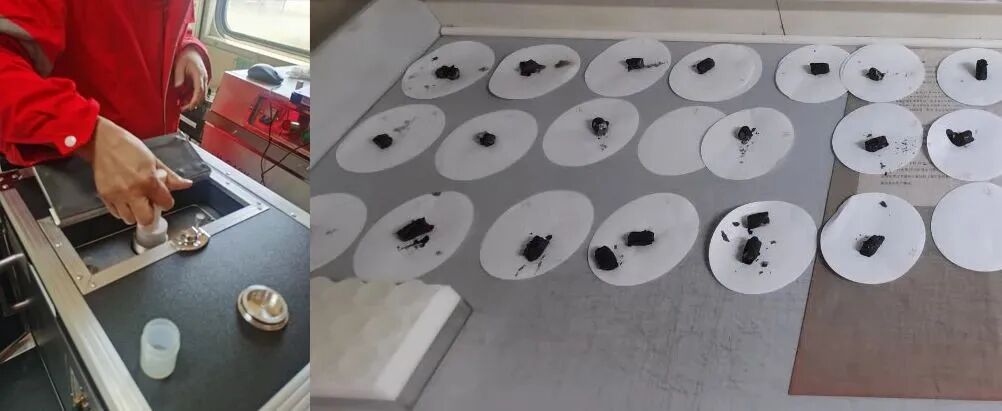
Oilfield site
 Scan QR Code
 Scan QR Code
 Phone Support
Phone: 400-060-3233
After-sales: 400-060-3233
 WeChat Support

 Official Account

Back to Top