


Natural gas hydrates are widely distributed in seafloor sediments and permafrost regions around the world. In addition to their abundant global reserves, the clean combustion characteristics and high energy density of natural gas hydrates make them one of the most promising alternative energy resources for the future. Consequently, the demand for commercial development of natural gas hydrates continues to grow, attracting significant attention from scientists and engineers worldwide [1].
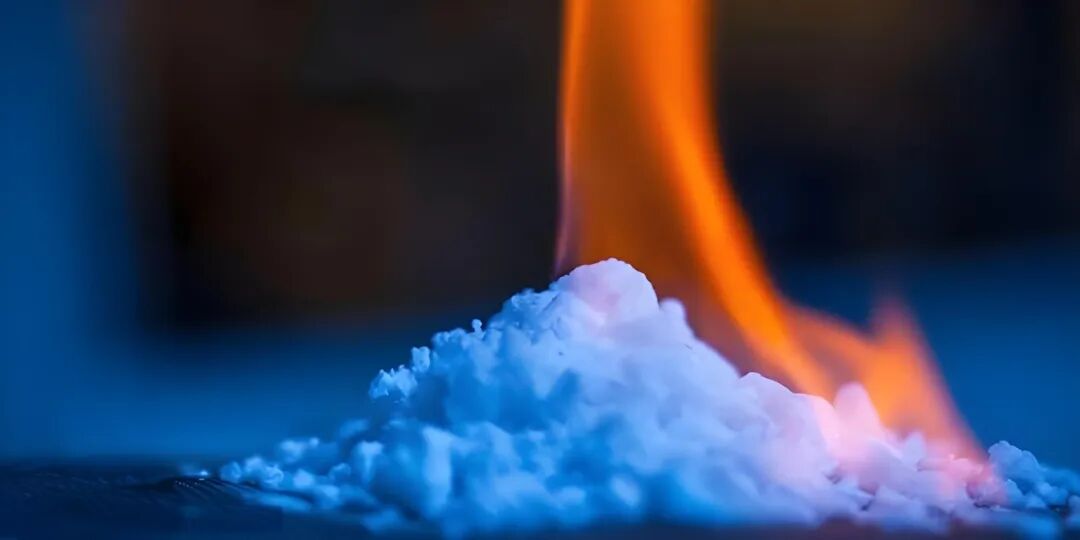
Due to their occurrence in unconventional reservoirs such as seabed sediments, natural gas hydrates present considerable challenges for exploration and development. Researchers have long been committed to studies on accumulation mechanisms, reservoir physical properties, and development mechanisms. Among these, how to extract natural gas efficiently and safely is directly related to commercial value. At the same time, it is essential to understand gas production behavior and dynamic gas exsolution characteristics during hydrate dissociation in the development process.

This case study utilizes nuclear magnetic resonance (NMR) technology for in‑situ, online monitoring of the experimental process of natural gas hydrate formation, and discusses the kinetic characteristics of methane hydrate formation in porous media [2].
Experimental Protocol
01 Sample Measurement
The sample is placed in a reaction vessel and positioned within the NMR device. The flow switch is opened, and the initial temperature of the coolant is set to 10 °C. The NMR device is started, and the software automatically monitors the NMR signal of the sample.
02 Cooling Process
When the sample temperature reaches 10 °C, the temperature is further reduced at a cooling rate of 5 °C/h. When the temperature drops to 0 °C, the cooling rate is adjusted to 2 °C/h. When the temperature drops to –2 °C, if a rapid decrease in signal intensity is observed, it indicates that the water in the sample has frozen. Cooling is then stopped, and the temperature is maintained stable at –2 °C.
03 Pressurization Process
After the water in the sample has frozen, methane gas at 8.5 MPa is injected into the reactor. Subsequently, the pressure is maintained stable and the state is kept unchanged.
04 Temperature Ramping Process
After the water in the sample has frozen and the pressure has remained constant for a considerable period, the temperature is raised at a rate of 0.02–0.05 °C/min. At the same time, changes in NMR signal intensity and pressure are monitored.
05 Formation Process
When the pressure gauge indicates that the pressure begins to decrease, it signifies that methane hydrate formation has started, and the temperature increase is stopped. The temperature at this point is maintained constant. The NMR signal no longer rises and begins to gradually decrease. Finally, the pressure drops to a lower value, and the NMR signal decreases to a certain value; both remain stable for an extended period, indicating that the methane hydrate formation process is complete.
Experimental Process Analysis
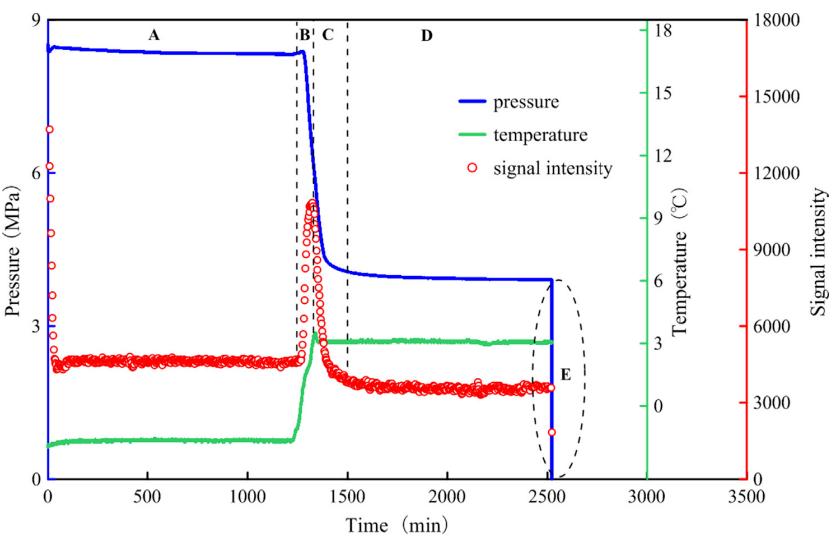
Figure 1: Relationship between pressure, temperature, NMR signal intensity, and time during hydrate formation.
This study used low‑field NMR technology to investigate the kinetic process of methane hydrate formation in‑situ and online. The main conclusions are as follows: The figure above shows the changes in NMR signal during hydrate formation, dividing the process into four stages (A–D): induction stage, nucleation stage, growth stage, and stable stage.
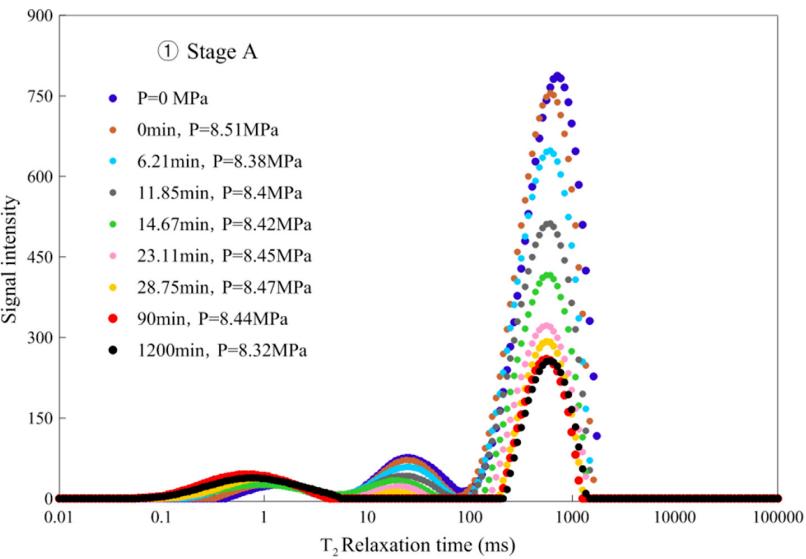
Figure 2: T₂ relaxation time distribution during Stage A of hydrate formation.
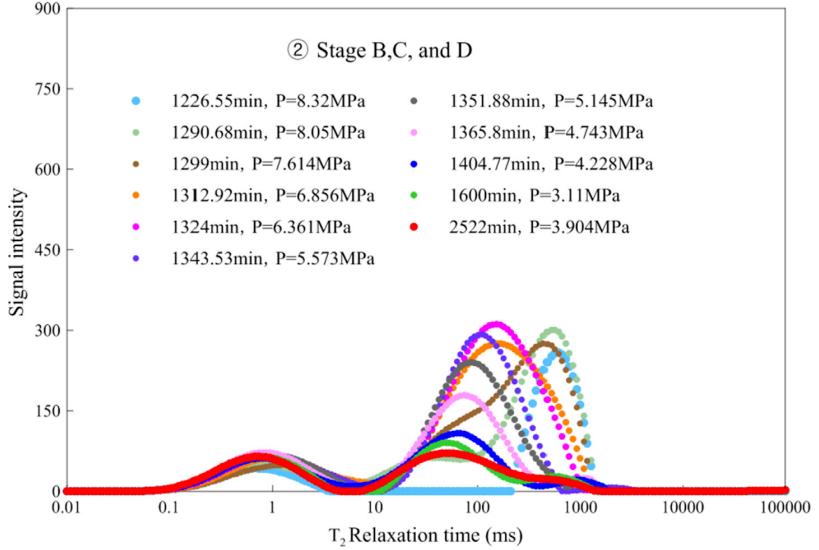
Figure 3: T₂ relaxation time distribution during Stages B, C, and D of hydrate formation.
According to the NMR signals in Figure 2, pore water is classified into three types: small‑pore water (T₂ < 9 ms), medium‑pore water (9 ms < T₂ < 100 ms), and large‑pore water (T₂ > 100 ms). The freezing process indicates that freezing begins in large pores and gradually moves from large pores to small pores.
Figure 3 reveals the T₂ relaxation time distribution from nucleation to formation of hydrates in porous media. At 1324 min of nucleation (temperature 3.1 °C, pressure 6.36 MPa), the water signal reaches maximum intensity. Subsequently, as hydrates continue to grow, the NMR signal continues to weaken. Large‑pore water content decreases significantly, while the remaining pore water resides in small pores. In addition, some large‑pore water migrates to small pores, while small‑pore water remains essentially unchanged in form due to adsorption effects on molecular surfaces.
Low‑field nuclear magnetic resonance (LF‑NMR) technology can not only monitor the hydrate formation process in‑situ and online, but also track the in‑situ dissociation process of natural gas hydrates, study methane gas dissociation mechanisms and seepage evolution in hydrate‑bearing sediments, and provide accurate permeability and wettability data for hydrate‑bearing sediments, thereby offering guidance for natural gas hydrate development.
References
[1] Gainullin S E, Kazakova P Y, Pavelyev R S, et al. New promoters derived from amino acids and citric acid for the efficient storage of methane as gas hydrates[J]. Chemistry and Technology of Fuels and Oils, 2024, 60(4): 848‑854.
[2] B, Jing Zhan A, et al. Experimental research on methane hydrate formation in porous media based on the low‑field NMR technique[J]. Chemical Engineering Science, 244 (2021).
 Scan QR Code
 Scan QR Code
 Phone Support
Phone: 400-060-3233
After-sales: 400-060-3233
 WeChat Support

 Official Account

Back to Top