


In both scientific research and industrial fields, polydimethylsiloxane (PDMS) has attracted considerable attention due to its outstanding performance and wide range of applications.
Notably, PDMS exhibits unique application value in low-temperature environments owing to its excellent low-temperature resistance. It is commonly used as sealing gaskets for cryogenic storage containers, seals for low-temperature reactors, and housings for cryogenic sensors. However, PDMS crystallizes rapidly below its melting point (Tₘ ≈ 228 K), leading to a significant reduction in its elasticity.
In the modification of silicone-based elastomers, the incorporation of fillers is essential to improve the freeze resistance of the material. However, the addition of nanofiller particles causes marked changes in the polymer’s structure, dynamics, interaction strength, thermal transitions, and properties. Low‑field nuclear magnetic resonance (LF‑NMR) can characterize the low‑temperature performance of materials by studying parameters such as transverse relaxation time (T₂) and the temperature‑dependent variation of the relative proportions of free and rigid chain segments in the polymer network.
In this application, the authors used a variable‑temperature low‑field NMR instrument to investigate the relaxation spectra of PDMS (VMQ/SiO₂) with different SiO₂ loadings at various temperatures. They employed the MSE sequence to ensure the integrity of the NMR relaxation signals.
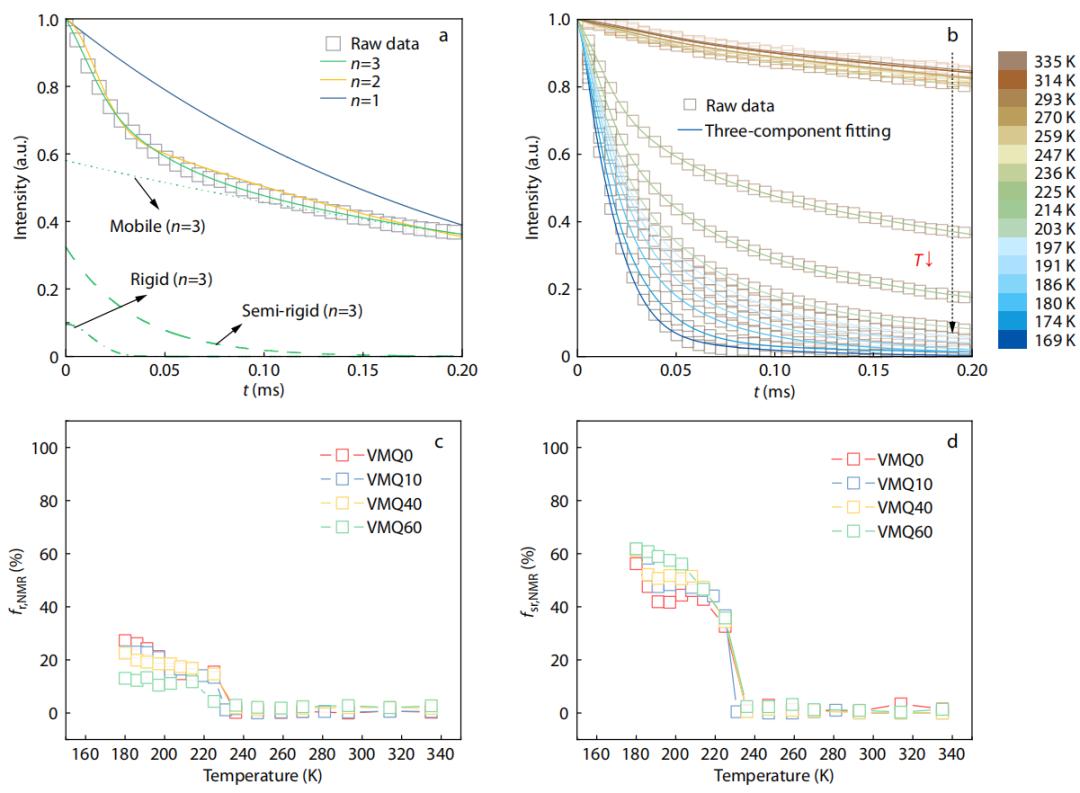
Figure a shows the fitting results of the relaxation curves at low temperature using a modified Weibull function. The fitting resolves three main components: free chains, rigid chains, and semi‑rigid chains.
Figure b shows that as the temperature decreases, the relaxation of the material becomes faster, indicating that temperature indeed affects the mobility of hydrogen protons in the material. At this point, the rigid fraction of the material consists mainly of two components: the crystalline regions and the tightly bound layer formed by chemical crosslinking between the polymer and the particle surface (for PDMS without SiO₂, the rigid region consists only of the crystalline fraction).
The fitting results shown in Figures c and d indicate that the rigid fraction (fr, NMR) of VMQ/SiO₂ undergoes an abrupt change below Tₘ (228 K), exceeding 30%. A similar trend is observed in the semi‑rigid region at 180 K, where the semi‑rigid component accounts for approximately 60%.
Figure c also shows that the rigid fraction content after 228 K decreases with increasing silica nanoparticle filler content, demonstrating that the addition of nanoparticles does indeed enhance the freeze resistance of the material.
Reference
Xiong, Y. Q.; Li, C. L.; Lu, A.; Li, L. B.; Chen, W. Conformational disorder within the crystalline region of silica‑filled polydimethylsiloxane: a solid‑state NMR study. Chinese J. Polym. Sci. https://doi.org/10.1007/s10118-024-3164-y
 Scan QR Code
 Scan QR Code
 Phone Support
Phone: 400-060-3233
After-sales: 400-060-3233
 WeChat Support

 Official Account

Back to Top