


Monitoring of food denaturation processes
Study of denaturation temperatures and time effects
If you are interested in any of these applications, please contact us at mobile/WeChat: 15618037925, Manager Chen
Rice cooking analysis (heating modes, texture evaluation)
Food drying processes
Glass transition temperature measurement
Determination of food ice points
Monitoring of food denaturation processes
Study of denaturation temperatures and time effects
If you are interested in any of these applications, please contact us at mobile/WeChat: 15618037925, Manager Chen
Rice cooking analysis (heating modes, texture evaluation)
Food drying processes
Glass transition temperature measurement
Determination of food ice points
Monitoring of food denaturation processes
Study of denaturation temperatures and time effects
If you are interested in any of these applications, please contact us at mobile/WeChat: 15618037925, Manager Chen
An in-situ variable-temperature low-field nuclear magnetic resonance (LF-NMR) system refers to a low-field NMR setup capable of changing the sample temperature online and performing measurements in situ at the set temperature. The system can simultaneously perform relaxation analysis and magnetic resonance imaging.
Traditional low-field NMR systems operate at ambient temperature, with the sample temperature maintained close to the laboratory environment. Data obtained reflect the sample properties at room temperature. In contrast, an in-situ variable-temperature LF-NMR system allows programmable temperature control (both heating and cooling) and real-time in-situ measurements. This enables the study of sample characteristics under different thermal conditions, including freezing, drying, cooking processes, ice point determination, and monitoring food denaturation.
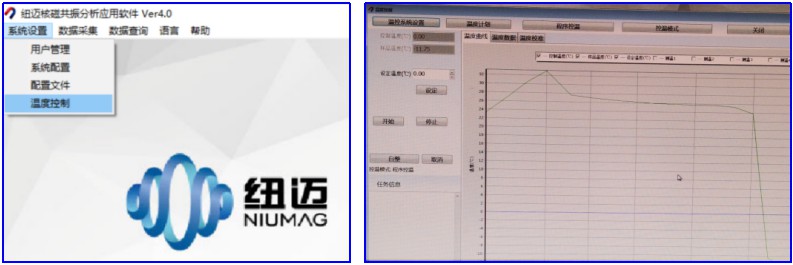
The in-situ variable-temperature LF-NMR system is based on a conventional LF-NMR instrument, enhanced with a variable-temperature probe, temperature control hardware, and dedicated control software. A prototype of the system is shown below:

Low-field NMR technology offers rapid, accurate, non-destructive, and real-time sample analysis, providing multiple parameters from a single measurement. LF-NMR has been widely applied in food science research, particularly in food processing, drying, and storage. It plays a key role in improving food quality, optimising processing conditions, and extending shelf life.
With increasing living standards, consumers pay more attention to nutrition, taste, and safety. These characteristics are closely linked to food preservation and processing technologies, which are highly influenced by temperature variations.
Food samples are typically measured at various temperatures during processing. Conventional ambient-temperature or offline variable-temperature testing cannot reflect the true water status of food in situ and therefore cannot fully support optimisation of preservation or processing techniques. Real-time in-situ monitoring of samples during heating, drying, or freezing is essential for improving preservation methods and refining food processing protocols.
Study of food freezing processes (refrigeration, preservation, and quick-freezing research)
Rice cooking analysis (heating modes, texture evaluation)
Food drying processes
Glass transition temperature measurement
Determination of food ice points
Monitoring of food denaturation processes
Study of denaturation temperatures and time effects
If you are interested in any of these applications, please contact us at mobile/WeChat: 15618037925, Manager Chen
 Scan QR Code
 Scan QR Code
 Phone Support
Phone: 400-060-3233
After-sales: 400-060-3233
 WeChat Support

 Official Account

Back to Top