

Unsaturated soil is widely distributed in the shallow subsurface of the Earth and serves as a direct research object in many geotechnical engineering projects (e.g., slopes, subgrades, embankments) as well as agricultural and environmental fields. One of the key factors controlling its mechanical and hydraulic properties is matric suction—the pressure difference between the water phase and the gas phase in the soil. Matric suction directly influences the strength, deformation, and permeability characteristics of the soil, thereby determining the stability and safety of engineering structures.
The soil-water characteristic curve (SWCC) is a key relationship describing the connection between water content and matric suction, and it is essential for unsaturated soil theory and engineering applications. Since water content significantly affects the strength of unsaturated soils, experimental investigation of water distribution within the soil matrix is necessary. However, despite numerous studies on SWCC, few have explored the water distribution characteristics that underlie the SWCC. Specifically, under different matric suctions, water retained in pores of different radii contributes differently to the total suction. The composition of pore water, its distribution pattern, and the relative content of residual water remain unclear.
Based on low-field nuclear magnetic resonance (LF-NMR) technology, the pore water distribution characteristics of unsaturated soil under varying matric suctions can be explored. This helps to elucidate how water is drained from pores of different sizes as matric suction increases during the drying process, thereby revealing the dynamic changes in water distribution and drainage behavior. Such insights provide critical information and reference data for establishing unsaturated soil mechanics models based on pore water distribution.
Research Case: Characterization of pore water distribution in unsaturated soils during drying process with NMR and soil-water characteristic curves [1]:
Sample Information:
Expansive soil, kaolin, and calcium carbonate waste soil.
Sample Preparation:
Based on compaction test results and subgrade compaction considerations, the initial water contents of expansive soil, kaolin, and calcium carbonate waste soil specimens were set to 17.68%, 17.50%, and 8.00%, respectively; the corresponding dry densities were 1.40 g/cm³, 1.61 g/cm³, and 1.80 g/cm³. The specimens were prepared using PTFE cutting rings and compacted in five layers, forming cylinders with a diameter of 61.8 mm and a height of 20 mm.
Experimental Method:
Low-field nuclear magnetic resonance (LF-NMR) was used to detect residual pore water (instrument model: MacroMR12-110H-I). A one-dimensional stress-dependent soil-water characteristic curve (SWCC) pressure plate apparatus was used to apply matric suction.
Experimental Conclusions:
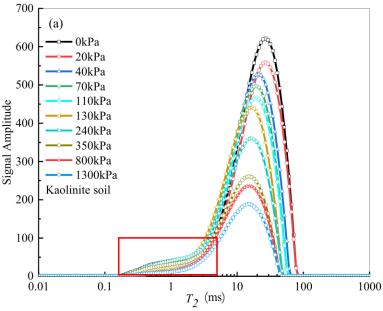
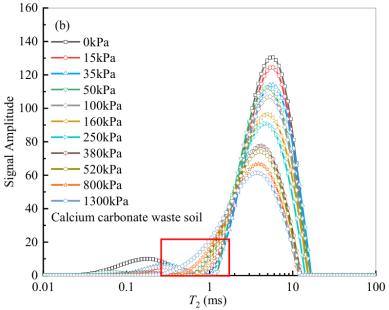
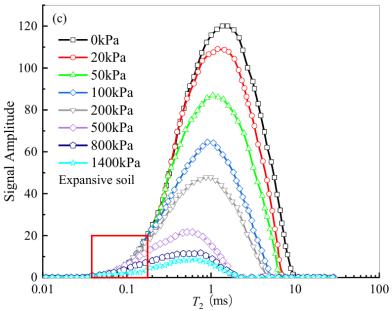
Figure 1 NMR T2 relaxation curves under different matric suctions
Overall trend and drainage behavior: For all soil types, as matric suction increases, the peak of the T2 curve gradually decreases, and the T2 value at the peak shifts to the left (i.e., decreases). This indicates that the water content in the soil decreases and that water is drained from larger pores. The minimum T2 value remains relatively constant, suggesting that the pore structure associated with bound water remains relatively stable during drying.
Curve shape and pore structure: The T2 curves of the three soils are roughly unimodal, indicating a relatively simple pore structure, which helps to distinguish different types of water in the soil.
Integrated area variation: As matric suction increases, the integrated area under the T2 curve gradually decreases, directly corresponding to the reduction in soil water content. For kaolin, the integrated area decreases most rapidly in the suction range of 0–130 kPa; for calcium carbonate waste soil, in the range of 0–380 kPa; for expansive soil, in the range of 0–50 kPa.
Differences among soils: The characteristics of the T2 curve changes vary among different soils, mainly due to differences in particle size distribution, initial water content, dry density, and mineral composition, which lead to diverse pore structures. For example, the T2 values of expansive soil are mainly distributed between 0.04 and 10 ms, while the distribution for kaolin is broader, ranging from 0.1 to 85 ms.
From the relaxation curves, the pore size distribution and the water component distribution under different matric suctions can be further delineated during the dehydration process (using the kaolin specimen as an example).
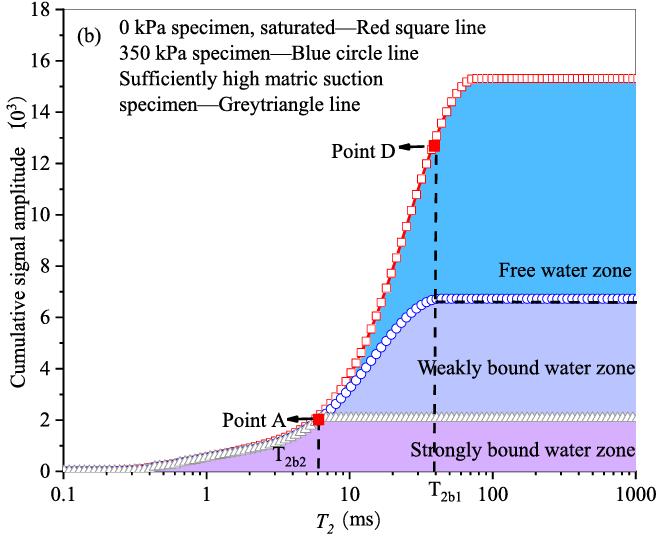
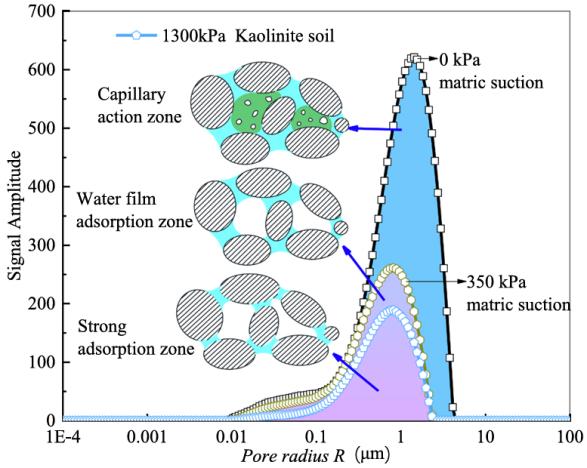
Figure 2 Classification of water forms in the kaolin soil sample
①Free water: The figure compares the two cumulative curves under saturated conditions (0 kPa suction) and at a critical matric suction (e.g., 350 kPa for kaolin). The area between the two curves represents the water drained during the increase of suction from 0 kPa to the critical value; this portion is defined as free water.
②Strongly bound water: The curves under all different suctions converge at a constant point. The area below this point (i.e., below the corresponding T2 value) is water that is not drained and is defined as strongly bound water.
③Weakly bound water: The region between the free water zone and the strongly bound water zone corresponds to weakly bound water. This portion of water continues to be slowly drained after the suction exceeds the critical value.
Low-field nuclear magnetic resonance (LF-NMR) technology can non-destructively and continuously detect the pore water distribution in unsaturated soil under varying matric suctions. It provides a key experimental tool for the quantitative analysis of the dynamic changes between free water and bound water, and strongly supports the study of micro-scale dynamic flow behavior.
Recommended Equipment:
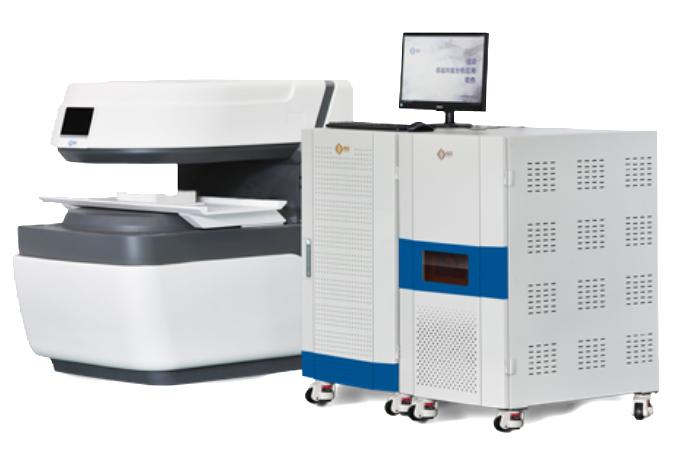
Large-Size Nuclear Magnetic Resonance Imaging Analyzer
Reference:
[1] Lyu H, Fan L, Gu J, et al. Characterization of pore water distribution in unsaturated soils during drying process with NMR and soil-water characteristic curves[J]. Transportation Geotechnics, 2024, 49(000).
 Scan QR Code
 Scan QR Code
 Phone Support
Phone: 400-060-3233
After-sales: 400-060-3233
 WeChat Support

 Official Account

Back to Top