


Gel molecular mobility refers to the speed or rate at which molecules move within the gel. This speed or rate is influenced by multiple factors, including the physical properties of the molecules (such as size, configuration, and charge), the gel’s concentration, electric field strength, buffer composition, and temperature. Nanostructures refer to the organization and structure of materials at the nanoscale (1-100 nanometers). Nanostructures significantly impact the physical, chemical, and mechanical properties of materials. In gel electrophoresis, nanostructures may influence the pore size, shape, and distribution of the gel, thus affecting the molecular mobility within the gel.
There is a close relationship between gel molecular mobility and nanostructures. Nanostructures affect the gel’s physical properties, such as pore size, shape, and distribution, which in turn influence the molecular mobility within the gel.
Low-field nuclear magnetic resonance (LF-NMR) plays an important role in analyzing gel molecular mobility and changes in nanostructures. For instance, low-field 1H nuclear magnetic resonance is a powerful tool that monitors the movement of hydrogen atoms through spin-spin relaxation time (T2). It helps us understand the changes in the nanostructure of ionic gels.

The team from Donghua University, led by Peiyi Wu and Shengtong Sun, used Newmai’s LF-NMR fluorospectrometry, SAXS, infrared, molecular simulation, and other characterization methods to analyze the mechanism behind the drastic enhancement of ionic conductivity in ionic liquid crystal elastomer fibers. The study found that the increase in ionic conductivity mainly occurs in the post-soft elasticity region (post-soft elasticity, strain > 200%). The rigid liquid crystal elements densely packed lead to poor compatibility between ionic liquids and the liquid crystal elastomer network, causing slight phase separation and forming highly ordered ionic nano-channels that are interconnected along the stretching direction. From Figure C below, we can see that NMR results confirm the presence of ionic liquids with weak binding effects in large voids within ionic channels for samples with strain > 200%. These ionic channels act like “swim lanes,” allowing ions (mainly PF6 anions) to pass through in the shortest time.
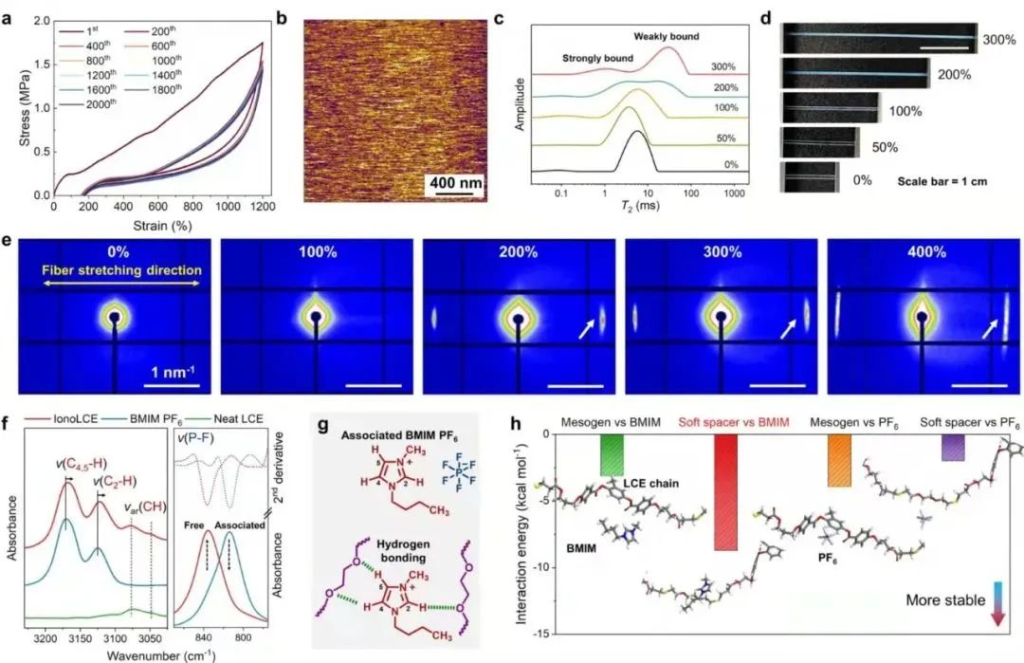
Figure 1: Structural Analysis of the Ionic Conductivity Enhancement Effect in Ionic Liquid Crystal Elastomer Fibers.
The research team has designed a type of highly mechanically tough ionic liquid crystal elastomer fibers (LonoLCE) through ionic conduction tortuosity modulation, achieving a thousand-fold increase in ionic conductivity with stretching. Stretchable ion conductors are important materials for simulating ion transport in elastic biological tissues. The development of “stretchable ionics” has gained widespread attention in fields such as artificial muscles, bionic membranes, soft robotics, and stretchable energy storage.
 Scan QR Code
 Scan QR Code
 Phone Support
Phone: 400-060-3233
After-sales: 400-060-3233
 WeChat Support

 Official Account

Back to Top