


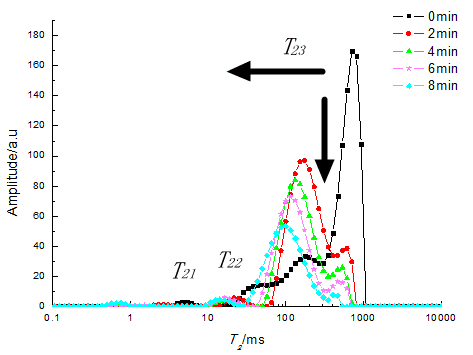
Figure 1.1 Changes in T2 Relaxation Properties of Button Mushrooms During Microwave Heating
The T21 peak corresponds to bound water tightly associated with biological macromolecules via hydrogen bonding. T22 indicates water within the cell walls (immobile water), and T23 represents intracellular and intercellular water (free water).
As shown in Figure 1.1, the amplitude of the free water peak decreases continuously as microwave heating time increases. This is due to the progressive removal of free water from the mushroom. Additionally, compared to fresh samples, microwave-treated samples show noticeable water migration. Some free water shifts leftward on the T2 spectrum due to reduced mobility caused by tissue shrinkage, while other free water migrates from inside the cell to the exterior, becoming surface-bound moisture.

Figure 1.2 Proton Density-Weighted Imaging of Button Mushrooms During Microwave Heating
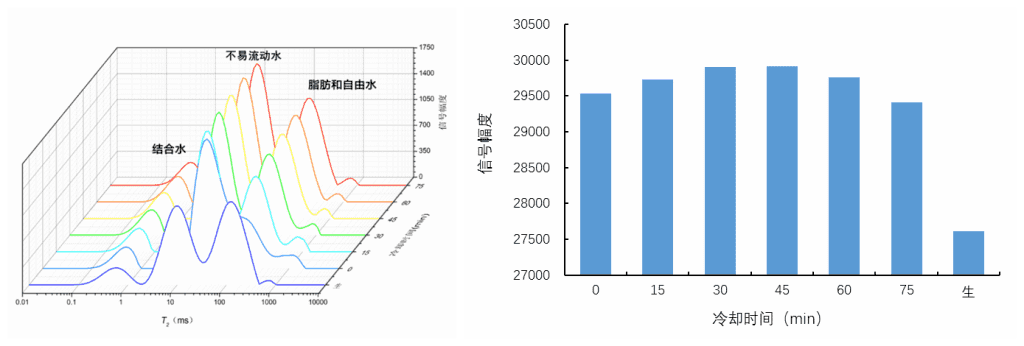
Figure 2.1 T2 Relaxation Profiles of Vegetable Buns Under Different Cooling Durations
Figures 2.1 and 2.2 indicate that during steaming, the vegetable buns absorbed moisture from the environment. This led to a migration of water from free to immobile states. With the help of MRI, spatial changes in moisture and fat during post-steaming freezing were visualized in a clear and intuitive manner.
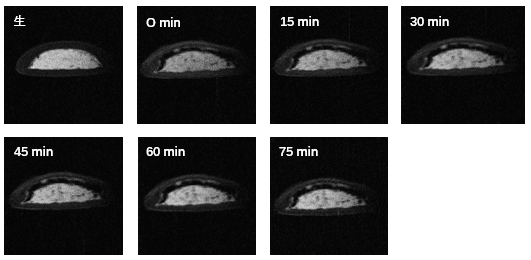
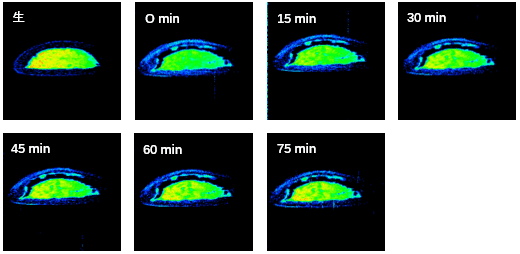
Figure 2.2 Sagittal Proton Density Images of Vegetable Buns at Different Cooling Durations
Recommended Instruments:
NMR Imaging Analyzer NMI20-040V-I
NMR Imaging Analyzer NMI20-040H-I
NMR Imaging Analyzer NMI20-060H-I
NMR Imaging Analyzer NMI20-060V-I
 Scan QR Code
 Scan QR Code
 Phone Support
Phone: 400-060-3233
After-sales: 400-060-3233
 WeChat Support

 Official Account

Back to Top