


In many foods, water and oil coexist in complex systems. Their respective contents and distributions directly affect eating quality and shelf stability. In recent years, the rising incidence of obesity and cardiovascular diseases has prompted increased research into reducing fat content and controlling oil intake in food. These trends highlight the critical importance of accurately measuring oil and water in complex food matrices.
However, conventional techniques—such as Soxhlet extraction for oil and oven drying for water—are time-consuming, unstable, and easily disrupted, making them unsuitable for modern needs.
Given LF-NMR’s high sensitivity to hydrogen nuclei in small molecules (e.g., water and oil), this study introduces a new, high-efficiency method using low-field NMR for simultaneous determination of water and oil in model starch-based fried food. The method is also explored for analyzing how frying parameters influence water and oil content.
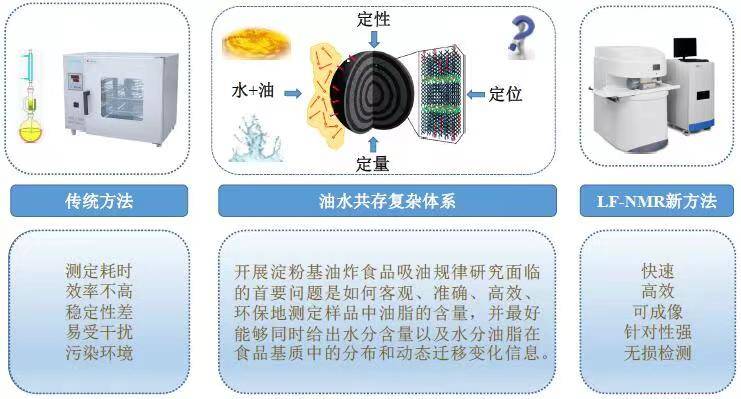
Figure 1. Comparison of water–oil analysis methods in complex coexisting systems
LF-NMR analysis revealed two main peaks in the model starch-based fried system: one for oil and one for bound water. The bound water signal was further separated into weakly bound water (removable at 105°C) and strongly bound water (which remained in the sample).
To better distinguish signals, manganese ions were added to reduce the relaxation of free water, allowing its signal peak to align more closely with the bound water signal (Figure 2).
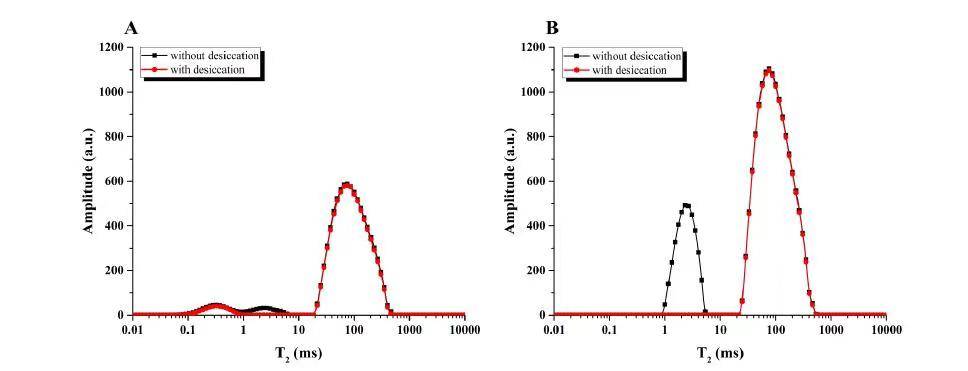
Figure 2. CPMG transverse relaxation spectra of starch-based fried model system.
(A) 20% moisture content; (B) 50% moisture content
Using LF-NMR, a series of oil and water standard samples were analyzed, and the corresponding relaxation peak areas were plotted against known sample masses to create calibration curves (Figure 3). The R² values for these curves were all greater than 0.99, confirming that LF-NMR can effectively quantify water and oil content in fried foods.
Compared with traditional methods (Figure 3E and 3F), LF-NMR achieved excellent consistency, demonstrating its practical utility.
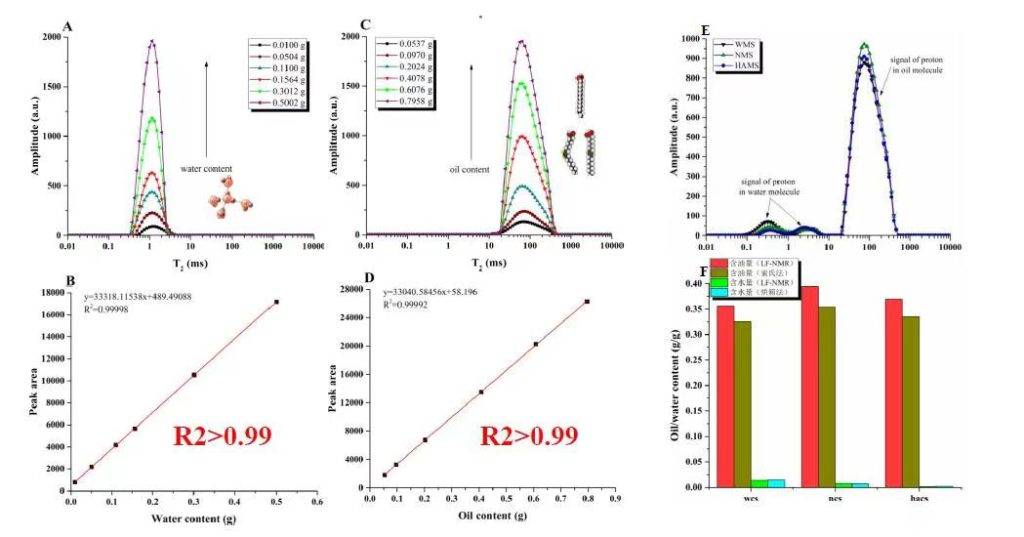
Figure 3. Transverse relaxation spectra and calibration curves for oil and water standards
(A) Water sample spectra; (B) Water calibration curve;
(C) Oil sample spectra; (D) Oil calibration curve;
(E) Spectra of fried model samples; (F) Water and oil content analysis of fried samples
LF-NMR was also used to investigate the influence of frying parameters on water and oil content.
Initial moisture content had a significant impact on oil absorption during frying. For regular corn starch, oil uptake at 30% moisture was nearly double that at 10%. This is attributed to enhanced swelling and disruption of the crystalline double-helix structure, resulting in a looser matrix that facilitates oil penetration.
Frying temperature also affected oil absorption, though the relationship was complex and requires further study. Among tested conditions, oil uptake was lowest at 180°C for regular corn starch.
Interestingly, all three types of starch exhibited significantly reduced oil absorption with longer frying times. This may be due to swelling and rupture of oil-absorbing starch granules, causing previously absorbed oil to be released.
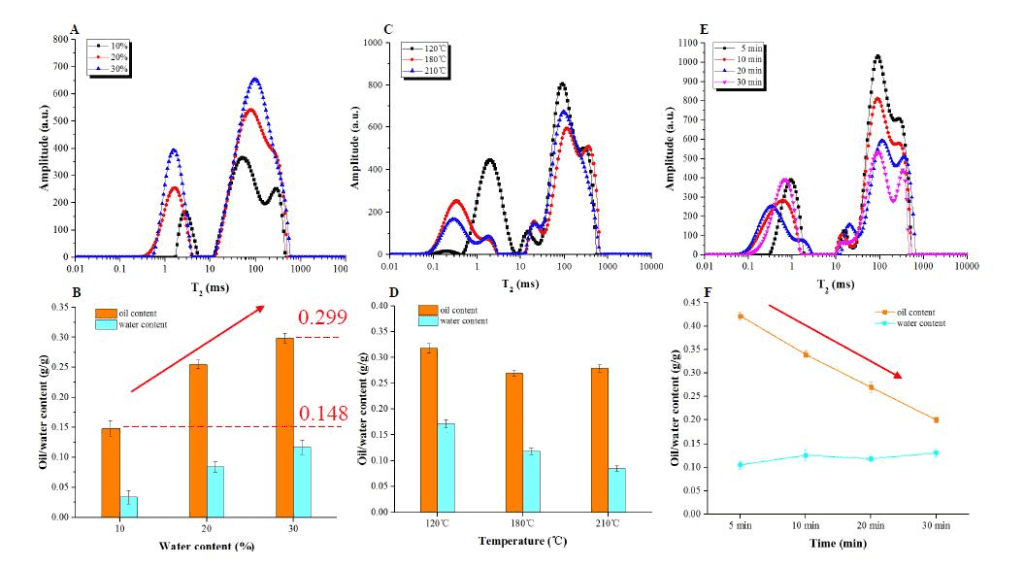
Figure 4. LF-NMR analysis of frying conditions on oil and water content
(A, B) Effect of initial moisture; (C, D) Effect of frying temperature; (E, F) Effect of frying time
LF-NMR enables simultaneous analysis of water and oil content in fried food systems.
By integrating oven-drying experiments, the study clearly identified oil and water signals in the transverse relaxation spectrum without overlap—paving the way for simultaneous LF-NMR quantification.
Compared to Soxhlet extraction, the oil content measured via LF-NMR was more accurate. The process is rapid, efficient, and requires no sample pretreatment.
Reference: Long Chen, Yaoqi Tian, Binghua Sun, Jinpeng Wang, Qunyi Tong, Zhengyu Jin*. Rapid, accurate, and simultaneous measurement of water and oil contents in the fried starchy system using low-field NMR. *Food Chemistry*, 2017, 233: 525–529. (SCI, IF = 4.529, Tier 1 Journal in Food Science)
Instrument used:
NMR Imaging Analyzer NMI20-060H-I
 Scan QR Code
 Scan QR Code
 Phone Support
Phone: 400-060-3233
After-sales: 400-060-3233
 WeChat Support

 Official Account

Back to Top