


In food processing, frequent moisture measurements of raw materials and final products are often required. To meet quality and process control timelines, moisture analysis methods must deliver reliable results quickly.
Among various techniques for determining moisture content, Nuclear Magnetic Resonance (NMR) offers distinct advantages. NMR has been applied to measure moisture in a wide range of materials including food, seeds, and wood. As pulse NMR becomes more widespread, a series of moisture detection methods based on it have also evolved.
Compared to traditional methods, NMR offers several key benefits:
1. Speed — rapid acquisition of results.
2. Non-destructive and non-invasive — preserving the integrity of the sample.
3. Minimal sample requirement.
4. Real-time data acquisition enables automation.
5. Ability to distinguish water content in different regions based on molecular mobility.
6. Simultaneous measurement of both moisture and oil content.
In food and biological materials, water migration or redistribution can occur during processing, storage, or transport. This is one of the main causes of reduced product stability and quality. On the other hand, understanding how much water has moved helps determine how to manage it — enabling improved process control. Studying the relationship between water migration and product stability also provides insight for predicting shelf life.
Most food and biological materials are non-homogeneous. Knowing only the average water content provides limited insight. Spatial moisture distribution is equally important. NMR can be used to investigate both internal moisture distribution and water migration behavior.
NMR Analysis of Moisture Migration During Rehydration of Sea Cucumber [1]
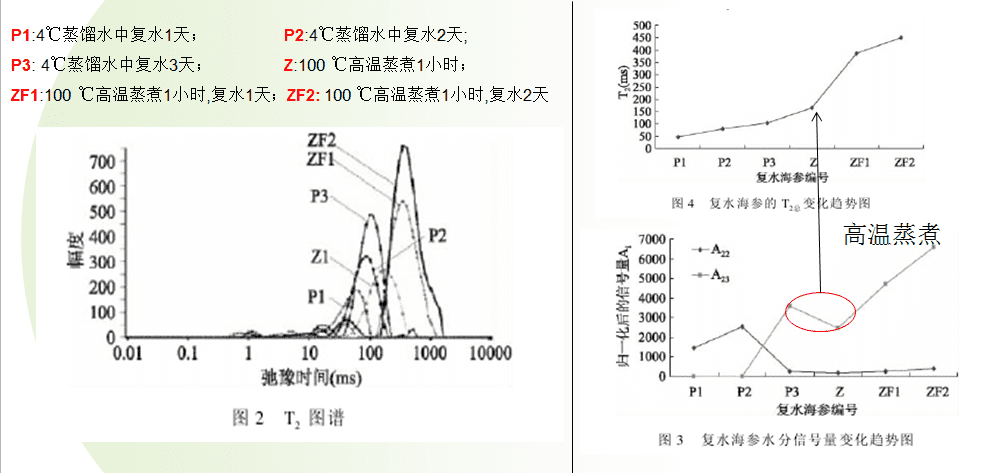
Conclusion: At a fixed temperature, as the rehydration time of sea cucumber increases (P1 to P3, ZF1 to ZF2), the free water content increases significantly. Correspondingly, the relaxation peak shifts to the right, indicating increased water mobility.
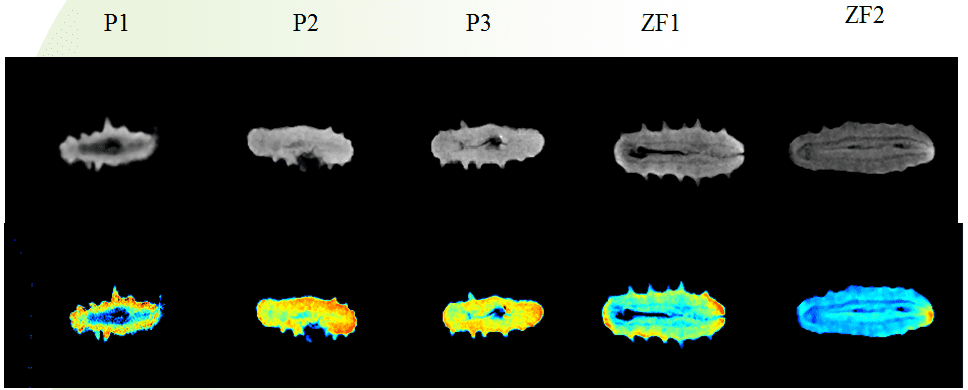
Conclusion: At a stable temperature, the free water content in sea cucumber continues to increase with longer rehydration time (P1 to P3, ZF1 to ZF2), and water mobility is enhanced. In T1-weighted images, signal intensity darkens progressively. Note that shorter T1 relaxation times produce brighter images (redder tones in pseudocolor images).
[1] Source: “Study on Moisture State Changes in Sea Cucumber During Rehydration Using Low-Field NMR and Imaging Technology”
 Scan QR Code
 Scan QR Code
 Phone Support
Phone: 400-060-3233
After-sales: 400-060-3233
 WeChat Support

 Official Account

Back to Top