


Nuclear Magnetic Resonance (NMR) is an emerging technology in the food industry that enables microscopic-level analysis of moisture distribution and migration in food matrices. T2 inversion spectra indirectly reflect the binding states, relative content, and migration behavior of water in the system.
The following case illustrates the application of NMR in studying how enzyme preparations influence water distribution in frozen-thawed, unleavened dough.
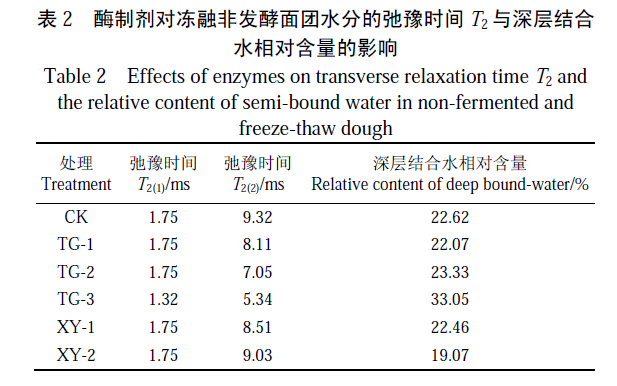
In the figure below, two peaks are observed: – Peak 1 corresponds to tightly bound water, which is closely associated with the internal structures of proteins and starch. – Peak 2 represents semi-bound water, located between protein and starch molecules.
T2(1) and T2(2) represent the relaxation times of peaks 1 and 2, respectively. The T2 value indicates the degree of water mobility — the smaller the value, the more tightly water is bound, resulting in better water-holding capacity of the dough.
The intensity of the proton signal is directly proportional to the number of hydrogen protons, and thus also correlates with the integral area under each peak. Therefore, changes in peak 1 area reflect variations in tightly bound water. The relative content of tightly bound water is calculated as:
Relative Tightly Bound Water (%) = Area of Peak 1 / (Area of Peak 1 + Area of Peak 2)
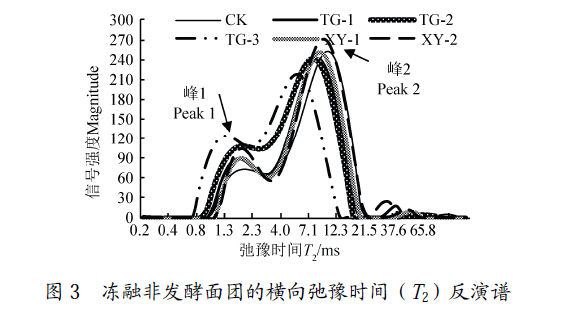
Effect of Enzyme Preparations on T2 Relaxation Time and Relative Tightly Bound Water Content in Frozen-Thawed Unleavened Dough
Reference: “Effects of Two Enzyme Preparations on the Quality of Unleavened Dough After Freeze–Thaw Cycles” Transactions of the Chinese Society of Agricultural Engineering, Vol. 31, No. 6, March 2015
 Scan QR Code
 Scan QR Code
 Phone Support
Phone: 400-060-3233
After-sales: 400-060-3233
 WeChat Support

 Official Account

Back to Top