

Gelatinized starch is thermally unstable, prone to molecular rearrangement and retrogradation, which negatively impacts the quality and shelf life of starch-based foods and leads to unnecessary food waste.
Certain hydrophilic colloids can effectively inhibit or delay starch retrogradation. However, the underlying molecular mechanisms—especially those involving interactions between macromolecules and water molecules—remain unclear.
This study uses low-field nuclear magnetic resonance (LF-NMR) technology to investigate the mechanism by which a specific hydrophilic colloid—pullulan (PUL)—affects the cold storage stability of rice starch gels. The research innovatively explores the inhibitory effect of PUL on starch retrogradation from the perspective of molecular interactions among starch, pullulan, and water.
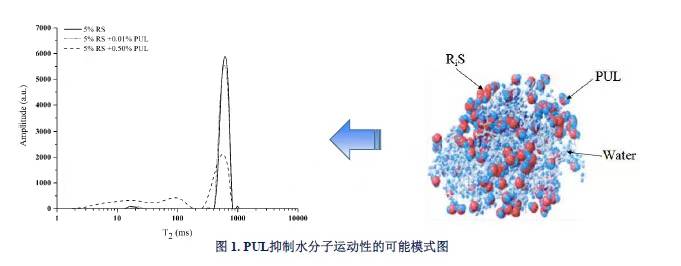
PUL significantly reduced the mobility of water molecules in the rice starch paste system.
PUL can form a coating around starch granules, preventing complete gelatinization.
Additionally, PUL may interact with leached amylose to form a unique starch–hydrocolloid gel network, which restricts the free movement of water molecules (see Figure 1).
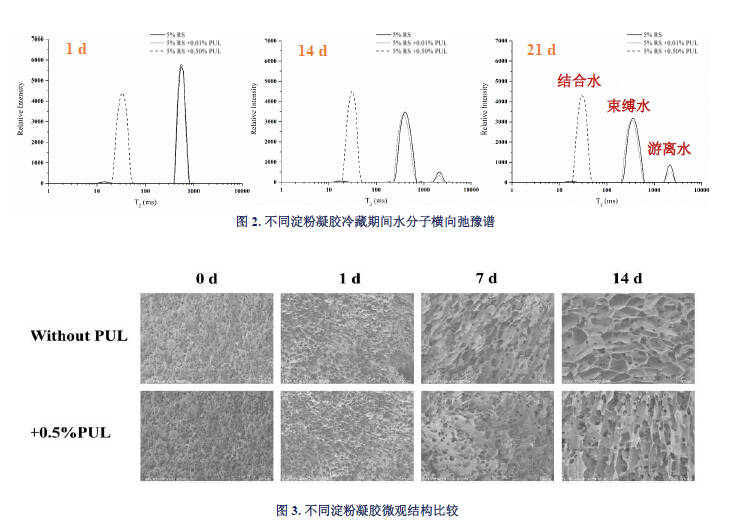
As shown in Figure 2, after one day of cold storage, only physically bound water remained in the gel samples.
In samples containing 0.5% PUL, the transverse relaxation time of water molecules was significantly shorter than that in the control group, indicating the presence of more strongly bound water.
After 14 days, free water appeared in the control group and increased significantly by day 21. In contrast, no free water was observed in the 0.5% PUL samples throughout the entire cold storage period.
SEM micrographs (Figure 3) show that the 0.5% PUL samples maintained a well-structured gel network throughout storage, whereas the control samples showed progressive structural degradation over time.
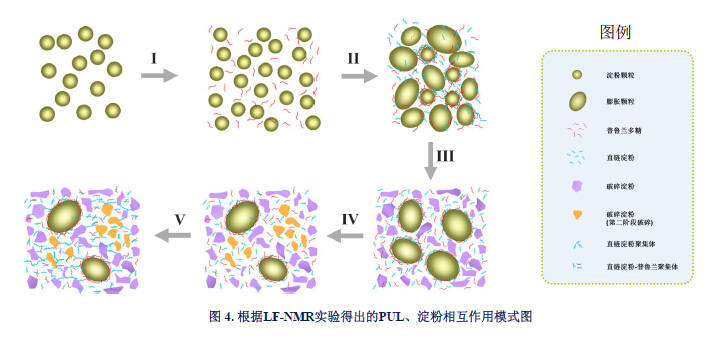
PUL competes with starch for available water molecules and entangles with starch chains, increasing steric hindrance and reducing the mobility of starch molecules. These effects help preserve the gel structure and inhibit molecular rearrangement.
The mechanism by which PUL acts in starch systems is illustrated in Figure 4.
PUL suppresses full expansion of starch granules during gelatinization by coating their surfaces and interacting with leached amylose chains.
This inhibited gelatinization reduces gel instability during storage. PUL’s strong hydrophilicity retains water within the gel matrix. Its linear chains penetrate between starch chains, increasing rigidity and limiting hydrogen bond-induced molecular reorganization.
These combined mechanisms explain how PUL stabilizes the starch gel structure and prevents retrogradation.
PUL inhibits complete starch gelatinization and reduces the transverse relaxation time of water in starch gel systems.
PUL effectively suppresses retrogradation and prevents free water release during refrigerated storage.
The addition of PUL helps maintain the integrity of the starch gel network, enhancing water retention and cold storage stability.
From the Niumag Excellence Case Collection Competition. Research by Long Chen, State Key Laboratory of Food Science and Technology, Jiangnan University. Utilizing NMR technology to investigate the effects of pullulan on cold storage stability of starch gels.
Source:
Long Chen, Yaoqi Tian, Qunyi Tong, Zipei Zhang, Zhengyu Jin*. Effect of pullulan on the water distribution, microstructure, and textural properties of rice starch gels during cold storage. Food Chemistry, 2017, 214: 702–709 (SCI, IF = 4.529, Top-tier journal in food science).
Recommended Instruments:
NMR Imaging Analyzer NMI20-025V-I
NMR Imaging Analyzer NMI20-060H-I
Related Link:
Applications of Low-Field NMR in Food Science
 Scan QR Code
 Scan QR Code
 Phone Support
Phone: 400-060-3233
After-sales: 400-060-3233
 WeChat Support

 Official Account

Back to Top