


Low-field nuclear magnetic resonance (LF-NMR) is a rapid, accurate, and non-destructive method that can be applied to measure the moisture content of tea leaves.
Moisture content is a critical factor affecting tea quality. Across the various stages of tea processing—whether intermediate or finished products—precise control of moisture is essential. Therefore, fast and accurate determination of moisture content is of great importance for tea production.

The current national standard methods for measuring tea moisture are oven-drying approaches: the 103 °C constant-weight method (arbitration method) and the 120 °C drying method (rapid method). Both provide high stability, low error, and strong accuracy. However, they are time-consuming, taking several hours, and thus cannot meet the need for rapid measurement.
Thanks to its affordability and speed, LF-NMR is increasingly being adopted in the food industry for non-destructive testing. Among all nuclei, hydrogen is most commonly measured in NMR due to its natural abundance and strong signal, making it easy to detect. Since water is present in all foods and is central to many chemical changes, moisture is a key indicator of food quality. Therefore, NMR is a feasible approach for measuring moisture content in tea and other foods.
In LF-NMR moisture measurement, the FID signal amplitude is directly proportional to the density of hydrogen protons in H2O. Using water of known mass as a calibration standard, the FID signal amplitude is measured and fitted to produce a calibration curve. Under the same conditions, the FID signal of tea samples of known mass is measured and matched against the calibration curve to calculate their moisture content. Results can then be compared with those obtained from the 103 °C constant-weight method, evaluating the accuracy and stability of LF-NMR in tea moisture determination.
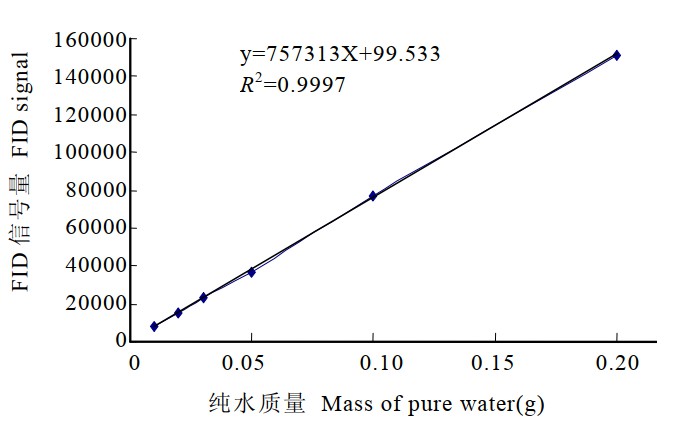
Compared with the 103 °C constant-weight method, LF-NMR is simpler and more convenient. Once calibration is established, measuring tea moisture requires only weighing a fixed amount of tea and placing it into the NMR analyser. Within one or two minutes, accurate results can be obtained, offering clear advantages in speed and practicality.
[Reference: Li Ran, Chen Shanshan, Yu Jie, et al. Determination of tea moisture content using LF-NMR technology. Journal of Tea Science, 2010, 30(006):38-42.]
 Scan QR Code
 Scan QR Code
 Phone Support
Phone: 400-060-3233
After-sales: 400-060-3233
 WeChat Support

 Official Account

Back to Top