


Every year, a large amount of waste sludge is generated. If not properly disposed of, it can cause ecological pollution and safety risks. Solidifying sludge for use as fill material in subgrades, embankments, and similar applications is a widely recognized and effective approach. However, due to its high water content, conventional solidified sludge (SS) is difficult to compact directly. In practical engineering, sludge is first mixed with a solidifying agent and cured to form SS, which is then excavated, crushed, transported, placed in layers, and compacted, ultimately producing recombined solidified sludge (RSS).
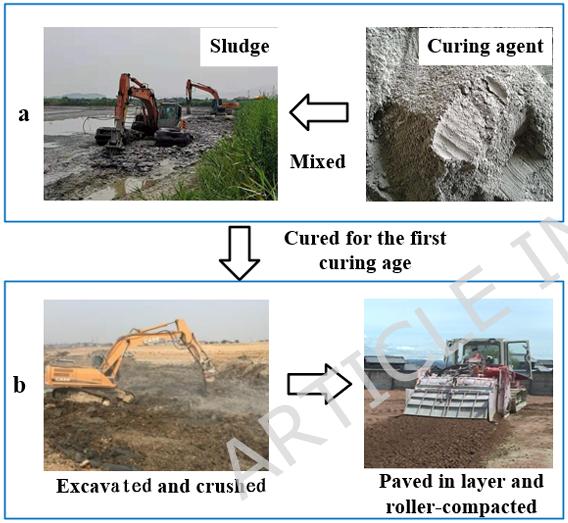
The crushing and compaction processes inevitably damage the original structural bonding of SS and lead to particle recombination. Consequently, the mechanical behavior of RSS differs fundamentally from that of uncrushed SS. In the laboratory, strength indices are usually measured on uncrushed SS specimens, which may lead to an underestimation of the strength requirements for RSS in actual engineering, posing a risk of failure. Existing studies have limited systematic investigation of the synergistic changes in the microstructural characteristics of RSS at different recombination times, and there is a lack of reliable strength prediction models to guide engineering applications.
Low‑field nuclear magnetic resonance (LF‑NMR) is an in‑situ, online, and non‑destructive testing technique. Through continuous measurements and relaxation analysis as a microstructural characterization tool, it can reveal the pore structure evolution of solidified waste sludge–cement mixtures, analyze pore size distribution curves, and quantify various pore types. When combined with macroscopic mechanical testing, it can further investigate the synergistic relationship between macroscopic strength development and micropore structure evolution after particle recombination, providing mechanistic insights to guide practical engineering applications.
Research Case
Effect of particle recombination on mechanical property and microstructure of solidified waste sludge [1]:
01 Sample Information
①Sludge sample: Obtained from an excavation project in Ningbo, China.
②Solidifying agent: Ordinary Portland cement.
02 Sample Preparation
①Conventional solidified sludge (SS):
The sludge was air‑dried, crushed, and sieved (<2 mm). After adjusting to the initial water content, it was mixed with cement. The mixture was immediately poured into 70.7 mm cubic molds and steel cutting rings (diameter 61.8 mm, height 20 mm) for molding. The specimens were wrapped with plastic film and cured in a standard curing room (22 °C, 90% humidity). After 48 hours, they were demolded and continued to cure until the design age T.
②Recombined solidified sludge (RSS):
To simulate on‑site placement construction, the mixture was first placed in 40 × 30 × 22 cm boxes and sealed for curing until the designated recombination time t₁. At time t₁, the mixture was taken out, crushed, and sieved to less than 5 mm. The crushed material was then compacted in three layers into 70.7 mm cubic molds, with the compaction energy controlled between 2677.2 and 2687.0 kJ/m³. After demolding, the specimens continued to cure until the design time T. LF‑NMR test specimens were 60 mm × 100 mm cylinders cut from the center of the cubic specimens.
03 Experimental Design
The experiment mainly investigated three variables: cement content, curing age (T), and recombination time (t₁).
Cement content: 3%, 5%, 7%, 9%.
Curing age (T): 1, 3, 7, 14, 28, 60 days.
Recombination time (t₁): For SS specimens, t₁ = 0; for RSS specimens, t₁ was set to 1, 3, 7, and 14 days.
A MicroMR20‑025V low‑field nuclear magnetic resonance (LF‑NMR) analyzer was used to characterize pore structure evolution and pore size distribution. Before testing, representative samples were vacuum‑saturated in water for 24 hours, then transferred to glass vials and placed in the NMR instrument for relaxation measurements.
04 Experimental Conclusions
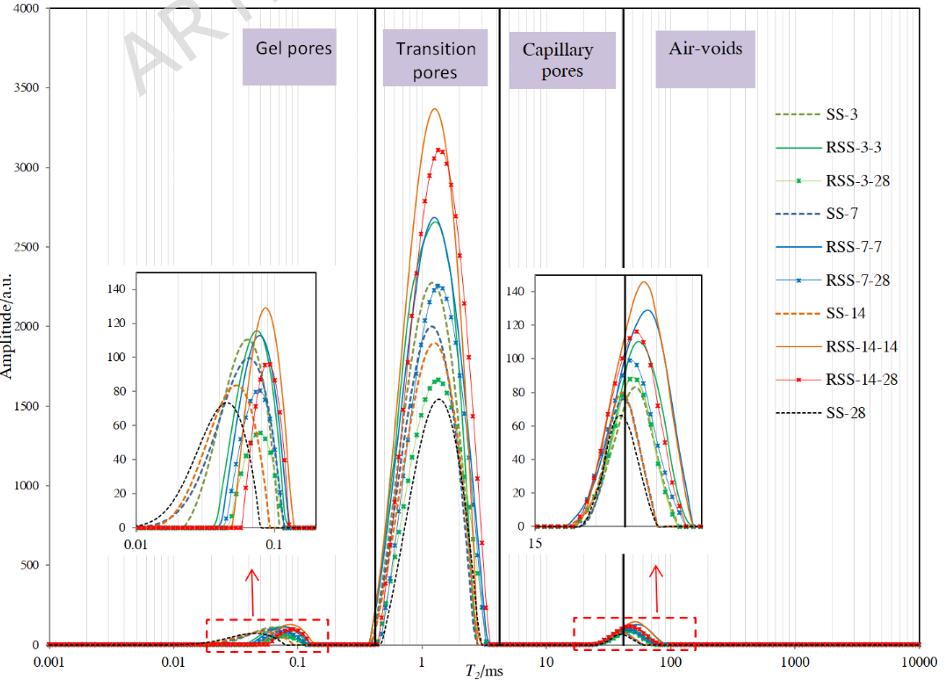
Figure: Relaxation distribution curves of sludge‑cement mixtures at different recombination times and curing ages (cement content = 7%).
The figure shows the relaxation distribution curves of RSS specimens under different recombination times and curing ages. Based on the relaxation analysis, the following conclusions were drawn:
①Pore evolution of SS specimens:
For SS specimens, the peak intensities and integrated areas of all three relaxation intervals decreased with increasing curing age. The relaxation distribution curves of the left and right intervals shifted to the left over time, while the middle interval showed little change. The integrated area represents pore volume, and a left shift of the curve indicates a decrease in pore size. This phenomenon demonstrates that, with prolonged curing time, the pore size and volume of SS continuously decrease due to the filling effect of hydration products.
②Pore evolution of RSS specimens:
Variation with recombination time t₁: For RSS specimens (at T = t₁), the peak intensities and integrated areas of all three intervals increased with longer t₁. The relaxation distribution curves of the left and right intervals shifted to the right as t₁ increased, while the relaxation time corresponding to the peak of the middle interval remained essentially unchanged. This indicates that pore size and volume increase with longer t₁.
Variation with secondary curing age: When T reached 28 days, the peak intensities and integrated areas of RSS specimens decreased compared to those at T = t₁, and the decrease was larger for smaller t₁. The relaxation distribution curves shifted leftward with curing time, indicating that pore size and volume decreased due to the secondary filling effect of hydration products.
05 Summary
Low‑field nuclear magnetic resonance (LF‑NMR), through in‑situ, online microstructural characterization, revealed the evolution of micropore structures in recombined solidified waste sludge‑cement mixtures. It elucidated the mechanism by which particle recombination damages the original cemented microstructure, leading to a reduction in gel pores and an increase in macropores, thereby significantly reducing cohesion and strength. The results confirmed that a shorter recombination time corresponds to a higher degree of microstructural and pore distribution optimization as well as higher strength, providing a basis for determining the optimal recombination time in engineering practice.
Recommended Equipment
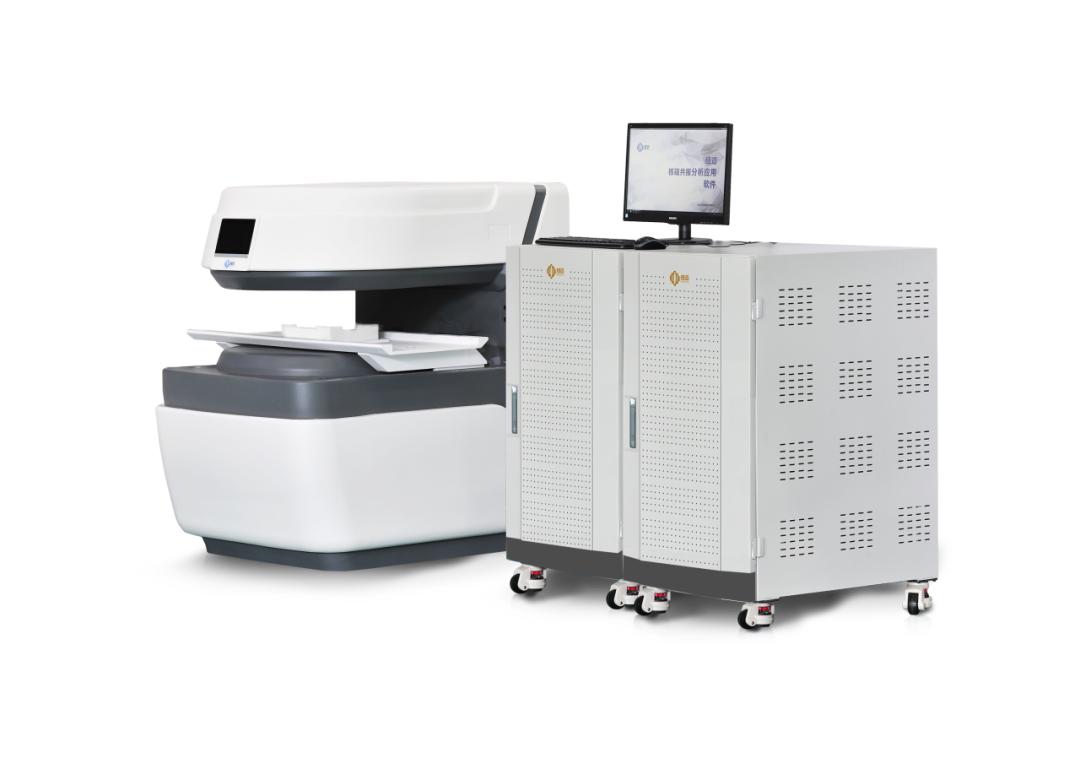
Large Size Nuclear Magnetic Resonance Imaging Analyzer
Reference
[1] Cheng X, Chen Y, Chen H. et al. Effect of particle recombination on mechanical property and microstructure of solidified waste sludge. Sci Rep (2026).
 Scan QR Code
 Scan QR Code
 Phone Support
Phone: 400-060-3233
After-sales: 400-060-3233
 WeChat Support

 Official Account

Back to Top