


Preface
As an important unconventional resource, tight gas is critical for future oil and gas production growth, especially in the context of achieving carbon neutrality goals. However, such reservoirs typically exhibit poor physical properties, strong heterogeneity, complex pore structures, and limited connectivity, presenting significant development challenges.
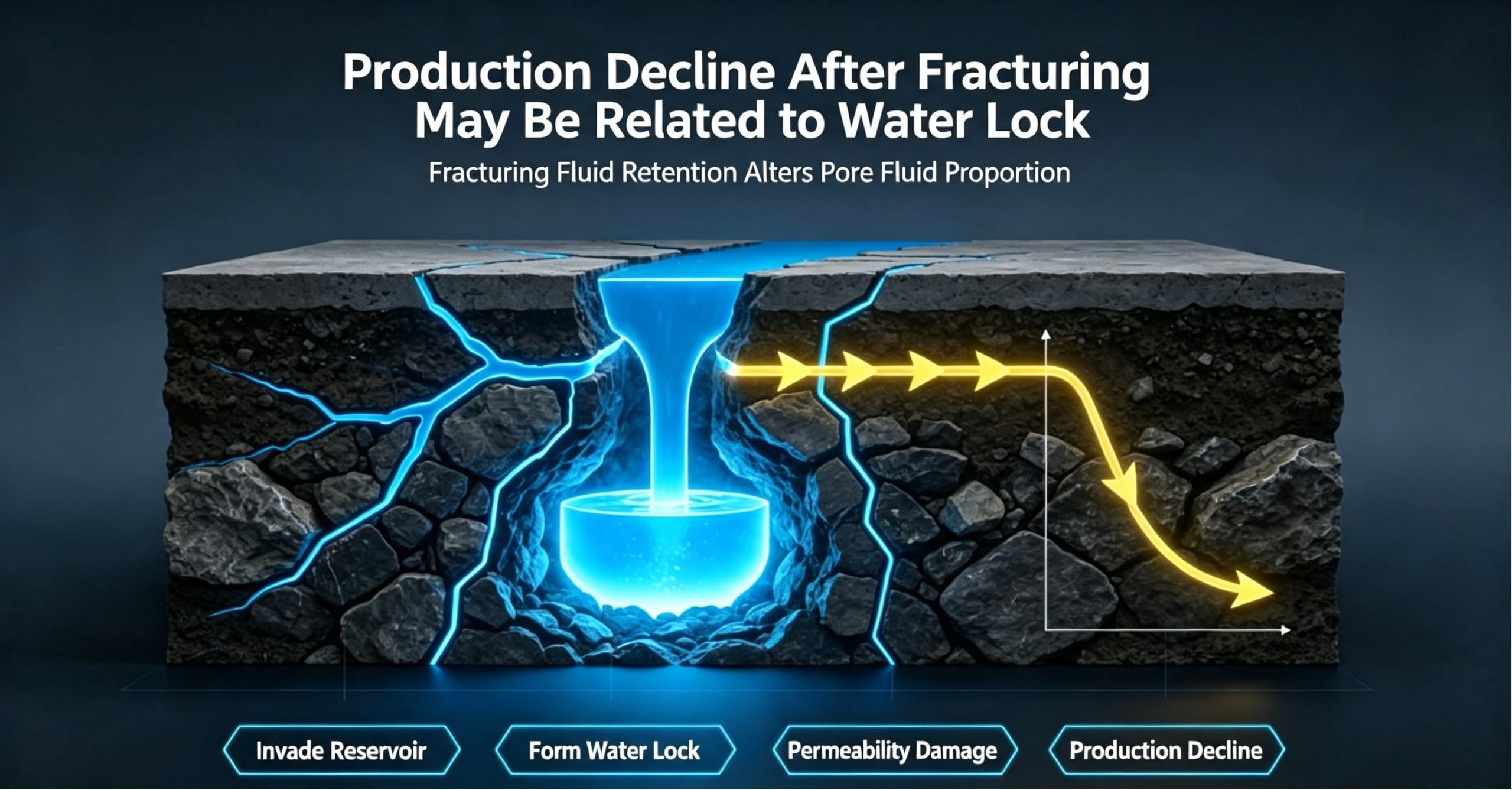
Although hydraulic fracturing has proven effective for developing tight gas reservoirs, fracturing fluid invasion into the reservoir matrix can cause permeability damage. One of the most common forms is water blocking damage. The retention of fracturing fluid in pores creates water blocks, altering the ratio of bound fluid to free fluid and reducing fluid mobility, which severely impairs productivity. Timely and effective flowback is essential to mitigate such damage.
Existing studies have limitations in characterizing fracturing fluid damage. For example, scanning electron microscopy (SEM) lacks systematic investigation of pore structure evolution, while CT technology is constrained by resolution and sample requirements, making it difficult to capture subtle changes. Most NMR studies rely on one-dimensional T₂ spectra, which can only roughly distinguish “free fluid” from “bound fluid,” with overlapping signals leading to significant errors in evaluating water blocking damage. Furthermore, most experiments lack dynamic data under different flowback pressure differentials, making it difficult to reveal the continuous process of increasing pressure difference driving fluid displacement and mitigating water blocking damage.
To address these issues, this study combines one-dimensional NMR T₂ spectra with two-dimensional NMR T₁–T₂ spectra to develop a multi-scale pore-fluid characterization method. The aim is to precisely identify different hydrogen-bearing substances, quantify the degree of water blocking damage at different pore scales, and reveal the dynamic regulation mechanism, thereby providing a scientific basis for optimizing fracturing flowback.
Research Case: Characteristics of fracturing fluid water blocking damage in tight gas reservoirs based on two-dimensional NMR T₁–T₂ [1]
Rock samples: Three sandstone cores, with pore types mainly intergranular and dissolution pores; clay minerals mainly kaolinite and illite.
Simulated formation water: CaCl₂ type, salinity 27,200 mg/L.
Fracturing fluid system: Guar gum-based fracturing fluid, pH range 7–10.
Low-field NMR: PQ001 (Suzhou Niumag Analytical Instrument Corporation)
①Dry the cores in an oven for 24 hours, then vacuum-saturate with formation water for 24 hours and measure porosity.
②Inject N₂ at 0.5 MPa until no liquid is produced at the outlet, establishing the initial gas-water distribution state.
③At simulated formation temperature (80 °C), inject fracturing fluid in reverse at 0.05 mL/min until 10 pore volumes are injected, then close the inlet and outlet and soak for 12 hours.
④Set the N₂ flowback pressure differential to 2 MPa and continue gas injection until no liquid is produced at the outlet, then perform NMR testing.
⑤Change the core type and flowback pressure differential (4, 6, 8 MPa) and repeat steps 1–4.
⑥Use NMR T₂ and T₁–T₂ spectra to determine fluid distribution and quantify the degree of water blocking damage, analyze damage characteristics, and reveal the mechanism.
The analysis focuses on the characterization of fracturing fluid water blocking damage using one-dimensional NMR T₂ spectra and two-dimensional NMR T₁–T₂ spectra, systematically examining pore scale fluid occurrence and water blocking mechanisms.
4.1 By integrating high-pressure mercury intrusion and NMR T₂ spectra, the conversion coefficients for the three types of reservoir cores were determined, and pores were classified into micropores (T₂ < 0.25 ms), mesopores (0.25 ms ≤ T₂ < 5.41 ms), and macropores (T₂ ≥ 5.41 ms).
4.2 The NMR T₂ spectra of all three core types show a bimodal distribution, with the left peak amplitude higher than the right, indicating that mesopores and micropores are the main retention spaces for fracturing fluid. As reservoir properties deteriorate from Type I to Type III, the amplitude difference between the left and right peaks becomes more pronounced.
As the flowback pressure differential increases, the NMR curves of the cores shift leftward and the amplitudes decrease, indicating a significant reduction in fracturing fluid retention in mesopores and macropores.
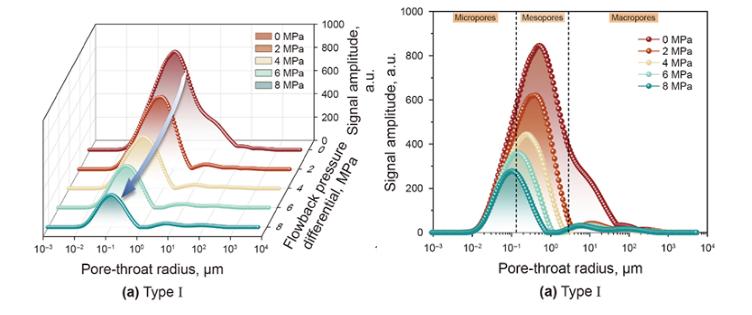
Fig. 1 NMR relaxation spectra of Core #1
4.3 Based on T₂ spectra of dry, water-saturated, and centrifuged states, the boundary values of hydrogen-bearing substances in the reservoir were determined. On the T₁–T₂ spectra, three regions were delineated: the strongly bound region (region i), the bound fluid region (region ii), and the free fluid region (region iii), establishing a distribution map of hydrogen-bearing substances.
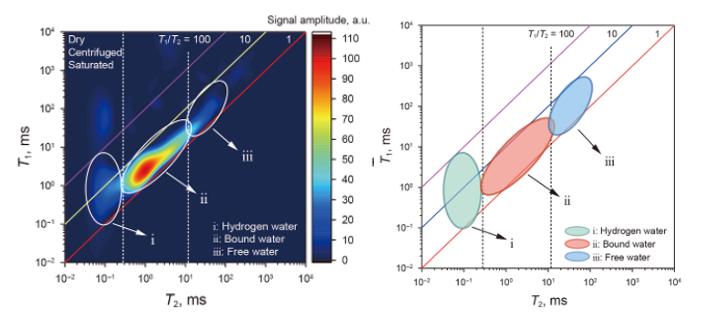
Fig. 2 T₁–T₂ distribution of hydrogen-bearing substances for Core #1
4.4 During flowback, the changes in T₁–T₂ spectral signals directly reflect fluid retention: at 2 MPa, the signal in region iii disappears, indicating that fracturing fluid in macropores is almost completely recovered; at 6 MPa, the signal in region ii shifts leftward, with fluid in mesopores and macropores markedly reduced; in the final stage, regions i and ii become the main retention areas, with strong water signals still present in micropores, indicating that strongly bound water is the primary cause of permanent water blocking in micropores.
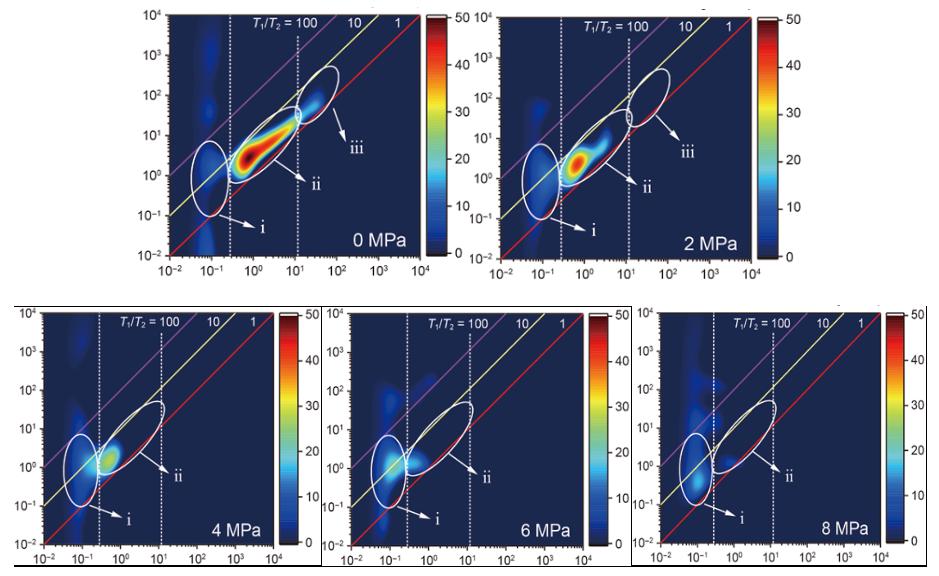
Fig. 3 Two-dimensional T₁–T₂ spectra of Core #1 under different pressures
4.5 Through statistical analysis of two-dimensional NMR signals, the water blocking damage at different pore scales for the three groups of samples was evaluated:
Macropores: Lowest degree of water blocking damage; significant decrease at 2 MPa, dropping to 13.44%, 25.86%, and 26.40% at 8 MPa, respectively.
Mesopores: Large initial retention; at 4 MPa, the water blocking degrees are 38.68%, 38.96%, and 36.37%, respectively. After flowback, the change in mesopores is most significant, with reductions of 83.33%, 80.01%, and 76.82%.
Micropores: Highest degree of water blocking damage, ultimately reaching 66.74%, 39.90%, and 47.14%, with reductions of only 31.83%, 60.05%, and 52.64%, indicating that micropores may suffer long-term or permanent water blocking damage.
Fracturing fluid retention in macropores is minimal, capillary forces are weak, connectivity is good, flowback is easy, and water blocking damage is low.
Mesopores are the primary region for fluid retention, but their capillary forces are weaker than those of micropores, making them recoverable by increasing flowback pressure differential.
In micropores, the fine pore throats, strong capillary forces, and the Jamin effect together make it difficult to displace fracturing fluid. In particular, water strongly bound to clay minerals is the core cause of permanent water blocking.
Overall, micropores and mesopores are the main retention zones for fracturing fluid. Increasing flowback pressure differential can effectively reduce water blocking damage in mesopores and macropores, but its effect on micropores is limited.
Two-dimensional NMR technology can effectively resolve overlapping hydrogen signals in one-dimensional T₂ spectra, enabling precise classification and identification of hydrogen-bearing substances. It allows intuitive observation of pore development and fluid retention, providing critical evidence for quantitative assessment of water blocking damage at different pore scales.
Recommended Equipment
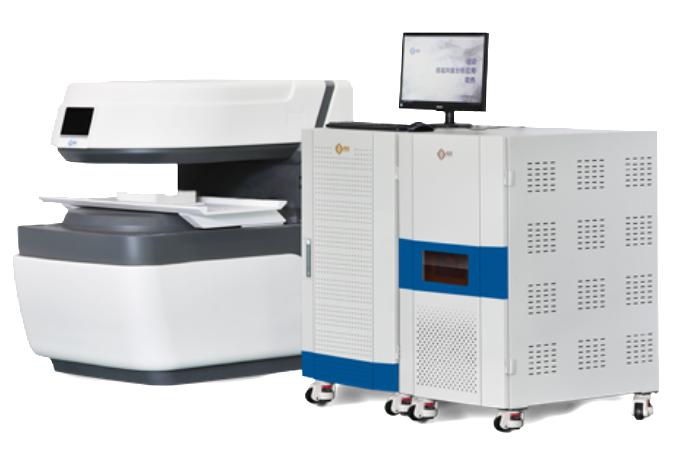
Large-bore Nuclear Magnetic Resonance Imaging Analyzer
Reference
[1] Xiao-Hang Li, Hui Gao, Yong-Gang Xie, et al. Characteristics of fracturing fluid water blocking damage in tight gas reservoirs based on two-dimensional NMR T₁–T₂. Petroleum Science, 23 (2026).
 Scan QR Code
 Scan QR Code
 Phone Support
Phone: 400-060-3233
After-sales: 400-060-3233
 WeChat Support

 Official Account

Back to Top