

01 Research Background
α-methylstyrene/styrene copolymer tackifying resin (commercial name Kristalex™ 5140, Mn = 1690 g/mol) is widely used in tire tread compounds to enhance the tackiness of unvulcanized rubber, improve filler dispersion, and regulate tire rolling resistance and wet grip performance. The effectiveness of the tackifying effect essentially depends on the compatibility and intermolecular interaction strength between the resin and the styrene-butadiene rubber (SBR) matrix.This study was conducted in collaboration between the University of Pisa (Italy) and Pirelli Tyre. Focusing on four groups of samples—unvulcanized SBR (SBR), unvulcanized SBR with resin (SBR_k), vulcanized rubber (vSBR), and vulcanized rubber with resin (vSBR_k)—Low-Field Time-Domain NMR was employed to resolve the resin-rubber blending uniformity and restricted segmental motion at the molecular scale. These results were mutually validated with macroscopic data such as DSC glass transition temperature (Tg) and equilibrium swelling crosslink density.
02 Industry Pain Points
03 Detection Projects Completed by Low-Field NMR
① ¹H MSE-FID (Free Induction Decay) Test (20.8 MHz, 303 K)
A three-component non-linear least-squares fitting was applied to the FID signal: Gaussian rigid phase (T2,g) + two exponential phases (moderately mobile T2,e1, highly mobile T2,e2), outputting the mass fractions Wg, We1, and We2 of each phase. This is used to quantitatively distinguish rigid components (resin, crosslinked/entangled restricted chains, filler interfaces) from rubber segments with varying degrees of segmental motion.
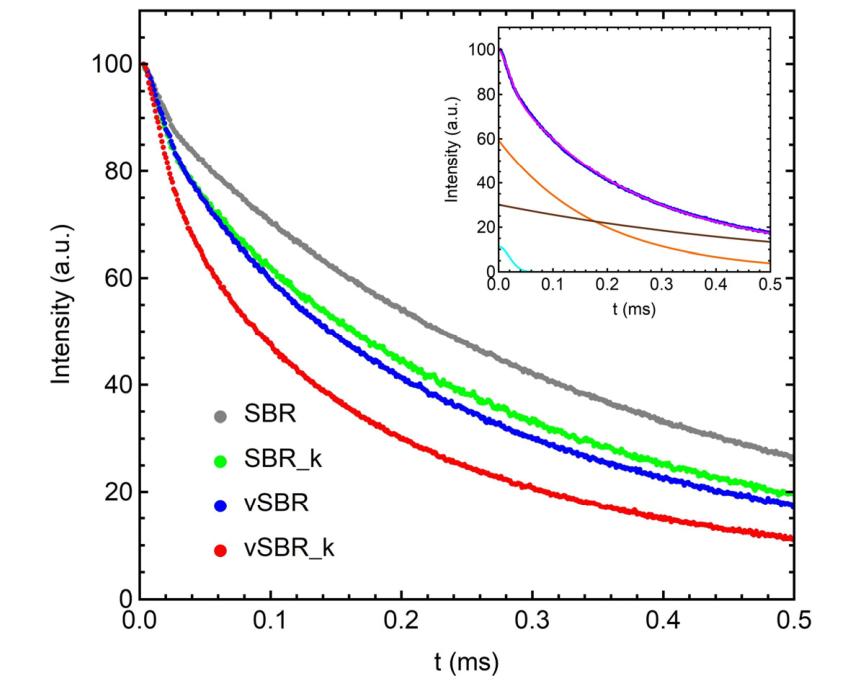
Figure 1. ¹H MSE-FID curves of the four samples at 303 K (first 0.5 ms); the inset shows the three-component fitting decomposition of vSBR.
② ¹H T₁ Longitudinal Relaxation Test (IRSE sequence, 303 K)
All sample relaxation curves exhibited single-exponential decay. The T₁ values for pure Kristalex, vSBR, and vSBR_k were 114, 66, and 74 ms, respectively. The single-exponential behavior is direct evidence of sufficient spin diffusion averaging, proving that the resin and rubber achieve tight blending uniformity at the tens-of-nanometers scale without micron-scale phase separation.
04 Solved Problems and Key Conclusions
In summary, Low-Field Time-Domain NMR (MSE-FID + T₁) provides, for the first time, a trinity of characterization capabilities—”rigid phase fraction, nanoscale blending scale, and restricted segmental motion”—at the molecular scale for the tackifying resin-SBR system. This directly serves the formulation optimization of tread compounds and molecular-level regulation of rolling resistance and wet grip performance.
Reference:
Influence of Resins on the Structure and Dynamics of SBR Compounds: A Solid-State NMR Study (Appl. Sci. 2023, 13, 1939)
 Scan QR Code
 Scan QR Code
 Phone Support
Phone: 400-060-3233
After-sales: 400-060-3233
 WeChat Support

 Official Account

Back to Top