


Experimental Preparation: Two sets of glass beads with different sizes—small beads with diameters in the micrometre range and large beads in the millimetre range; tap water; copper(II) sulfate pentahydrate. Experimental equipment includes a core NMR imaging analyser with an operating frequency of approximately 22 MHz and a probe coil diameter of 15 mm. The experiment was conducted at a controlled temperature of 31.99–32.00℃. Porosity and permeability measurements were performed using the core NMR analysis software.

Using the NMR imaging software, a full spin-echo sequence was applied to acquire T2-weighted images.
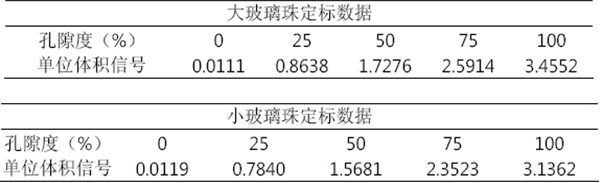
Porosity measurement: Due to the different pore sizes formed by the two types of glass beads, the relaxation times of water in the pores vary significantly when fully saturated. Calibration was performed using pure water for the large beads and fully saturated small beads for the small bead calibration line. The calibration data are as follows:
Water was gradually dripped into the dry glass beads until full saturation. Three time points during the dripping process (transient states) were selected for porosity measurement. Saturation was calculated as: (transient porosity / saturated porosity) * (transient total volume / saturated total volume). Permeability was calculated using the SDR model with parameter a set to 1. Test results are shown below:
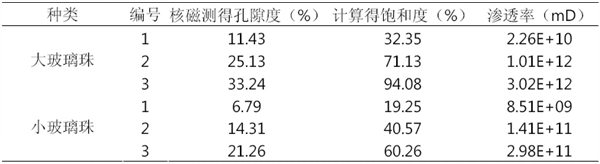
Saturation calculations are based on porosity, so accuracy depends closely on porosity precision. Permeability increases with water content; at the same saturation level, large beads exhibit higher permeability than small beads. NMR imaging of small beads is shown below:
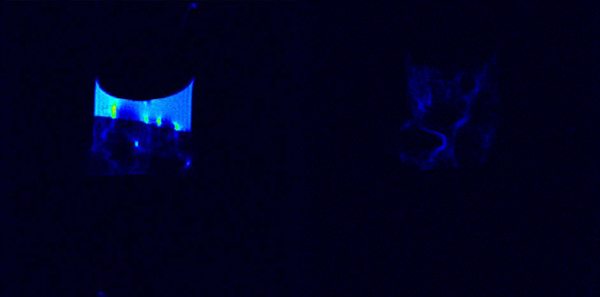
Left: Fully saturated, saturation = 100%; Right: Saturation = 14.31%. The brighter region at the top of the left image represents the water solution, while the darker region below corresponds to fully saturated small beads. The right image shows a partially saturated sample, indicating uneven water distribution within the sample. NMR imaging of large beads is shown below:
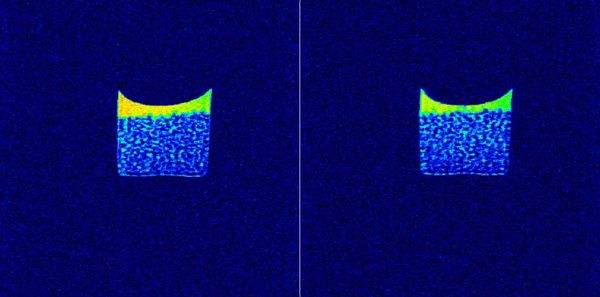
Left and right images are from the same sample. After acquiring the left image, the sample was gently stirred before capturing the right image to observe changes.
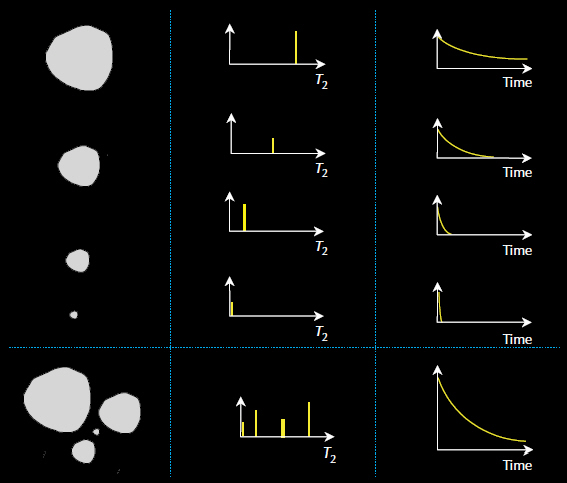
When the pore fluid is water and the magnetic field gradient is approximately zero, T2 depends solely on the pore structure. Given the T2 distribution, the pore size distribution can be calculated according to the selected model.
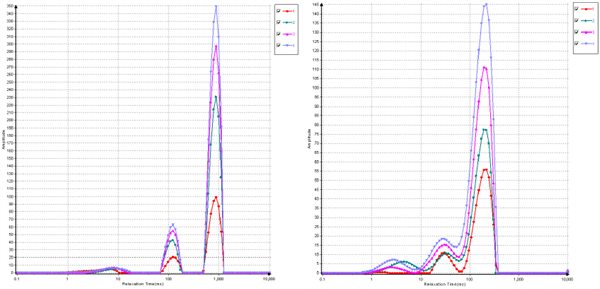
Left: Large bead pore distribution with saturation levels of 32.35%, 71.13%, 94.08%, and 100%. Right: Small bead pore distribution with saturation levels of 19.25%, 40.57%, 60.26%, and 100%. The x-axis represents T2, and the y-axis represents signal intensity. For each T2 distribution, the peak areas relative to total area indicate the proportion of corresponding pore volumes. As saturation increases, signal intensity rises, and peak proportions remain relatively stable, suggesting minimal influence of saturation on pore distribution.
NMR has become a powerful tool in petroleum exploration, accurately analysing core pore structures and providing detailed information on porosity, pore distribution, permeability, bound and free fluid saturations. Compared to conventional neutron, density, and sonic methods, NMR uniquely provides information on: (1) fluid quantity in pores; (2) fluid properties; and (3) pore size distribution containing fluids. Low-field NMR primarily studies material relaxation behaviour, measured via relaxation time—the shorter the relaxation time, the faster the decay of the NMR signal.
Cores, as typical porous media, exhibit three types of relaxation phenomena:
1. Bulk Relaxation: Inherent relaxation of liquid within pores, determined by fluid properties (e.g., viscosity, molecular structure), independent of pore size, typically in pores >50 nm or fractures.
2. Surface Relaxation: Relaxation at the liquid–solid interface, dependent on pore size; smaller pores relax faster, usually within 2–50 nm.
3. Diffusion Relaxation: Relaxation influenced by self-diffusion of pore fluid, affecting transverse relaxation (T2) but not longitudinal relaxation (T1).
 Scan QR Code
 Scan QR Code
 Phone Support
Phone: 400-060-3233
After-sales: 400-060-3233
 WeChat Support

 Official Account

Back to Top