


Currently, NMR logging is based on one-dimensional nuclear magnetic resonance technology, which only measures the transverse relaxation time (T2) of formation fluids. It cannot distinguish whether the signals originate from oil or water. When oil, gas, and water coexist, their T2 signals overlap. Early fluid identification methods such as Differential Spectrum Method (DSM), Shift Spectrum Method (SSM), Time Domain Analysis (TDA), Diffusion Method (DIFAN), and Diffusion-Enhanced Method (EDM) have practical limitations.
Two-dimensional NMR logging expands the hydrogen nucleus distribution of pore fluids from a single T2 variable in 1D to two variables in 2D, fully utilising NMR observational information and opening new avenues for rock physics studies in NMR logging.
Keywords: Multi-echo train inversion, diffusion–relaxation, logging
The transverse relaxation time of fluids in NMR is mainly influenced by free relaxation, surface relaxation, and diffusion relaxation, which can be expressed as:
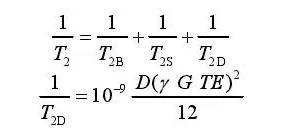
In a uniform magnetic field, where the field gradient (G) is zero, diffusion relaxation does not contribute to transverse relaxation time. At this point, relaxation is primarily governed by free and surface relaxation, known as intrinsic relaxation time, expressed as:
For gradient fields, the relationship becomes:
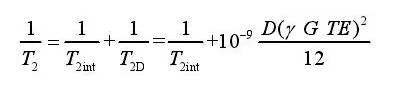
As shown, for oil, gas, and water, their transverse relaxation times may partially overlap, but differences in diffusion coefficients allow fluid differentiation using relaxation–diffusion-based 2D NMR data.
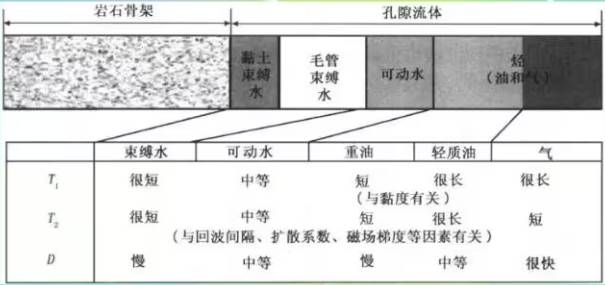
Figure 1 Characteristic T1, T2, and D of Different Pore Fluids
In a gradient field, if data is acquired with the same TW but different TE (as shown in Figure 2), the measured transverse relaxation time incorporates fluid diffusion information.
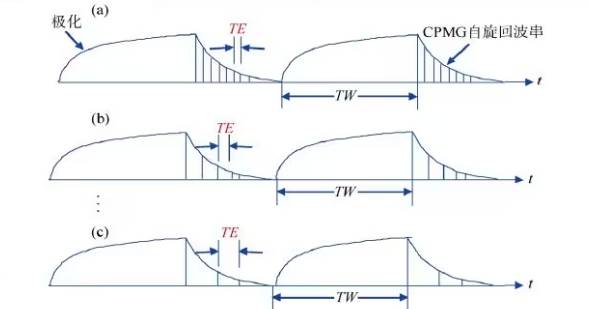
Figure 2. Data Acquisition Pattern with Different Echo Intervals
In the T2–D spectra shown in Figure 3, the water line depends on temperature and salinity; water diffusion increases with temperature and decreases with salinity. The oil line depends on oil viscosity; diffusion decreases as viscosity increases. Special inversion techniques allow the separation of diffusion coefficient signals embedded in T2, enabling fluid property identification in 2D space.
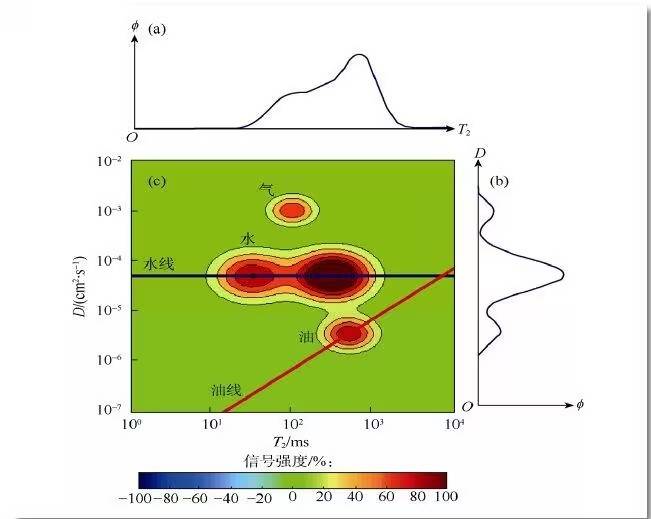
Figure 3. 2D NMR Signal Distribution of Different Pore Fluids
The Nanbao Depression contains various depositional facies, with rapidly changing reservoir lithology and properties, making fluid identification challenging using conventional logs. Considering the viscosity of crude oil, numerical simulation was used to select an acquisition mode: echo intervals of 0.9, 1.2, 3.6, and 6.0 ms, and a waiting time of 12.998 s. This combination allows separation of oil, gas, and water signals in the pore space.
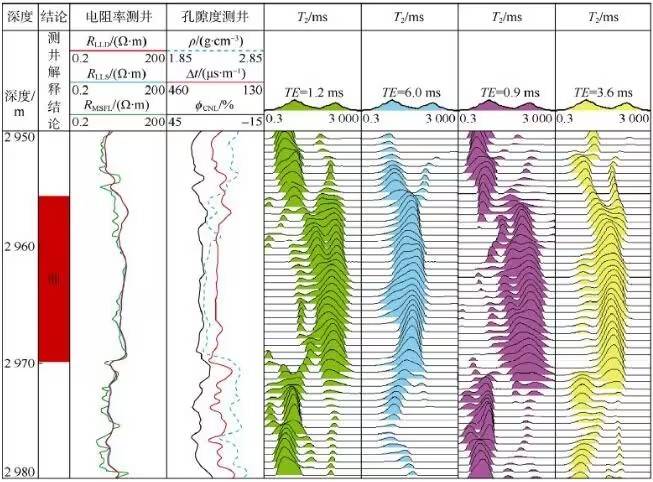
Figure 4. Four Echo Interval T2 Distributions Collected from Well A
In the 2,955–2,970 m section, T2 spectra exhibit primarily single-peak distributions, indicating predominantly free fluid. As echo interval TE increases, the T2 spectra shift slightly towards faster relaxation, yet remain single-peak. Due to the low viscosity of the local crude, shift-spectrum methods cannot effectively separate oil and water in T2 space. Therefore, 2D NMR is applied. Raw NMR signals from the four echo intervals were combined, orthogonally decomposed, phase-smoothed, and filtered to generate four echo trains at the same depth. Joint inversion of these trains provides relaxation–diffusion 2D NMR logging information (Figure 5).
Oil saturation at the corresponding depth was calculated at 62%, confirming the layer as oil-bearing. Production testing yielded an initial daily output of 99 tons, validating the accuracy of 2D NMR fluid identification.
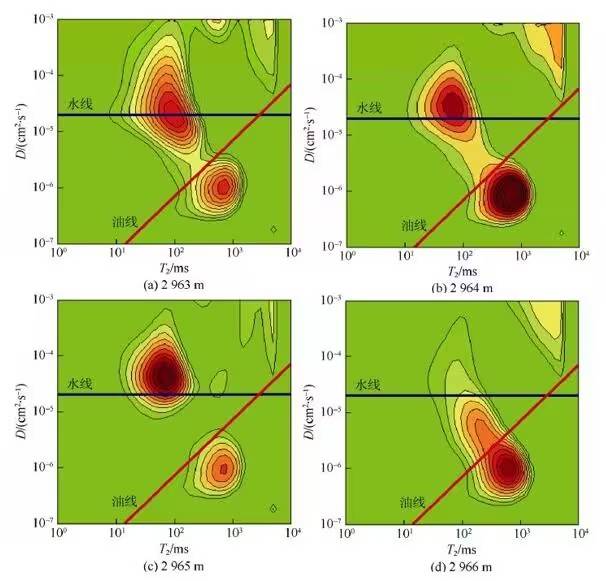
Figure 5. 2D NMR Information Distribution at Different Depths in Well A
Two-dimensional NMR logging applies 2D NMR spectroscopy concepts to petroleum logging, distinguishing oil and water signals based on differing diffusion coefficients. As exploration and development increasingly target deep and complex reservoirs, 2D NMR logging will become an essential high-tech tool for rapid, early-stage evaluation of hydrocarbon potential.
Hu F, Zhou C, Li C, Xu H, Zhou F, Si Z. Fluid Identification Using Relaxation–Diffusion-Based 2D NMR Method[J]. Petroleum Exploration and Development, 2012, 39(05):552-558.
Xie R, Xiao L, Deng K, Liao G, Liu T. Two-Dimensional NMR Logging[J]. Logging Technology, 2005(05):43-47+89. Author: Newmai Analytics https://www.bilibili.com/read/cv16364779/ Source: bilibili
 Scan QR Code
 Scan QR Code
 Phone Support
Phone: 400-060-3233
After-sales: 400-060-3233
 WeChat Support

 Official Account

Back to Top