


With the rapid expansion of urban areas, available surface construction space has become increasingly limited, leading to large-scale development of underground infrastructure. In complex geological conditions, especially in weak rock formations, tunnel excavation and other subsurface construction activities often cause significant disturbances to the surrounding rock. These disturbances typically manifest as stress redistribution and the propagation of pre-existing fractures, which can alter seepage characteristics and reduce load-bearing capacity—potentially leading to rock mass instability and associated engineering hazards.

Microbially Induced Calcite Precipitation (MICP) is an emerging technique for rock mass reinforcement. It utilises specific microbes that produce urease, which catalyses the hydrolysis of urea into carbonate ions. These ions then react with calcium ions to form calcium carbonate (CaCO3) precipitates—effectively improving the geotechnical properties of the rock-soil matrix. Compared with conventional grouting methods, MICP can significantly reduce rock permeability. However, practical applications face bottlenecks such as uneven mineral deposition and clogging near injection points. This highlights the need for efficient monitoring tools during the precipitation process.
Among various monitoring technologies, Nuclear Magnetic Resonance (NMR) stands out due to its non-invasive, non-destructive nature—making it especially suitable for tracking the evolution of pore-fracture systems during microbial mineralisation. NMR can precisely reveal bacterial migration and attachment patterns within fracture networks, and how these influence the spatial distribution of CaCO3. Studies show that controlling structural stability under poor geological conditions is one of the key challenges in underground urban development. MICP offers a novel solution—and NMR offers the means to visualise and quantify it.
Core sample: 1-inch shale cylinder
Microorganism: Bacillus pasteurii
Instrument: Mid-size low-field NMR imaging analyser
1. Dissolve Bacillus pasteurii in deionised water and inject to saturate the shale core; allow it to rest for 1 hour.
2. Rinse the core with deionised water to flush out unattached bacteria.
3. Repeat the saturation process using a fresh Bacillus pasteurii solution; each cycle includes 1-hour rest. A total of five cycles are performed.
4. After each bacterial saturation, conduct NMR T2 relaxation tests and record the data.
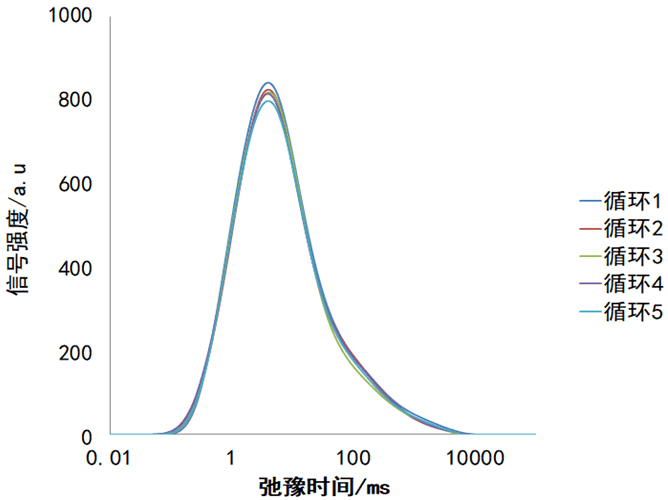
Figure: T2 distribution of the shale core during Bacillus pasteurii treatment cycles
The figure illustrates the T2 distribution trends of the shale core after each bacterial treatment cycle. As the cycles progress, the peak value of the T2 curve gradually decreases, indicating a reduction in overall pore volume due to calcium carbonate precipitation induced by microbial activity. This experimental result confirms that NMR is a powerful tool for in-situ, real-time monitoring of the MICP process, offering actionable insights for geotechnical and civil engineering applications.
 Scan QR Code
 Scan QR Code
 Phone Support
Phone: 400-060-3233
After-sales: 400-060-3233
 WeChat Support

 Official Account

Back to Top