


Fuel cells are high-efficiency power generation devices that use hydrogen as a fuel. They are gaining widespread attention due to their ability to reduce carbon dioxide emissions. The ion exchange membrane is the core component of a fuel cell, where proton transfer is achieved through nanoscale pores within the membrane structure.
Ion exchange membranes used in vehicle-mounted fuel cells must maintain performance over a wide temperature range—from –50°C to 80°C—despite repeated heating and cooling cycles.
Therefore, it is essential to evaluate the changes in pore size within the electrolyte membrane under thermal cycling. However, until now, there has been no simple and effective method to assess such changes caused by temperature fluctuations.

This application uses low-field nuclear magnetic resonance (LF-NMR) to evaluate changes in pore size by measuring the relaxation time of water within the membrane during thermal cycling. It is well known that the T2 relaxation time of water confined in smaller pores becomes shorter as the pore size decreases.
This principle enables characterization of pore size distribution. A variable temperature LF-NMR system was used in this study, with a temperature range of –50°C to 80°C and a ramp rate of 10°C/min. A total of 12 thermal cycles were performed. T2 relaxation times were measured at 25°C after each cycle. To ensure thermal equilibrium, the membrane was held at 25°C for 20 minutes before measurements. The CPMG pulse sequence was used for the T2 tests.
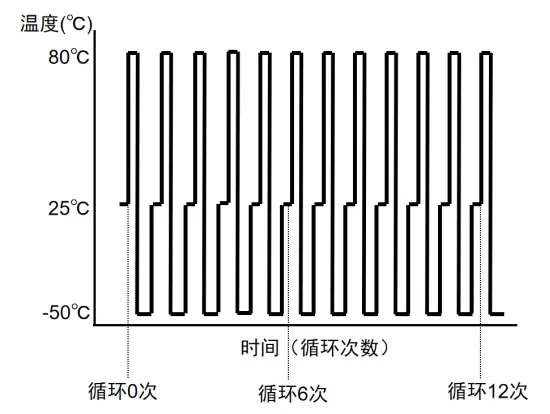
Figure 1: Temperature cycling curve
The tested proton exchange membrane was preconditioned under 80°C and 100% relative humidity for one day. Figure 2 shows the LF-NMR results. It can be observed that with increasing cycle count, the relaxation process slows down.
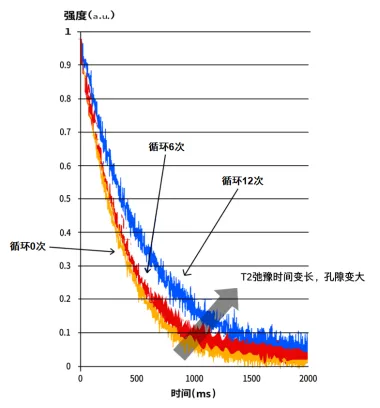
Figure 2: T2 relaxation times at different cycle counts
Figure 3 presents the inversion curves of the T2 relaxation spectra. As the number of cycles increases, the T2 relaxation time becomes longer, and the distribution becomes broader.
This indicates that pore size increases with thermal cycling, and the distribution becomes more dispersed. In other words, the pore structure of the proton exchange membrane is significantly affected by repeated high and low temperature conditions.
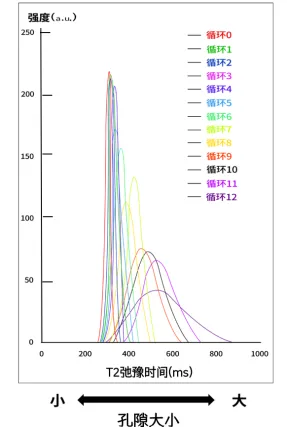
Figure 3: T2 inversion curves at different cycle counts
 Scan QR Code
 Scan QR Code
 Phone Support
Phone: 400-060-3233
After-sales: 400-060-3233
 WeChat Support

 Official Account

Back to Top