


On 17 November 2023, the National Health Commission and the State Administration for Market Regulation issued the Announcement on 9 Substances—Including Codonopsis—Traditionally Used as Both Food and Chinese Medicinal Materials (No. 9 of 2023). These nine items were added to the catalogue of substances traditionally regarded as both food and medicinal materials (hereafter “food–medicine substances”). To date, the State Council’s health authority has released three batches of such lists, covering a total of 102 substances.
National People’s Congress deputy and CAE academician Zhang Boli remarked that bringing these substances under statutory supervision affirms TCM dietotherapy and the “preventive healthcare” concept, and that there remains significant room for growth [1]. So, for researchers in this field, should future work lean more toward medicinal materials or toward food science?
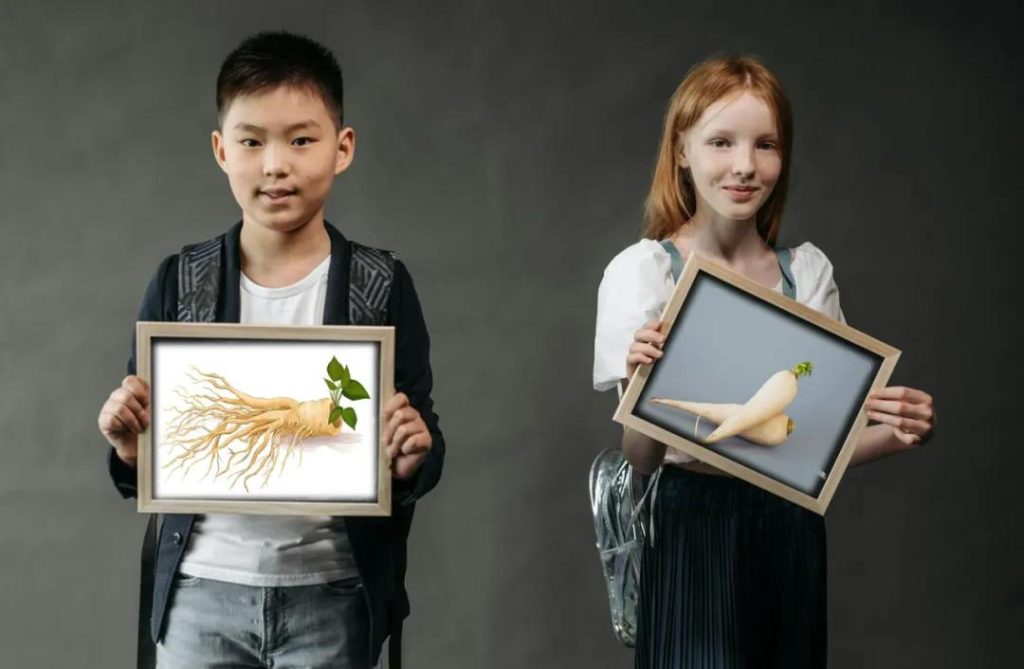
Throughout TCM manufacturing and quality inspection, LF-NMR/MRI enables analysis of water and lipid signals in samples. Use cases include seed germination, herb drying/rehydration, identification and storage of medicinal materials, and decoction-piece processing. These tools clarify drying end-points, storage behaviour, and authentication, offering a data-driven approach to quality control and evaluation in TCM [2].
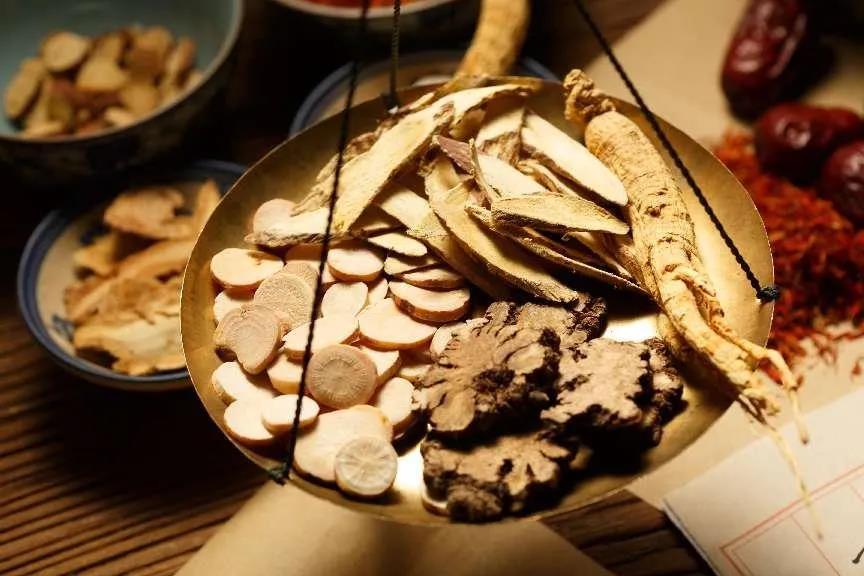
LF-NMR is even more widely adopted in food science: mapping water distribution and migration, evaluating lipid-quality changes, measuring glass transition temperature (Tg), and assessing fruit-and-vegetable quality and maturity [3]. It has been successfully integrated into baking, drying, frying, freezing, microencapsulation, 3D printing, and rapid testing workflows [4].
From the LF-NMR technique itself to results reported by Niumag users, there is substantial overlap between TCM and food applications. These methods are well-suited to the study and evaluation of food–medicine substances.
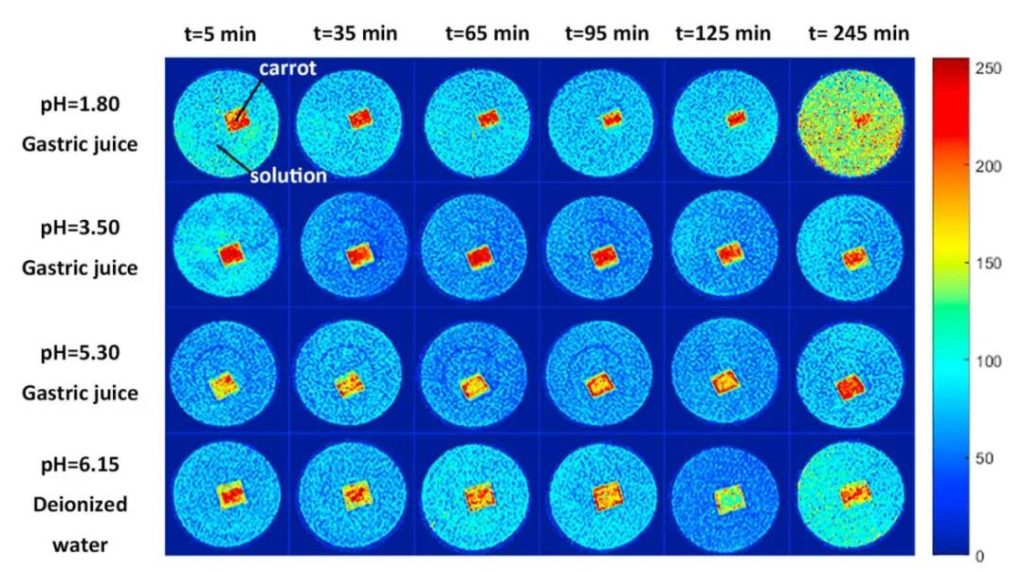
Niumag customers are also exploring cross-domain LF-NMR approaches to unlock greater research scope. For example, LF-NMR is used to model disintegration and controlled release in drug-delivery studies; using proton-density imaging, one can similarly investigate the gastric disintegration of solid foods [5].
The figure below shows carrot cubes in simulated gastric fluids at pH 1.8, 3.5, and 5.3, and in deionised water at pH 6.15—clearly visualising disintegration and nutrient release over time.
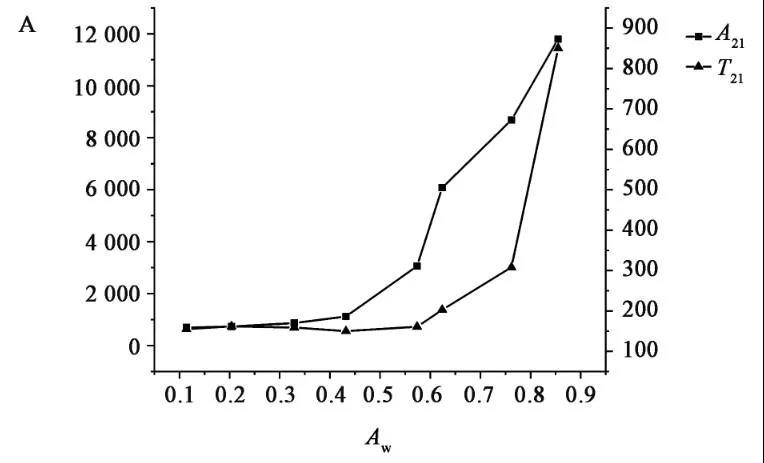
Water activity (aw) is a standard metric for water status in foods. Coupled with LF-NMR mobility theory, it can better guide TCM decoction-piece research by helping control hydrolysis, enzymatic reactions, and related stability risks [6].
As shown below, correlating aw during moisture uptake with A21 (bound water, moisture-content related) and T21 (transverse relaxation time of bound water, reflecting molecular mobility) in Prunus mume decoction pieces reveals that, for example at aw = 0.624, the moisture content may meet the Chinese Pharmacopoeia (2020) specification, yet increased bound-water mobility could compromise product quality (i.e., pharmacological efficacy).
As a green, non-destructive modality, low-field NMR can power high-quality research into food–medicine substances across both the food and TCM domains—and, through cross-domain methods, help clients build broader, more scalable solutions.
[1] Wang Xiaobo, Deng Jie. NPC Deputy Zhang Boli: “Food–Medicine Homology Is a Sunrise Industry—Recommend a Negative List Approach.” Economic Information Daily, 2024-03-08(003).
[2] Liu Qinrong, Wei Ruibin, Zhang Zhiqiang, et al. Applications of low-field NMR and MRI in TCM quality control and evaluation. China Journal of Traditional Chinese Medicine and Pharmacy, 2022, 40(05): 184-188+279. DOI:10.13193/j.issn.1673-7717.2022.05.043.
[3] Zhang Chi, Ruan Zheng. Advances in LF-NMR and MRI for food applications. In: Healthy China 2030 · Safety and Innovation of Healthy Foods—Proceedings of the 2018 Guangdong Institute of Food Science Annual Meeting. 2018: 7.
[4] Chen Lin, Gao Tong, Fang Jiaqin, et al. Research progress on LF-NMR in food processing. Food Industry, 2021, 42(02): 274-278.
[5] Meilai Ding, Peng Wu, Xiao Dong Chen. Investigation of gastric disintegration of carrot during in-vitro digestion using a low-field NMR device. Journal of Food Engineering, 2021, 292: 110307.
[6] Han Tongtong, Rao Xiaoyong, Qi Fengmei, et al. Safe storage moisture of Prunus mume decoction pieces based on water activity and molecular mobility. China Journal of Experimental Traditional Medical Formulae, 2023, 29(13): 151-156.
 Scan QR Code
 Scan QR Code
 Phone Support
Phone: 400-060-3233
After-sales: 400-060-3233
 WeChat Support

 Official Account

Back to Top