


The triaxial compressive behavior of rock is a key focus in rock mechanics. The failure process under load essentially involves the initiation, propagation, and coalescence of internal microcracks. Studying the damage evolution of rock fractures under triaxial compression is therefore crucial for theoretical analysis and design in mining, hydropower, tunnel, and foundation engineering projects.
Traditional techniques—such as acoustic emission, electron microscopy, and CT scanning—are effective for investigating rock failure mechanisms under triaxial compression and characterizing fracture propagation. However, these methods primarily emphasize macroscopic mechanical properties and parameters, while often overlooking how microcrack evolution governs changes in macro deformation and mechanical behavior. Nuclear Magnetic Resonance (NMR) offers a non-destructive alternative to obtain T2 relaxation time spectra and porosity data, enabling detailed analysis of crack damage across different pore sizes.
This study introduces a method combining NMR technology with continuum damage mechanics. Using T2 spectra, we track the changes in number and aperture of pores within rock samples under triaxial loading. By integrating porosity and damage metrics, we derive functional relationships between porosity, axial stress ratio, and damage level. These results provide experimental data supporting the micromechanical damage evolution of marble under triaxial compression.
The quantity and size of pores within rock samples can be directly visualized through T2 relaxation spectra. T2 values correlate positively with pore size—the larger the T2 value, the smaller the pore. Additionally, the total spectral area reflects the overall pore volume; a larger area indicates a higher number of pores. The area and peak height of individual spectral peaks are also positively related to the number of pores of a given size.
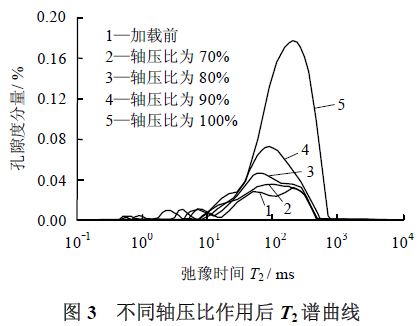
As axial stress increases, the T2 spectrum shifts to the right and its overall area expands, indicating that both the number and aperture of internal pores in the marble sample grow. This reflects a continuous increase in damage. When the axial stress ratio is below 90%, the T2 area gradually increases, with the growth rate accelerating—while the spectral shift remains relatively limited. This suggests that, under lower axial stress levels (less than 90% of peak strength), damage is mainly due to increasing numbers of pores.
However, as the stress ratio increases from 90% to 100%, the T2 spectral area expands sharply and shifts significantly to the right. This indicates that when axial stress exceeds 90% of triaxial compressive strength, both the number and aperture of cracks increase rapidly, leading to imminent failure. The appearance of large-aperture fractures at this stage also implies the formation of shear bands—localized zones where fractures align and propagate directionally, rapidly forming through-going cracks. Meanwhile, cracks in other directions cease to propagate.
(Reference: “Study on Damage Evolution of Marble under Triaxial Compression Based on NMR Technology”, Rock and Soil Mechanics, Vol. 35, No. 11, 2014)
 Scan QR Code
 Scan QR Code
 Phone Support
Phone: 400-060-3233
After-sales: 400-060-3233
 WeChat Support

 Official Account

Back to Top