


In northern regions, pavement concrete structures not only endure significant stress from vehicle overloading but are also exposed to severe freeze–thaw cycles in spring and winter, large day–night temperature variations, and salt-induced freeze damage due to de-icing salts used in winter. As a result, cement concrete pavements and other concrete infrastructure in these areas suffer substantial deterioration. However, research on high-performance concrete tailored to such conditions remains limited across many northern regions.
Previous studies have shown that key factors influencing concrete’s freeze–thaw and salt–freeze resistance include: air content, water–cement ratio, saturation level, freezing age, cement type, aggregate quality, and the use of admixtures. International laboratory and field research has demonstrated that, under the same conditions, concrete with air-entraining agents can achieve over five times greater durability and service life.
Low-field nuclear magnetic resonance (LF-NMR) is an emerging technology in recent years for rapid, non-destructive evaluation of physical properties in cement and rock materials. Since water contains the highest concentration of hydrogen protons in nature—and NMR signals originate from hydrogen nuclei—higher signal intensity corresponds to higher moisture content, and vice versa. Thus, through signal calibration, NMR can be used to accurately measure the water content in a material.
After vacuum saturation, most of the internal pores in a porous medium are filled with water. By detecting the water content using NMR and knowing the density of water, the total pore volume can be calculated, thereby determining the material’s porosity. This technique allows for precise analysis of pore structure variations in different cement-based materials.
NMR was used to evaluate the porosity and pore size distribution of salt-freeze damaged specimens (Mix groups C1, C2, C3, and C4) under different magnetic field strengths. For comparison, traditional gravimetric (weighing) methods were also used to measure porosity.

Porosity results varied across equipment with different magnetic field strengths. The highest porosity was recorded using the 12M instrument, followed by the 2M instrument, while the 23M instrument showed the lowest values. The reduced porosity readings from the 23M device are primarily attributed to the presence of fly ash in the concrete mix, which contains paramagnetic ions. These ions accelerate relaxation processes in the sample. The higher the magnetic field strength, the more significant this acceleration effect, which shortens relaxation times and causes part of the NMR signal to be missed.
Based on the porosity results from NMR analysis, pore size distribution curves were obtained as shown below:
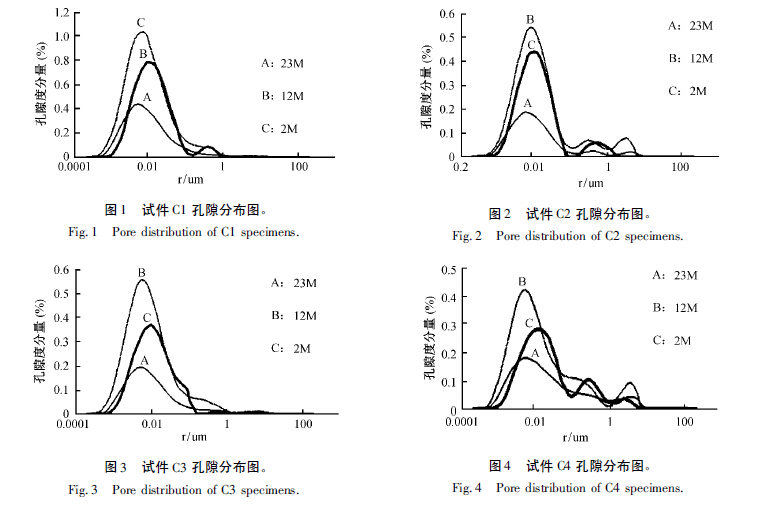
From the pore size distribution chart above, the 12M instrument displayed the highest signal amplitude, while the 23M instrument yielded the lowest. Again, this is due to the paramagnetic content in the fly ash, which leads to faster relaxation at higher field strengths, resulting in partial signal loss. Additionally, for the 2M device, the peak of the spectrum is shifted to the right compared to that from the 12M device. This shift is due to the longer TE (echo time) used in the 2M system, which causes some initial signals to be lost. Therefore, the 2M system requires optimization for samples containing fly ash. In conclusion, for cementitious samples with short relaxation times and mineral admixtures like fly ash, the 12M instrument is more effective in detecting short T2 signals and significantly improves the signal-to-noise ratio.
Reference: “Analysis of the Relationship Between NMR-Determined Porosity and Salt–Freeze Resistance of Concrete”, Journal of Electron Microscopy, Vol. 34, No. 5, October 2015
 Scan QR Code
 Scan QR Code
 Phone Support
Phone: 400-060-3233
After-sales: 400-060-3233
 WeChat Support

 Official Account

Back to Top