


Nuclear Magnetic Resonance Cryoporometry (NMR-C) is an emerging pore structure characterization technique that covers the nanoscale pore measurement range. It allows for continuous measurements on the same sample and directly, efficiently obtains information such as pore size distribution and porosity. With minimal disturbance to the sample, it shows great potential in nanopore studies of low-permeability media like shale and serves as a valuable complement to other pore characterization techniques.

Framework of Low-Temperature NMR System
NMR Cryoporometry collects nuclear magnetic resonance signals under variable temperature conditions to characterize the phase transition process of liquids within the pores of porous media. Based on the phase transition theory of confined materials, it enables in-depth studies of properties such as porosity and pore size distribution.
Essentially, NMR Cryoporometry leverages the relaxation differences of fluids in solid and liquid states to represent pore structure characteristics. In practice, a wetting liquid saturates the porous solid sample, and the instrument’s cooling system performs temperature variations. By monitoring phase transition, the amount of liquid change is measured to generate a melting (or freezing) curve, which reveals pore-related parameters.
The diagram illustrates the phase transition of confined fluid in porous media. As temperature rises, liquid (typically water) melts progressively from smaller to larger pores. The total liquid volume increases. According to the Gibbs–Thomson equation, this temperature-dependent liquid increase corresponds to cumulative pore volume from smallest to largest. Accurate measurement of the liquid volume during the temperature change yields the pore size distribution.
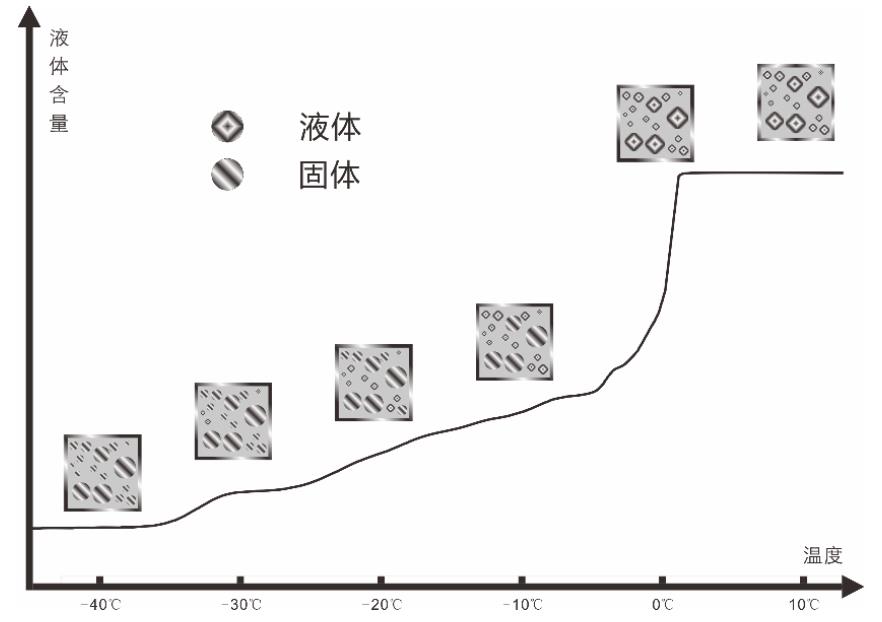
Phase Transition Behavior in Porous Media
Traditional NMR relaxation methods cannot reflect absolute pore sizes directly and require conversion coefficients. In contrast, NMR-C retains the benefits of conventional NMR while enhancing micropore and mesopore resolution. It also accommodates the pore scales found in low-permeability shale.
NMR Cryoporometry is a promising method for pore structure research. It has already been widely applied in characterizing materials such as mesoporous silica, biological cells, and wood. Its application in rocks like shale also holds great future potential.
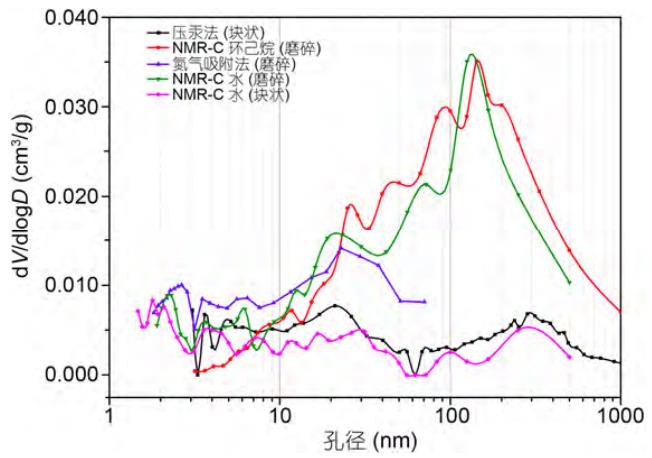
Comparison of Pore Size Distribution in Shale Using Different Methods
Compared to traditional methods, NMR Cryoporometry offers several key advantages for nanoscale porous media studies:
(1) It effectively characterizes nanoscale pore structures, unlike mercury intrusion or nitrogen adsorption, and allows testing under water-saturated conditions.
(2) NMR-C directly captures internal pore information using NMR signals, reducing damage to the pore structure and enabling a faster, more direct measurement process.
(3) By altering sample shape or utilizing fluid capillary and diffusion effects, NMR-C can detect closed pore spaces and compare effective vs. total porosity in low-permeability media.
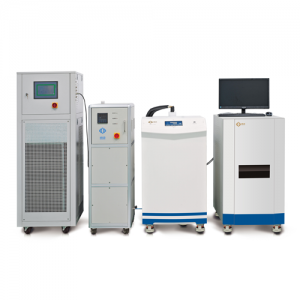
Recommended Instrument: NMR Nano-Pore Structure Analyzer NMRC12-010V
 Scan QR Code
 Scan QR Code
 Phone Support
Phone: 400-060-3233
After-sales: 400-060-3233
 WeChat Support

 Official Account

Back to Top