


This study explores the initial structure and related mechanisms of cement paste using Low-Field Nuclear Magnetic Resonance (LF-NMR) technology. The results indicate that NMR is highly advantageous for analyzing the early-stage structure of cement pastes. Signals within different ranges of transverse relaxation time (T2) can reflect the evolution of flocculated structures, pore water, interfacial transition zone water, and free bleeding water within the paste. Based on fractal theory, the initial pore structure was characterized using LF-NMR, revealing distinct fractal characteristics. The analysis showed that the fractal dimension decreases with increasing water–cement ratio. Furthermore, at similar T2 values, pastes with lower fractal dimensions exhibit higher bleeding rates and greater initial fluidity.
The fractal dimension offers an objective way to describe the complexity of the internal pore structure in cement paste. As shown in Figure 3, the fractal dimension decreases as the water–cement ratio increases. Due to bleeding and sedimentation effects, the fractal dimension at 60 minutes of hydration is lower than that at 5 minutes. As hydration progresses to 90 minutes, the fractal dimension gradually increases. Correlation analysis with macro-scale test results showed a significant linear relationship between the weighted T2 value and both bleeding rate and fluidity. When T2 values are similar, cement pastes with lower fractal dimensions tend to show higher bleeding rates and greater initial fluidity.
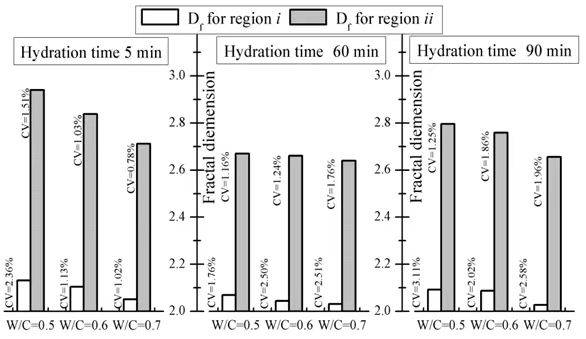
Figure 3. Fractal dimensions of cement pastes with different water–cement ratios

Figure 4. Relationship between bleeding rate and internal structure of cement paste
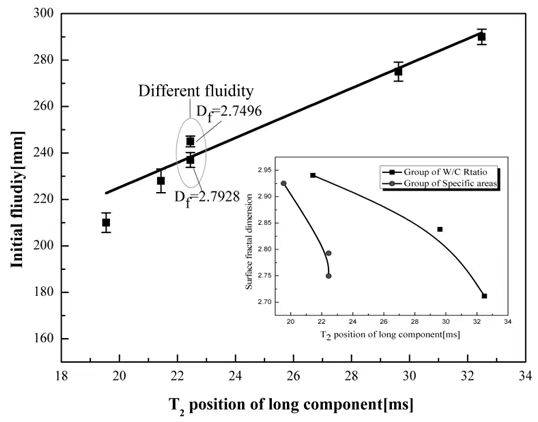
Figure 5. Relationship between initial fluidity and internal structure of cement paste
The internal structure of cement paste shows strong correlation with transverse relaxation time (T2) ranges measured by NMR.
The initial pore structure of cement paste exhibits significant fractal characteristics.
When transverse relaxation times are similar, pastes with lower fractal dimensions tend to exhibit higher bleeding rates and greater initial flowability.
Selected from the Niumag NMR Application Case Competition – by Ji Yanliang and Sun Zhenping, College of Materials Science and Engineering, Tongji University
Study on Initial Structural Characterization and Related Mechanisms of Cement Paste Using NMR Technology
Recommended benchtop NMR instruments:
MicroMR12-025V – NMR Shale Analyzer
MicroMR02-025V – NMR Core Analyzer
 Scan QR Code
 Scan QR Code
 Phone Support
Phone: 400-060-3233
After-sales: 400-060-3233
 WeChat Support

 Official Account

Back to Top