


Digital core applications leverage nuclear magnetic resonance (NMR) imaging technology to reconstruct three-dimensional digital cores that reveal the micro-pore network of rock samples.
This enables in-depth studies of micro-scale flow mechanisms, simulation of core flooding experiments, prediction of core anisotropy parameters, evaluation of enhanced oil recovery (EOR) techniques, and modeling reservoir production dynamics to optimize oilfield development strategies.
1) In the field of digital core analysis, NMR has been successfully applied to study micro-pore structures, micro-scale flow mechanisms, in-situ core flooding under formation conditions, enhanced oil recovery techniques, and multiphase flow behavior.
2) NMR imaging technology provides the fundamental data needed to build digital rock models.
3) By integrating pore structure and permeability data obtained from NMR with digital core modeling, it is possible to construct detailed pore and permeability models of tight sandstones—serving as alternatives to traditional mercury intrusion and permeability testing methods.
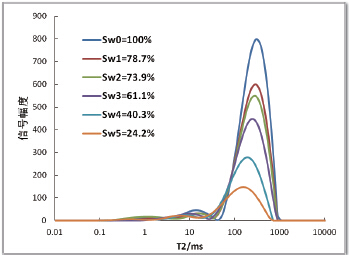
4) Given the high sensitivity of NMR to pore fluids, it holds strong potential for creating dynamic digital cores during displacement processes. When combined with an online high-temperature and high-pressure NMR testing platform and Nuomag’s newly developed imaging sequences, this enables visualization of displacement processes in tight cores with short relaxation times. Using 3D reconstruction, the real-time evolution and spatial distribution of pore fluids can be observed, offering a microscopic evaluation method to study residual oil distribution and assess enhanced recovery techniques.
MRI images from different stages of a gas flooding experiment on a synthetic core

T2 spectra of synthetic core during different stages of gas flooding
 Scan QR Code
 Scan QR Code
 Phone Support
Phone: 400-060-3233
After-sales: 400-060-3233
 WeChat Support

 Official Account

Back to Top