


In coalbed methane exploration and development, the physical properties of coal reservoirs directly determine resource recoverability and economic viability. Among these, porosity, as a fundamental physical parameter of coal reservoirs, is a core indicator for screening and grading coal rocks, evaluating reservoir storage capacity, and determining seepage characteristics. However, in actual measurement processes, researchers often face various challenges.
Coal rock is more brittle than conventional rock. During exploration drilling, coal rock is prone to fragmentation, making standard coal rock samples difficult to obtain and relatively precious; consequently, coal cuttings are more commonly acquired from exploration. Meanwhile, coal typically exhibits a “dual-porosity structure” (matrix pores and fracture pores) with an extremely wide pore size range (from nanometer-scale micropores to millimeter-scale fractures). Accurately measuring porosity using coal cuttings has become a major challenge in the industry. Traditional methods employ mercury intrusion porosimetry (MIP) and gas adsorption methods to measure coal cuttings porosity, but both require sample pretreatment such as degassing, crushing, or grinding, which destroys the original pore structure of the samples and affects test results. Furthermore, traditional methods have limitations in fully characterizing the entire pore size range for porosity measurement: mercury intrusion porosimetry loses nanopore signals, while gas adsorption methods lose fracture signals, resulting in significantly underestimated porosity values.
Compared to traditional methods such as mercury intrusion porosimetry, helium permeability methods, or adsorption methods, low-field nuclear magnetic resonance (LF-NMR) demonstrates significant advantages in coal porosity measurement. It does not require sample crushing or compaction; only saturating the sample with water or a probe liquid is needed for detection. This non-destructive characteristic preserves the original pore structure of the sample to the greatest extent possible, and the testing speed is fast, enabling results to be obtained in a short time. LF-NMR has been widely used for porosity measurement of coal rock. However, during water saturation processing of coal cuttings, the coal cuttings may undergo further fragmentation. Additionally, when removing surface moisture from coal cuttings after water saturation, the process heavily relies on operator judgment, introducing subjectivity that significantly impacts porosity measurement results.
This case study proposes a new LF-NMR method for measuring coal cuttings porosity that can greatly improve measurement accuracy, providing significant benefits for reservoir evaluation.
Case Study: Pore Characterization of Coal Cuttings Based on Low-Field Nuclear Magnetic Resonance: A New Method[1]:
Sample Information:
(1)Sample Selection: On-site samples were processed into standard cylindrical specimens with dimensions of 25 mm in diameter and 50 mm in height. To reduce experimental result variability, samples with consistent surface morphology and mass were preselected for ultrasonic testing, and ultimately cores with wave velocities between 1.953–2.273 m/s, indicating minimal differences, were selected for the experiments.
(2)Sample Pretreatment:
Progressive Crushing Group: Intact cores were crushed into irregular particles, with particle sizes decreasing geometrically.
Graded Crushing Group: A core plug was drilled from an intact coal block, and the remaining material was crushed and sieved into different particle size fractions.
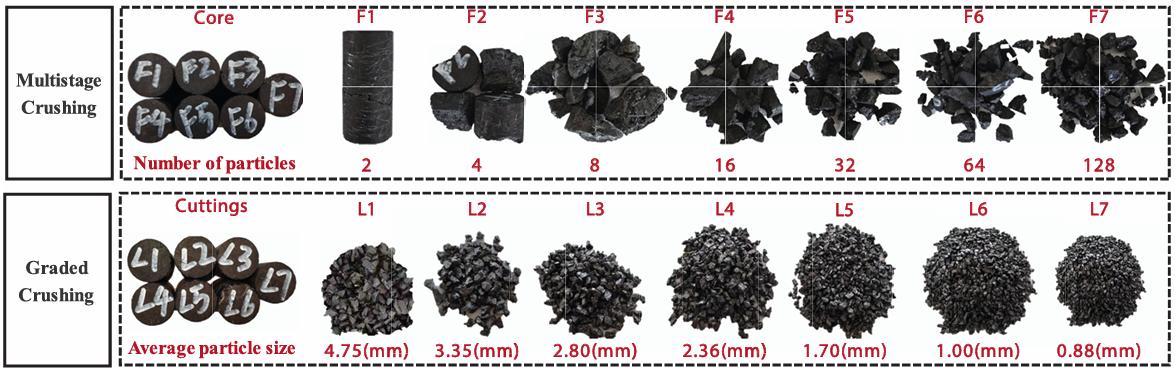
Figure 1 Sample Processing Diagram
Test Principles:
(1)Detection Zone Characteristics of the Radio Frequency Coil: Figure 2(a) illustrates that the detection zone of the RF coil in an LF-NMR device is divided into a uniform magnetic field zone and a non-uniform magnetic field zone. In the uniform zone, the signal amplitude is linearly proportional to the liquid volume. In the non-uniform zone, this relationship becomes non-linear; when the liquid exceeds a certain level, the signal reaches a maximum and stabilizes.
(2)Principle of Using CuSO₄ Solution to Shield Surface Water Signals: Figure 2(b) compares the T₂ decay curves of equal volumes of 5% CuSO₄ solution and pure water. The results show that the relaxation decay rate of the CuSO₄ solution is significantly faster than that of pure water, with its signal existing only when the relaxation time is less than 100 ms. In contrast, the signal of pure water remains detectable beyond 100 ms. This characteristic allows 5% CuSO₄ solution to mask the adhered water signals on the surface of coal cutting particles, thereby isolating signals originating solely from pore water within the coal cuttings.
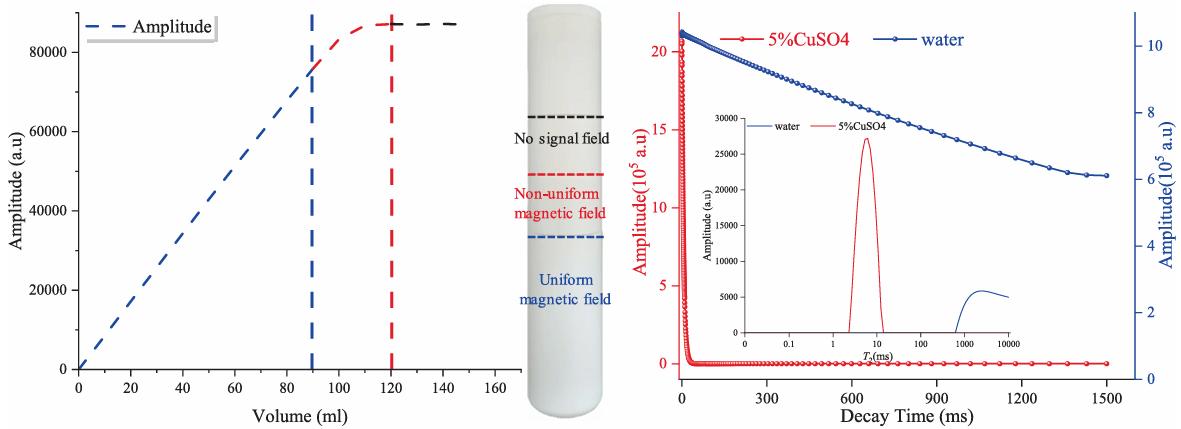
Figure 2 Experimental Principles (a, b)
Test Procedure:
Figure 3 details the LF-NMR experimental procedure and key steps used in this study for measuring the porosity of coal cuttings.
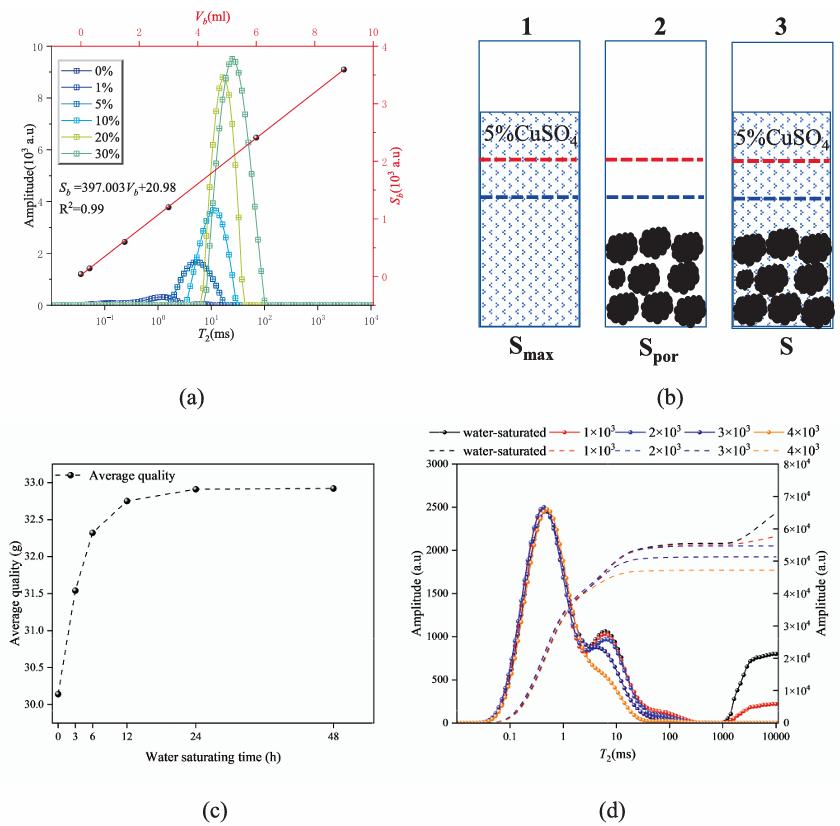
Figure 3 Test Procedure
Conclusion of the Proposed Method:
Advantages and Applicability Recommendations of This New Method: To eliminate interference from the irregular surface water film on coal cuttings, this case study proposes a novel method using copper sulfate solution to measure LF-NMR signals, enabling accurate separation of the skeletal volume and pore volume of the coal cuttings. This method effectively eliminates free water signals, resulting in a relative error for porosity measurement of less than 1.5%. It is recommended to use coal cuttings with a minimum particle size of not less than 1 mm and an average particle size in the range of 1.7–2.36 mm for testing. This approach ensures measurement accuracy while also accounting for contributions from isolated pores. This method provides technical support for rapid, non-destructive assessment of coal reservoir physical properties.
Recommended Equipment:
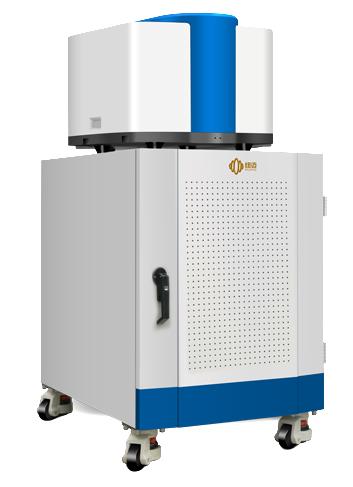
MicroMR23-040V
Reference:
[1] Wen H, Zhai C, Xu J, et al. Pore characterization of coal cuttings based on low-field nuclear magnetic resonance: A new method[J]. Fuel, 2010, 406(Part C): 14.
 Scan QR Code
 Scan QR Code
 Phone Support
Phone: 400-060-3233
After-sales: 400-060-3233
 WeChat Support

 Official Account

Back to Top