

Background
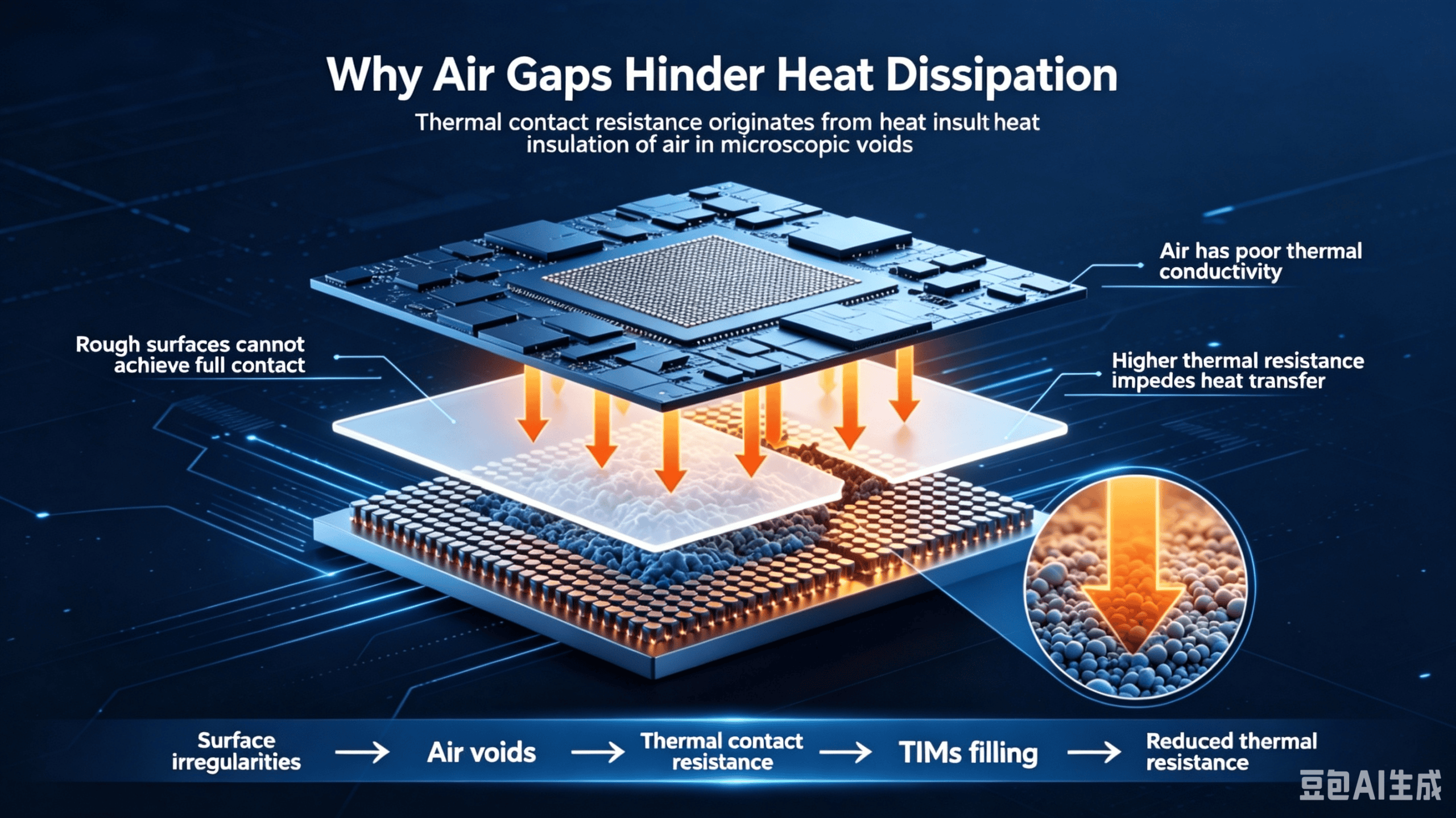
As electronic components advance toward higher performance, miniaturization, integration, and higher power density, efficient heat dissipation has become a critical challenge for ensuring device performance and service life. The air gaps created by surface roughness between chips and heat sinks give rise to substantial contact thermal resistance, severely impeding heat transfer. Thermal interface materials (TIMs) are key materials designed to fill these microscopic voids and reduce interfacial thermal resistance.
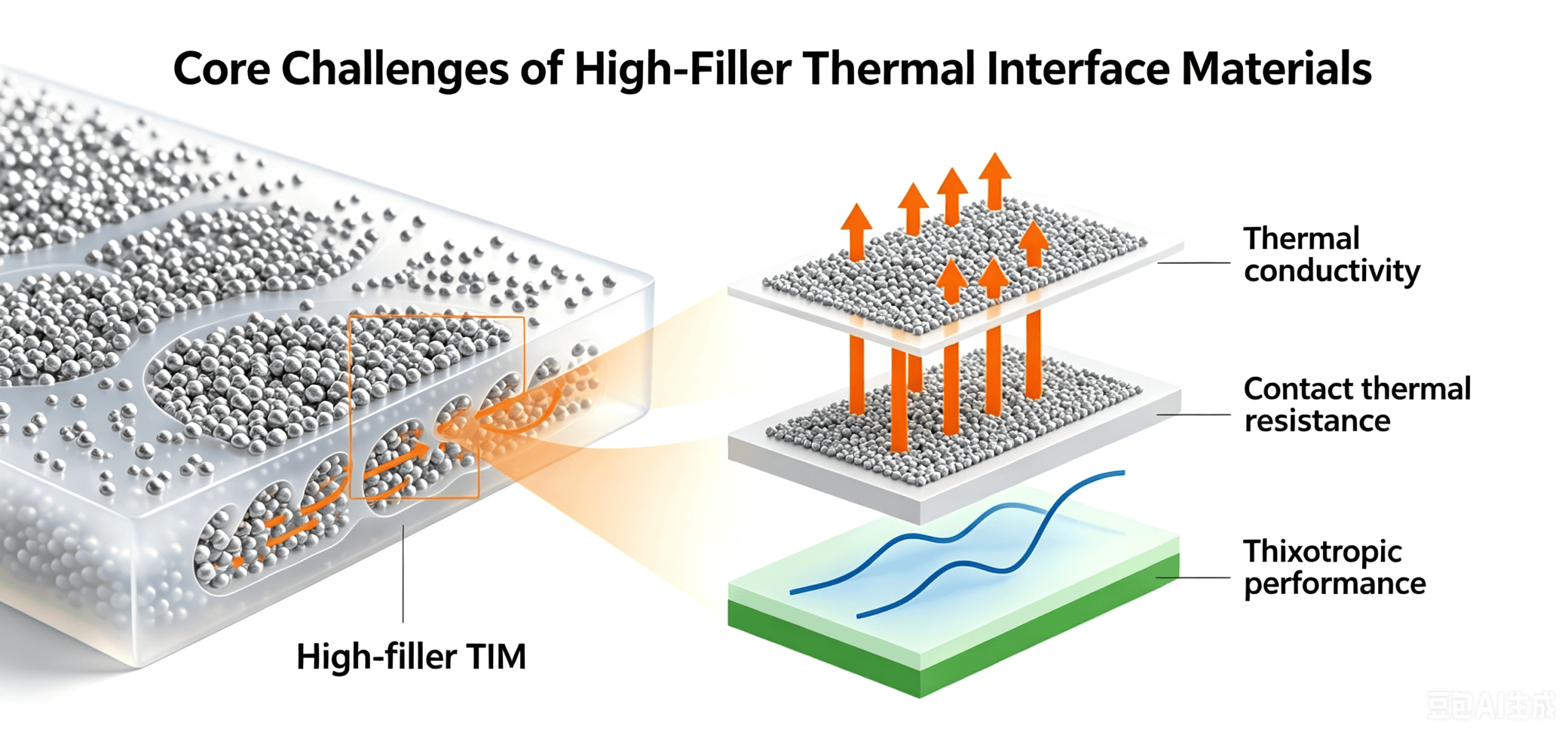
Among the various TIMs, polymer‑matrix composites dominate over 90% of the market, owing to their light weight, good toughness, low cost, easy processability, and high reliability. However, balancing high thermal conductivity, low contact resistance, and excellent thixotropic performance at high filler loadings remains a core challenge in the field.
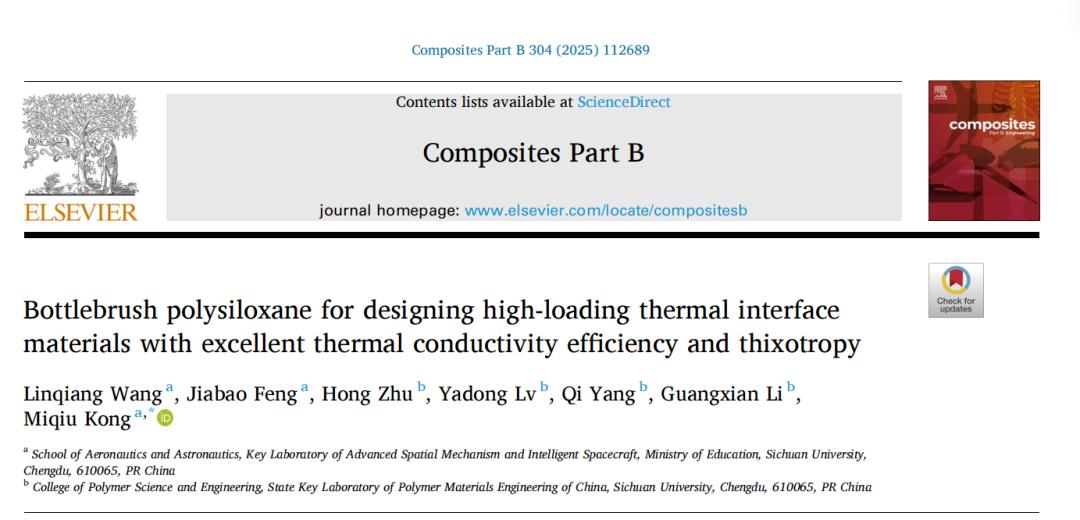
Recently, a research team from Sichuan University achieved a significant breakthrough in this area. They designed a bottlebrush‑like polysiloxane (PMVS‑ODT) based on a polymethylvinylsiloxane backbone grafted with octadecanethiol side chains, and compounded it with alumina (Al₂O₃) thermal fillers to produce high‑performance thermal interface materials. The study was published in Composites Part B, a top‑tier journal in the composites field.
Throughout this research, low‑field nuclear magnetic resonance (LF‑NMR) technology played an irreplaceable and critical role in characterization.
The Role of LF‑NMR Technology in Thermal Interface Material Research
Technical Principle
LF‑NMR uses hydrogen protons (¹H) within the sample as probes. By detecting the relaxation behavior of these protons under different environments, it reflects the mobility of polymer chain segments. In polymer composites, the transverse relaxation time (T₂) can characterize the mobility of hydrogen protons in the polymer matrix, serving as a key parameter for chain segment dynamics.
The core principle can be summarized as follows: shorter relaxation times indicate stronger constraints on molecular chain motion, typically arising from physical or chemical interactions between the chains and the filler surface, or from chain segments confined to the interfacial region. Conversely, longer relaxation times correspond to relatively free chain motion, representing free chains or chains in a bulk‑like environment.
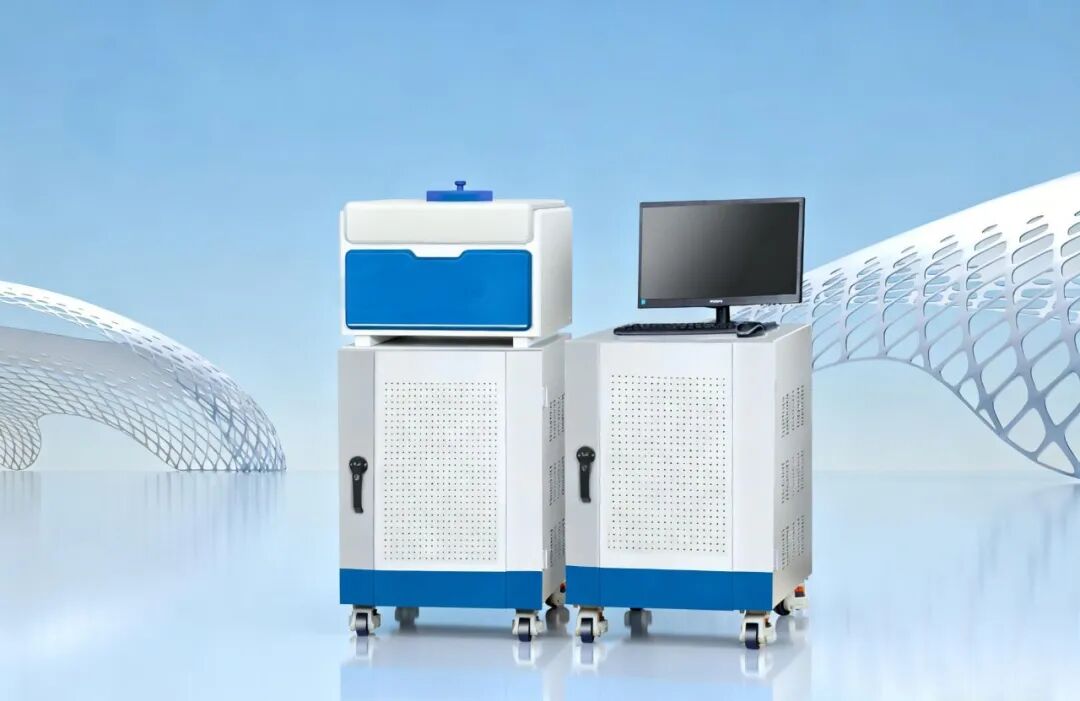
In the Sichuan University team’s study, they employed a variable‑temperature low‑field NMR instrument (VTMR20‑010V‑I) and used the CPMG pulse sequence to acquire transverse relaxation decay curves, systematically analyzing the chain segment dynamics of the PMVS‑ODT and PDMS matrices and their composites.
Core Contribution: Quantitative Characterization of Filler‑Matrix Interfacial Interactions
The most significant contribution of LF‑NMR was providing the first direct, quantitative experimental evidence of interfacial interactions between the polymer matrix and the thermally conductive filler.
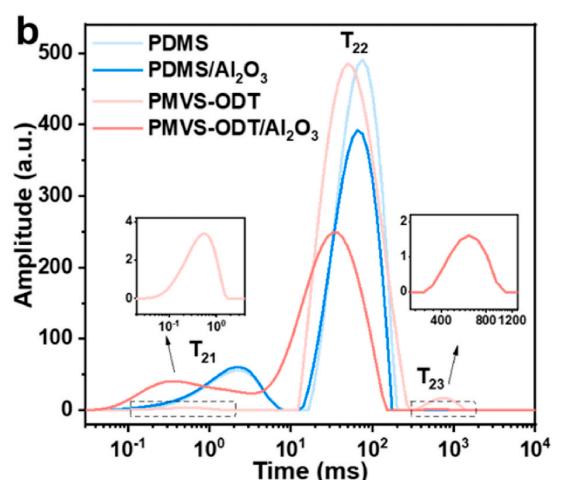
The study found that pure PDMS exhibits two relaxation peaks (T₂₁ = 2.3 ms, T₂₂ = 75.6 ms). After adding 75.5 vol% Al₂O₃, the T₂₂ of the PDMS/Al₂O₃ composite decreased from 75.6 ms to 65.8 ms, while T₂₁ remained essentially unchanged, and the fraction of short‑relaxation components (corresponding to T₂₁) increased. This indicates that PDMS chain motion was restricted to some extent, but the degree of restriction was limited – the interfacial interaction between PDMS and Al₂O₃ is relatively weak.
In contrast, the PMVS‑ODT system exhibited distinctly different behavior. Pure PMVS‑ODT showed T₂₁ and T₂₂ values of 0.6 ms and 49.8 ms, respectively. After Al₂O₃ addition, these values decreased markedly to 0.4 ms and 32.8 ms. More critically, the geometric mean relaxation time T₂gm, which represents the overall relaxation behavior, dropped sharply from 54.7 ms to 13.7 ms – a decrease of up to 75%!
This dramatic shortening of relaxation times directly demonstrates that PMVS‑ODT exhibits much stronger interfacial interactions with Al₂O₃ than PDMS/Al₂O₃. This is further confirmed by analysis of the relaxation peak area ratio (A₂₂/A₂₁): the decrease in this ratio for the PMVS‑ODT/Al₂O₃ composite was much larger than that for PDMS/Al₂O₃, indicating a significant increase in the fraction of constrained chain segments in PMVS‑ODT.
LF‑NMR thus bridges the gap between microscopic molecular chain dynamics and macroscopic interfacial interactions. Stronger interfacial interactions mean more efficient phonon transport channels – this is the microscopic origin of the substantial thermal conductivity enhancement (8.181 W/(m·K)) achieved in the PMVS‑ODT/Al₂O₃ composite.
Summary
In this study published in Composites Part B by the Sichuan University team, low‑field nuclear magnetic resonance (LF‑NMR) played a key role in revealing the mechanism of performance enhancement at the molecular level. It not only provided direct experimental evidence for the strong interfacial interactions between PMVS‑ODT and Al₂O₃, but also served as a quantitative tool to validate the effectiveness of the bottlebrush molecular design.
As the chip industry continues to demand high‑performance TIMs, LF‑NMR technology will play an increasingly important role in materials R&D. It not only accelerates the development of advanced TIMs, but also provides a powerful molecular‑level characterization tool for deepening the understanding of structure‑property relationships in polymer‑matrix composites.
Reference
[1] Wang L, Feng J, Zhu H, et al. Bottlebrush polysiloxane for designing high-loading thermal interface materials with excellent thermal conductivity efficiency and thixotropy. Composites Part B, 2025, 112689.
 Scan QR Code
 Scan QR Code
 Phone Support
Phone: 400-060-3233
After-sales: 400-060-3233
 WeChat Support

 Official Account

Back to Top